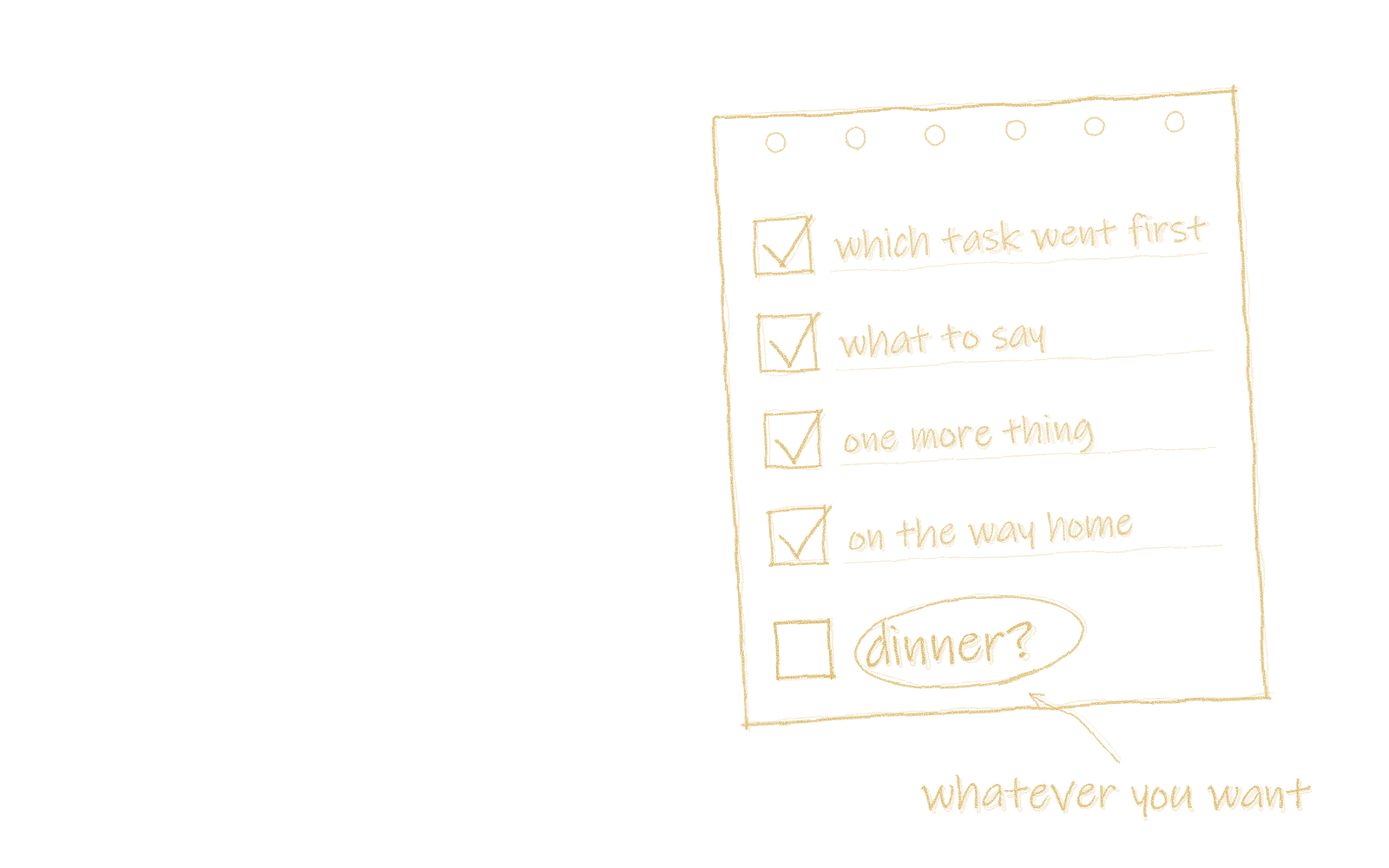
It’s seven in the evening, the fridge door is open, and “what do you want for dinner?” somehow feels harder than anything you got asked all day. And you did have to make decisions all day. You already picked which task went first, how to word a tricky message, whether to take on one more thing and what to pick up on the way home. They were all small decisions, but it feels like hundreds of decisions since breakfast, and you’re tired of making them. There’s a name for this that you’ve probably heard, and it’s decision fatigue. (If you work nights, your fridge moment might come at 7 a.m., after choices that mattered a lot more than dinner.) There are more everyday questions like it on the Work page.
Decision fatigue is the idea that when you have to make decisions one after another, it wears you down, so the later ones get worse or lazier. Researchers haven’t pinned it down much more tightly than that[9], and it is “not a diagnosable mental health condition,” as one counseling site puts it[10]. The popular version goes further, though. It says your mental energy is limited, like fuel in a tank, and every choice requires mental energy (even the tiny ones, like oat milk or regular), so what counts is the number of decisions. On this telling, making too many decisions will deplete the tank, and in the lab studies behind the idea, people who had made many choices then gave up sooner and put things off more[16].
So is decision fatigue real? Well, plenty of people say they experience decision fatigue, that worn-out feeling at the fridge, and I’m not here to argue with anyone’s evening. The fuel tank is a different matter. That’s the explanation I’d always heard, and it makes sense, right? You use the thing, the thing runs out. It even came with a famous study about hungry judges that everybody loves to retell. So that’s my argument for this post: the feeling is one thing and the tank is another. When people went and checked the tank, the big repeat experiments came out close to zero or small[4, 5, 6], and the famous judges turned into a fight that still isn’t over.
We’ll start with the judges, because nearly every retelling does.
Court is adjourned for snacks: The hungry judges study behind decision fatigue
In 2011, three researchers, Shai Danziger, Jonathan Levav and Liora Avnaim-Pesso, went through more than a thousand parole rulings made by eight judges in Israel[11]. And the thing they kept an eye on was food. The judges stopped to eat twice a day, a late-morning snack and then lunch, which cut each day into three sessions.
At the start of a session, about 65% of rulings went the prisoner’s way. Then, case after case, that share slid down until it was nearly zero. The judges ate. And the share jumped straight back to about 65%[11]. So on the chart, a judge behaves a lot like a toddler on a long car ride: less and less agreeable by the hour, until somebody hands over a snack.
It’s a wonderful story, and you can see why it gets retold. It has judges, it has snacks, and it seems to show the tank running dry in an actual courtroom. So I went to see what the paper says about it.
And it doesn’t say anything. The most famous study of decision fatigue never uses the words “decision fatigue”. The paper talks about mental depletion and mental fatigue instead[11], and histories of the term credit the journalist John Tierney with popularizing it in a 2011 New York Times Magazine essay[12].
The most famous study of decision fatigue never uses the words “decision fatigue”.
My first guess was that the researchers had oversold their result and everyone else just repeated them. It’s closer to the other way round, because the authors were more careful than most of the retellings. Each break was a meal, so they couldn’t tell whether it was the resting or the eating that made the difference. And they wrote that they “do not have a direct measure of the judges’ mental resources”[11] (fair enough, a judge doesn’t come with a fuel gauge).
They had also thought about whether the order of the cases could be doing the work. They argued that it wasn’t rigged, since the judge doesn’t know the upcoming cases and, with rare exceptions, the order follows when each prisoner’s lawyer arrives[11].
So the paper is careful. But the number in the middle of it is still very strange.
Objection, your honor: What happened when other researchers checked the hungry judges
So when other researchers checked the hungry judges, the short version is that they said the size of the drop was probably overestimated, and they pointed to ordinary scheduling that could produce a similar pattern (less exciting than snacks, I know, but stay with me). Think about what a fall from about 65% to nearly zero means. That isn’t a judge getting a little short with people before lunch. A researcher named Andreas Glöckner worked out the size of it, and it would be “more than twice the size of the conventional limit for large effects”[3] (so take what researchers already call big, double it, and keep going).
The methods researcher Daniël Lakens put it better on his blog. If hunger did that, he wrote, “our society would fall into minor chaos every day at 11:45”[13]. And look, most of us are hungry at 11:45, and somehow the office is still standing.
So if hunger probably isn’t doing ALL of that, what else changes between the start of a session and the end? Well, two people went and asked. Keren Weinshall-Margel and John Shapard reported from interviews that cases weren’t heard in random order. The board tried to finish one prison’s cases before a break, and prisoners without a lawyer usually went last and won less often[2]. If that’s right, the cases at the end of a session weren’t the same kind of case as the ones at the start, and the snack has a lot less explaining to do.
Danziger’s team didn’t accept that. They replied that order and the break still predicted rulings once they added legal representation and removed cases put off to a later date. They also pointed out that the critics’ own data had no record of case order, so the key test couldn’t be run on it[2, 14]. (All of this happened in the letters pages of the same journal, which is how researchers have an argument in public.)
Then Glöckner noticed something small in the original numbers. Favorable rulings took longer, about 7.4 minutes against 5.2[11] (so roughly two extra minutes each). Now imagine a judge with a break coming up and a case next in line that looks like a long one. Stopping to eat first would be perfectly sensible. So he ran a simulation with a made-up judge who does exactly that, ending a session rather than starting a long case just before a break, and the made-up judge produced a similar but somewhat smaller pattern. He doesn’t oversell it either. He adds that his analysis does “not preclude” a real effect of order and mental depletion[3].
A more recent analysis comes partly from the original team. A 2025 working paper, with two of the original authors on it, found a similar but weaker pattern in newer rulings from the same setting, from about 60% to around 30%, and little sign that judges aiming for a set session length was the main reason[7]. So that’s something for the judges’ side of the argument. But it hasn’t been peer reviewed, and it doesn’t test whether hunger or tiredness is behind the pattern[7].
Here’s where I think that leaves the judges. Something may well happen across a session in that one setting. But if it does, it looks smaller than the famous chart, and nobody has shown that an empty tank is the cause. The judges were supposed to be the proof, and I don’t think they can carry the weight that gets put on them.
Which means the tank has to be checked on its own.
Several radishes were harmed in the making of this theory: The idea that willpower and mental energy run down like a fuel tank
The tank idea has a starting point, and it involves radishes. In a 1998 experiment by Roy Baumeister and colleagues, some people had to make themselves eat radishes instead of tempting chocolates, and afterwards they gave up faster on puzzles than people who hadn’t had to hold back[15]. (The puzzles couldn’t be solved, by the way, so nobody in that room was having a good day.) And from there came the idea that willpower runs down like a fuel tank.
That’s willpower in general, though. The study closest to decision fatigue came in 2008. A team led by Kathleen Vohs reported that people who chose among products or college courses then showed less stamina and more procrastination than people who only thought about the same options[16]. So picking your classes was officially tiring, which any student could have told them for free.
Then came the big repeats, where lots of labs run the same kind of experiment at once to see whether a result holds up. There were three of them, with 23 labs, 36 labs and 12 labs, and between them the effect came out close to zero or small[4, 5, 6] (motivation vs discipline). And the 36-lab one was led by Vohs herself, whose planned tests “did not find evidence for a depletion effect”[5]. Checking your own idea in front of 36 labs takes some nerve.
So that settles decision fatigue too? Well, no, and this is the part I didn’t expect, because none of the big repeats was about choosing. They tested whether one task that takes mental effort leaves you worse at the next, using tasks such as crossing out letters or a color-word test[5, 6]. Nobody picked a college course. And as far as I could find, nobody has run a large planned repeat of the 2008 choice studies at all.
Meanwhile, a 2019 review called the evidence “inconclusive”[17]. Says who? Friese, Inzlicht and three colleagues. And what did they do? They didn’t run a new experiment. They went through the arguments on both sides of the fight and weighed them up. Their conclusion was that even after several hundred published studies, the evidence couldn’t make the case for either side, and that more work was needed before anyone could[17]. Several hundred studies, and the answer was basically that we need more studies. I can’t think of a more research thing to say.
So the lab leaves the question open. But there’s another place to look.
Bring your theory to work day: Decision fatigue in doctors, bail judges and 174 Swedish nurses
If a long run of decisions really wears the later ones down, the best place to catch it should be a job where the decision-making goes on all day and somebody keeps the records. And a few teams went looking. The short version is that in records from doctors, bail judges and nurses the signs are mixed and mostly small, and they didn’t show up at all in the one test that was planned in advance.
Start with Australian family doctors. In over a quarter of a million visits, the odds of prescribing an antibiotic rose as the day’s visits piled up[8]. So there it is? Well, records like these can’t show the cause[8]. And when some of the same researchers reviewed the healthcare studies as a group in 2025, they found a sign of decision fatigue in a bit under half of the results they counted[18]. Why count results and not give one neat average? I’d guess it’s because, as the review says, the studies defined and measured it inconsistently[18]. Everyone was studying “decision fatigue”, and everyone meant something slightly different by it, a bit like a group chat trying to agree on a restaurant.
Then back to court, this time for bail. In nearly 100,000 bail decisions in a large city court system, there was an early-shift advantage, but it looked largely due to changing case mix, meaning which cases came up when[19]. The authors call any effect “small and inconsistent with previous explanations implicating psychological depletion processes”[19], which is the research-paper way of saying “probably not the tank”.
And then there’s the one test that was carefully planned in advance, from Sweden. David Andersson and colleagues did the thing your teacher always wanted, which is to hand in the predictions before seeing the answers. A journal accepted their plan before they had access to the data (the format is called a Registered Report). Then they studied calls to Sweden’s national medical advice line, handled by 174 nurses[1]. Tiredness here meant hours into the shift and nearness to a break. And if the popular story is right, a worn-down nurse should drift somewhere: toward higher urgency ratings, or toward their own usual answer.
And the calls showed… neither. On that measure, the data favored no effect over either kind of drift[1]. Now, the sample was smaller than planned, and the authors say a weaker or more specific version of decision fatigue isn’t ruled out[1]. But they wrote their predictions down first, and the predictions didn’t come true.
If you’ve just come off a twelve-hour shift, notice the limit: the study judged tiredness by the clock alone, so, as I read it, it can’t speak to a shift that was hard rather than just long.
So the tank is hard to find in the lab and hard to find at work. Which sends us back to the fridge.
So why does my brain feel tired after a day of decisions?
The short answer is that researchers still don’t fully understand it. And none of these studies set out to tell you that you’re imagining the tiredness. Even the Swedish team, with their no-effect result, wrote that their argument is “with the supposed behavioral implications of fatigue, not with the experience of fatigue itself”[1]. So the mental exhaustion that so many people describe is one question. Whether it bends your choices is a different one, and that’s the part in doubt.
As for signs of decision fatigue, where researchers do describe one, it’s a drift toward the easier or default option, such as sticking with your usual answer instead of taking the time to weigh options[8, 1]. It’s when you choose the easiest option and order the same takeout again because picking a new one felt like too much (no judgment, the usual is the usual for a reason).
A small clue comes from Danish schools, where children did slightly worse on tests the later in the day they took them, and a short break lifted their scores a little[20]. So taking breaks of 20 to 30 minutes seems to go with slightly better test scores in schoolchildren, and somewhere a ten-year-old is saying “I TOLD you”. But those are children taking tests, so I’d treat it as a hint about mental tiredness that says little about how adults decide.
And if there’s no tank to empty, what the cause of decision fatigue would be (assuming it’s a real effect at all) is still open. One proposal, from Inzlicht (yes, the one from that 2019 review) and two colleagues, is that what looks like running out is really a shift in priorities, away from “have-to” goals and toward “want-to” ones[21]. On that view, by 7 p.m. dinner is a have-to and the couch is a want-to, and you haven’t run out of anything. You’ve just stopped wanting to do unpaid admin for your own life. It’s a proposal and not a tested result, so I’d hold it loosely, however much it sounds like 7 p.m.
Is decision fatigue the same as burnout?
No, burnout is a separate thing. The World Health Organization describes it as a syndrome from chronic workplace stress that hasn’t been successfully managed, with exhaustion as one of three parts, and says it “is not classified as a medical condition”[22]. By that definition one long day of decisions isn’t burnout, though that is my reading. If the wiped-out feeling lasts for weeks or gets in the way of sleep or work, raise it with your own doctor.
Same suit, different day: How people try to reduce or avoid decision fatigue, and what’s been tested
There’s no secret for how to overcome decision fatigue, but there is a famous closet. Barack Obama told the writer Michael Lewis he wore only gray or blue suits because “I’m trying to pare down decisions” (as Reason quoted the Vanity Fair profile)[23].
And that’s roughly what the standard advice on how to reduce decision fatigue tells you to do: reduce the number of decisions by creating routines, so a fixed morning routine, some meal planning on Sunday, and never again wondering what to eat for breakfast. It’s an appealing idea, and the hope is that you’ll have a clearer mind for the choices that matter, instead of spending it on socks. But has anyone tested whether a fixed wardrobe helps you make better decisions later in the day, or did we all just nod along because a president said it while wearing a very nice suit? Well, not that I could find. So cutting the choices you repeat every day is a reasonable convenience, not a proven way to avoid decision fatigue, and I wouldn’t count on it to protect your important decisions. One routine people do swear by is doing the hardest job first thing, and eat the frog looks at where that came from and what was tested.
Deciding once, ahead of time, does resemble something that HAS been tested: the if-then plans in the procrastination guide (How to stop procrastinating on the one thing you keep putting off). The comparison is mine. A 2025 review of 642 tests of planning ahead, which mixed if-then plans with simpler schedules, found a real but modest average effect, though it never mentions decision fatigue[24].
You can’t avoid decisions, and you don’t need a president’s closet. So here’s the one thing I’d try. Pick a small choice you make again every day (lunch, what to wear, which task goes first) and settle tomorrow’s version now, before the evening gets to you. It takes two minutes. And it’s my own idea and untested, so by this post’s own standards you’re allowed to be suspicious of it. If your next day starts with a night shift, settle that one instead. And if tomorrow feels lighter, you can settle the rest of the week the same way.
The researchers may keep arguing about the judges for years, and dinner is tonight. So if it still feels like too much, let someone else pick, or just have the usual again. Nobody’s keeping records on you. And if the evening wall is really just tiredness, why am I so tired all the time is the longer read. There are more everyday questions like this on the Work page.
If you want to read around this one:
- More from the Work page
- Eat the frog: should you do the hardest task first?
- Motivation vs discipline vs willpower
- Why am I so tired all the time?
One more round before the lunch break: Quick answers about decision fatigue and mental exhaustion
Is decision fatigue real?
Many people say they feel worn out after a long day of choices (you might be one of them tonight), but the evidence that this tiredness makes later decisions worse is weak and disputed. The big repeat experiments on the fuel-tank idea came out close to zero or small[4, 5, 6], and a planned test with 174 Swedish nurses favored no effect[1]. So whether a tired person can still make good choices is an open question, and the studies here haven’t settled it, however sure the internet sounds about it.
What is decision fatigue, and what causes it?
Decision fatigue is the idea that making one decision after another wears you down, so the quality of your later decisions is supposed to deteriorate. The usual line is that decision fatigue occurs because the brain’s ability to choose runs on limited cognitive resources (you’ll also see it called mental bandwidth, or decision-making capacity, which all sound very official). That’s the fuel-tank idea, and large repeat experiments of that general idea (none built around making choices) found its effect close to zero or small[4, 5, 6]. Researchers still don’t fully understand what causes the tired feeling.
What are the signs of decision fatigue?
Where researchers describe a sign, it is a drift toward the easier or default option, such as sticking with your usual answer[8, 1] (the “eh, whatever we had last time” move). Popular lists go a lot further and name impulsive choices, decision avoidance and not being able to think clearly. The field studies in this post mostly looked for that drift toward the easier or default option. And in the one test planned in advance, with Swedish nurses, even that didn’t show up[1].
How can you overcome or prevent decision fatigue?
I couldn’t find a well-tested way to overcome or prevent it, partly because the effect itself is in doubt. The usual lists also tell you to manage stress and keep getting enough sleep, which is fine general advice (when is it not?) that the studies here didn’t test. One related thing that has been tested, though not for decision fatigue, is planning ahead: a 2025 review of 642 tests found a real but modest average effect, though it never mentions decision fatigue[24]. So if you make decisions about lunch the night before, call it a convenience.
When should you seek professional help for decision fatigue?
Decision fatigue isn’t a diagnosis, so there’s no set point at which it calls for professional help. One counseling site describes it as “not a diagnosable mental health condition”[10]. But if the wiped-out feeling is worrying you, that’s a question for your own doctor.
The numbers, if you want them
- The parole judges. The 2011 study covered 1,112 rulings[11] (so somebody read 1,112 parole rulings and wrote down when the snack happened). Glöckner calculated that a fall from 65% to 5% equals an effect size of about 1.96 (the gap between two results, measured against how much results usually vary)[3].
- The lab repeats. One covered 23 labs and 2,141 people, and its effect of 0.04 had a margin of error that included zero[4]. A second, with 36 labs and 3,531 people, was led by Vohs, and its planned tests “did not find evidence for a depletion effect” (0.06)[5]. A third, with 12 labs and 1,775 people, found a small but real 0.10[6]. Vohs’s team noted that the 23-lab project had “used methods uncommon to depletion studies”[5].
Effect size in each repeat. Striped bars: the 23-lab margin of error included zero, and the 36-lab planned tests found no evidence of a depletion effect.
- Family doctors. The records covered 262,456 visits to 2,909 doctors, and the odds of prescribing an antibiotic rose 8.7% with every 15 additional visits[8]. The 2025 review covered 82 healthcare studies; its “bit under half” is about 45% of the numeric tests, a tally of results rather than an average effect[18].
- Bail. After adjusting for case mix, release rates fell about 6 percentage points before lunch and dinner but not after meals[19].
- Swedish nurses. Across 231,076 calls, the data were more than 22 times as likely if tiredness made no difference as if it pushed nurses toward higher urgency ratings or toward their own usual answer[1].
- Danish schools. Scores fell by 0.9% of a standard deviation (a typical spread in scores) for each hour later in the day, and a 20 to 30 minute break lifted them by 1.7% of a standard deviation[20].
- What I looked for and couldn’t find. A large planned repeat of the 2008 choice studies, and a study testing whether a fixed wardrobe protects later decisions (searched PubMed and Europe PMC, October 2026). If you ran either one, I’d honestly like to read it.
- What I didn’t read. John Tierney’s 2011 New York Times Magazine essay; I’m going by histories of the term[12]. And the Vanity Fair profile of Barack Obama; the quote is as Reason printed it[23].
Sources
- Andersson, D., Lindberg, M., Tinghög, G., & Persson, E. (2025). No evidence for decision fatigue using large-scale field data from healthcare. Communications Psychology, 3, 33. https://doi.org/10.1038/s44271-025-00207-8
- Weinshall-Margel, K., & Shapard, J. (2011). Overlooked factors in the analysis of parole decisions. Proceedings of the National Academy of Sciences, 108(42), E833. https://doi.org/10.1073/pnas.1110910108
- Glöckner, A. (2016). The irrational hungry judge effect revisited: Simulations reveal that the magnitude of the effect is overestimated. Judgment and Decision Making, 11(6), 601–610. https://doi.org/10.1017/S1930297500004812
- Hagger, M. S., Chatzisarantis, N. L. D., et al. (2016). A multilab preregistered replication of the ego-depletion effect. Perspectives on Psychological Science, 11(4), 546–573. https://doi.org/10.1177/1745691616652873
- Vohs, K. D., Schmeichel, B. J., Lohmann, S., et al. (2021). A multisite preregistered paradigmatic test of the ego-depletion effect. Psychological Science, 32(10), 1566–1581. https://doi.org/10.1177/0956797621989733
- Dang, J., Barker, P., Baumert, A., et al. (2021). A multilab replication of the ego depletion effect. Social Psychological and Personality Science, 12(1), 14–24. https://doi.org/10.1177/1948550619887702
- Meier, A. N., Levav, J., Meier, S., & Avnaim, L. G. (2025). Early release via parole and recidivism (IZA Discussion Paper No. 18076; working paper, not peer reviewed). https://docs.iza.org/dp18076.pdf
- Maier, M., Powell, D., Harrison, C., Gordon, J., Murchie, P., & Allan, J. L. (2024). Assessing decision fatigue in general practitioners’ prescribing decisions using the Australian BEACH data set. Medical Decision Making, 44(6), 627–640. https://doi.org/10.1177/0272989X241263823
- Pignatiello, G. A., Martin, R. J., & Hickman, R. L. (2020). Decision fatigue: A conceptual analysis. Journal of Health Psychology, 25(1), 123–135. https://doi.org/10.1177/1359105318763510
- Choosing Therapy. Decision fatigue: Definition, examples, & how to deal with it. https://www.choosingtherapy.com/decision-fatigue/
- Danziger, S., Levav, J., & Avnaim-Pesso, L. (2011). Extraneous factors in judicial decisions. Proceedings of the National Academy of Sciences, 108(17), 6889–6892. https://doi.org/10.1073/pnas.1018033108
- Fluidwave. What is decision fatigue? (glossary page tracing the term). https://fluidwave.com/glossary/decision-fatigue ; the article it names: Tierney, J. (2011, August 21). Do you suffer from decision fatigue? The New York Times Magazine (not read).
- Lakens, D. (2017, July 3). Impossibly hungry judges. The 20% Statistician (blog, not peer reviewed). https://daniellakens.blogspot.com/2017/07/impossibly-hungry-judges.html
- Danziger, S., Levav, J., & Avnaim-Pesso, L. (2011). Reply to Weinshall-Margel and Shapard: Extraneous factors in judicial decisions persist. Proceedings of the National Academy of Sciences, 108(42), E834. https://doi.org/10.1073/pnas.1112190108
- Baumeister, R. F., Bratslavsky, E., Muraven, M., & Tice, D. M. (1998). Ego depletion: Is the active self a limited resource? Journal of Personality and Social Psychology, 74(5), 1252–1265. https://doi.org/10.1037/0022-3514.74.5.1252
- Vohs, K. D., Baumeister, R. F., Schmeichel, B. J., Twenge, J. M., Nelson, N. M., & Tice, D. M. (2008). Making choices impairs subsequent self-control. Journal of Personality and Social Psychology, 94(5), 883–898. https://doi.org/10.1037/0022-3514.94.5.883
- Friese, M., Loschelder, D. D., Gieseler, K., Frankenbach, J., & Inzlicht, M. (2019). Is ego depletion real? An analysis of arguments. Personality and Social Psychology Review, 23(2), 107–131. https://doi.org/10.1177/1088868318762183
- Maier, M., Powell, D., Murchie, P., & Allan, J. L. (2025). Systematic review of the effects of decision fatigue in healthcare professionals on medical decision-making. Health Psychology Review, 19(4), 717–762. https://doi.org/10.1080/17437199.2025.2513916
- Shroff, R., & Vamvourellis, K. (2022). Pretrial release judgments and decision fatigue. Judgment and Decision Making, 17(6), 1176–1207. https://doi.org/10.1017/S1930297500009384
- Sievertsen, H. H., Gino, F., & Piovesan, M. (2016). Cognitive fatigue influences students’ performance on standardized tests. Proceedings of the National Academy of Sciences, 113(10), 2621–2624. https://doi.org/10.1073/pnas.1516947113
- Inzlicht, M., Schmeichel, B. J., & Macrae, C. N. (2014). Why self-control seems (but may not be) limited. Trends in Cognitive Sciences, 18(3), 127–133. https://doi.org/10.1016/j.tics.2013.12.009
- World Health Organization. (2019, May 28). Burn-out an “occupational phenomenon”: International Classification of Diseases. https://www.who.int/news/item/28-05-2019-burn-out-an-occupational-phenomenon-international-classification-of-diseases
- Lewis, M. (2012, October). Obama’s way. Vanity Fair. Quoted in Mangu-Ward, K. (2012, September 14), Reason. https://reason.com/2012/09/14/obama-wears-boring-suits-so-he-wont-twee/ (the Vanity Fair original was not read)
- Sheeran, P., Listrom, O., & Gollwitzer, P. M. (2025). The when and how of planning: Meta-analysis of the scope and components of implementation intentions in 642 tests. European Review of Social Psychology, 36(1), 162–194. https://doi.org/10.1080/10463283.2024.2334563