Somebody sneezes, you say “bless you”, and neither of you thinks about it again. But if you’ve ever stopped and asked “why do we say bless you when someone sneezes?”, you were probably told the one about the pope and the plague. (It’s one of the small mysteries collected on the Curious page.)
It goes like this. In the year 590, Rome was having a terrible time. A plague had killed the pope, Pelagius, and the Romans chose a deacon named Gregory to replace him, and while the crowd prayed, eighty people died in a single hour[8]. And the story says that sneezing was one of the first signs you had it, so the new pope ordered people to say “God bless you” after a sneeze[2], and we just never stopped.
And that’s a pretty good story, right? It has a plague, a pope and a reason, and it sounds like the kind of thing somebody wrote down at the time. Well, it has a problem, and the problem is a Roman writer named Pliny the Elder.
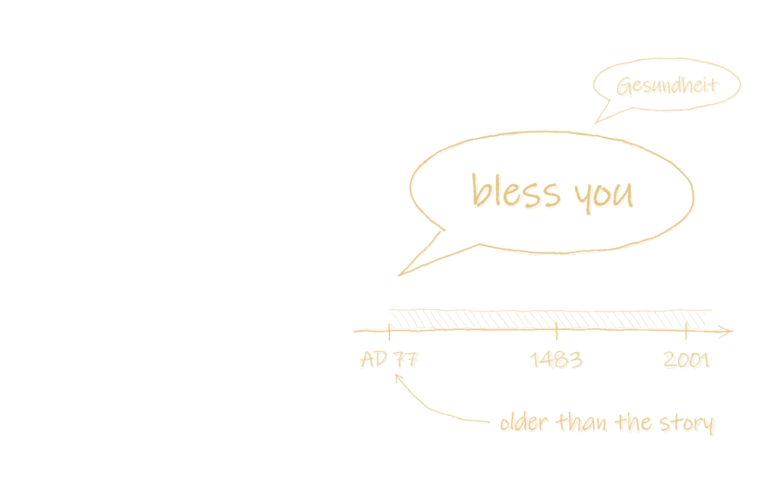
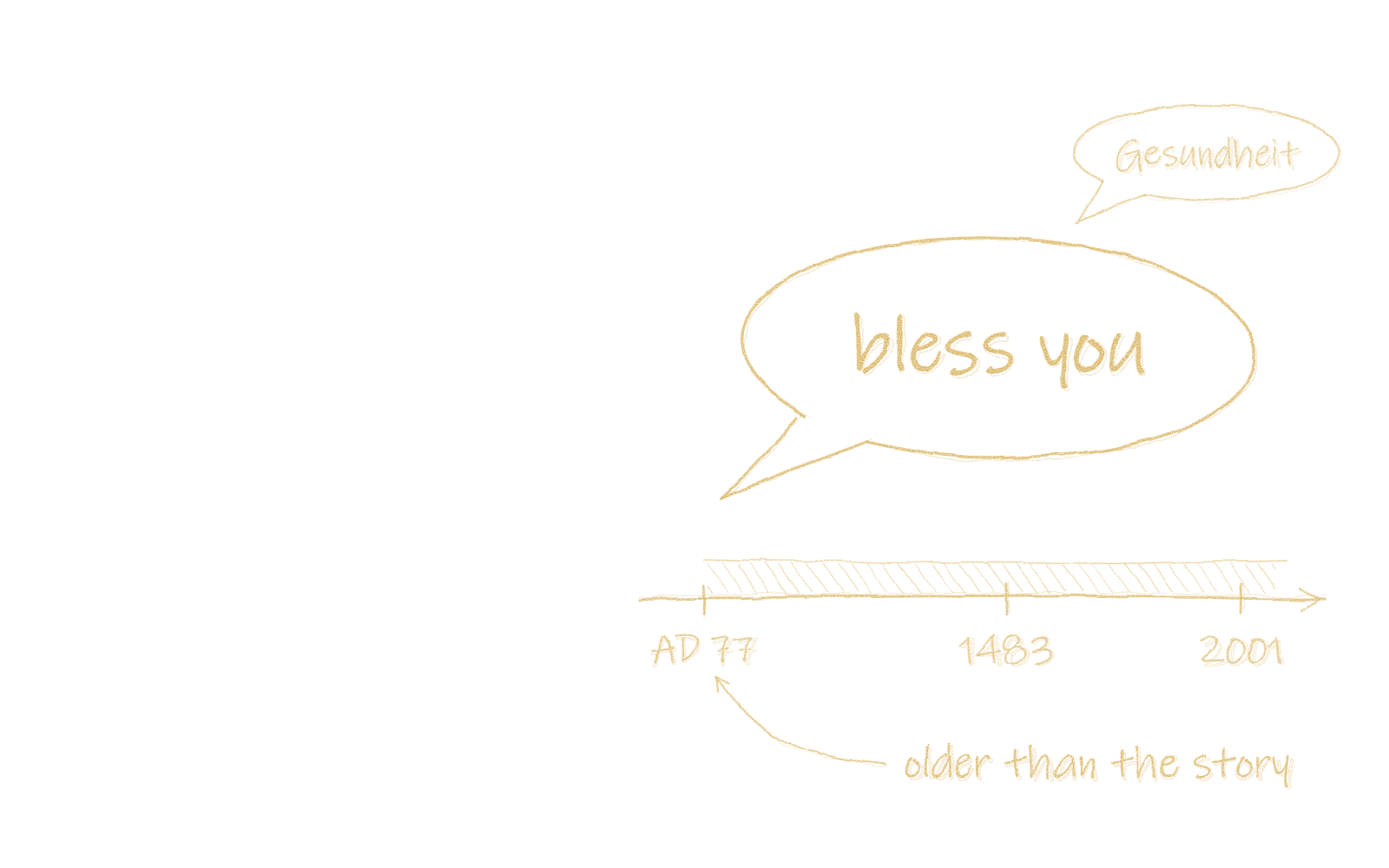
Around AD 77, centuries before that plague, Pliny was already asking why people “salute a person when he sneezes”[1]. He gave no reason. He did mention that Tiberius Caesar, who he calls “the most unsociable of men”, is said to have insisted on it even when he was riding in his chariot[1]. (So the grumpiest man in Rome still wanted his sneezes acknowledged. Honestly, same.)
So here’s what I think is going on, and it’s the argument of this whole post: the habit is older than the oldest versions of the stories that I could find. The stories sound very sure of themselves, but when I went looking for where each one came from, some of them I couldn’t trace back nearly as far as they sound. And more than 1,900 years after Pliny, the plain answer is still the one he was stuck with: nobody knows for sure.
You wouldn’t guess that from a quick search, though. Plenty of web pages will tell you why people say “bless you” in flat, certain sentences: the pope’s plague order, the escaping soul, the evil spirits[2, 3]. So I took the stories one at a time and went looking for the oldest page each one turns up on. And I started with Pliny, because for all I knew he was just one odd Roman with a thing about sneezes.
Seen in AD 77, still no reply: Why do we say “bless you” when someone sneezes?
Nobody knows for sure why it’s customary to say it, and people were answering sneezes long before ANY pope got involved. Pliny turns out to have plenty of company.
In Homer’s Odyssey, Telemachus sneezes just as his mother Penelope finishes speaking, and she takes it as a sign of “utter death” for the men courting her[4]. Which is a LOT to get out of your son’s sneeze, but okay.
In Xenophon’s Anabasis, set around 400 BC, an army is listening to a speech about rescue when one soldier sneezes. And the whole army bows to the god[5]. Imagine sneezing in the middle of someone’s presentation and the entire room drops into a bow. You would never sneeze in public again.
Imagine sneezing in the middle of someone’s presentation and the entire room drops into a bow.
Other replies were smaller. In Petronius’s Satyricon, from Pliny’s century, a sneeze gets the Latin salvere, a greeting that means roughly “be well”[6]. Early rabbis even argued over whether wishing a sneezer health was a forbidden pagan practice or only a distraction in the schoolhouse[7] (so “please stop disrupting the class” is also a very old tradition). And in the Bible, at 2 Kings 4:35, a child who had died “sneezed seven times, and the child opened his eyes”[11].
Now, none of those old texts explain why people first answered a sneeze. But they do settle one thing: Pope Gregory I can’t have started the habit. The most his legend can still claim is the Christian wording.
And that seemed fair enough to me. So maybe the pope didn’t invent answering a sneeze, but he did start the habit of saying “God bless you” during the plague? That sounded reasonable, so I went back to Rome in 590 to find the order.
Pics or it didn’t happen: The pope who supposedly made Rome say “God bless you” to anyone after sneezing
I found no sign that Pope Gregory ordered anyone to say “bless you”. The plague in Rome in 590 was real, but the nearest account from the time that I could find, read in English, never mentions a sneeze[8].
The plague scene at the top of this post (the dead pope, the deacon, the eighty people in a single hour) comes from one man, Gregory of Tours, a bishop in Frankish Gaul (a different Gregory, which doesn’t help). He wrote that account, relying on a deacon who was in Rome[8].
So this is where I expected to meet the famous order. There’s a plague, a newly chosen Gregory, a crowd praying, and… nothing. I found no sneeze anywhere in the English translation[8]. No one sneezed in it, so nobody gets blessed.
So when does the sneezing get in? The first link I found between sneezing and a Roman plague is in the Golden Legend, a book of saints’ lives put together around 1275[9]. That’s about 685 years after the plague (1275 minus 590, if my subtraction is right). In William Caxton’s English version of 1483, people in the pestilence died “sometime sneezing,” and bystanders said “God help you, or Christ help”[9].
That’s sooo close to our story. But look at what Gregory does in it. In the versions of the story I could read, he orders processions against the plague, and he never tells anyone to bless someone who sneezes. And the book’s own life of Gregory has no sneeze in it at all[9, 10].
People have been doubting this one for a long time, too. Already in 1646, Sir Thomas Browne (who wrote an entire chapter called “Of Sneezing”, so clearly my kind of person) found the sneezing plague in the historian Carolus Sigonius and set it aside, because the custom, he wrote, is older than that[11]. So the Gregory story already had a doubter in 1646.
As far as I can trace it, the whole thing works like a game of telephone. A real plague whose nearest account (in English at least) has no sneezing turns into a plague WITH sneezing about 685 years later, and only after that into a pope giving an order.
And by our own time the retellings have grown surer. In 2016 NPR called the pope story “one of the more prevalent theories”, and then said Gregory “commanded people to say ‘God Bless You’ after a sneeze”[2]. Commanded! Okay, but where? NPR names no document. I couldn’t find one from Gregory’s lifetime either, though I didn’t read his own letters or books (that part is on me). A 1910 book, meanwhile, quotes a French history that says “the year 750 is commonly reckoned the era of the custom of saying ‘God bless you’ to one who happens to sneeze” and calls the Gregory story “a fable contrived against all the rules of probability”[12], which is a very fancy way of saying somebody made it up.
Some pages don’t even keep the story in Gregory’s century. They move the whole thing to the 14th century and the bubonic plague, better known as the Black Death (the black plague, to its friends)[3].
So I’m filing the pope’s order under legend. The plague was real and Gregory was real, but I couldn’t find anyone from his time writing that order down. And that still leaves the other explanations, starting with the spooky one.
Big if true: The soul that escapes when somebody sneezes
I found no medieval source for the escaping-soul story. Many pages put it down to a belief that a person’s soul could be thrown from their body when they sneezed, or that an evil spirit could get in[3] (which would make allergy season a genuine emergency). And it certainly sounds medieval, right? There are souls, there are evil spirits, and something is trying to get in through your nose. So I tried to find something medieval that says it.
The oldest source I read for the spirit idea is a good deal younger than that. It’s the 1906 Jewish Encyclopedia, which says the custom “originated in the belief that it was the work of the spirits, good or evil”[7]. But why? Says who? Well, the encyclopedia states it as a plain fact and doesn’t really explain itself. It just points back to one book, the anthropologist E. B. Tylor’s Primitive Culture (1871)[7]. So that gets us to 1871, which is old, but it’s steam-train old, not knights-and-castles old.
And before that, I ran out of trail. Browne’s essay mentions neither a soul nor a devil[11]. Patricia O’Conner and Stewart Kellerman, the two writers behind the Grammarphobia blog, said in 2009 that they had seen no authoritative medieval source for the soul or heart stories[13]. That’s two people telling us what they haven’t seen, which isn’t proof of anything, but it does match what I found. And a Snopes page first published in 2001 is the oldest page I read that tells the soul story[14].
So the soul and spirit stories stay folklore for me, with nothing medieval behind them that I could find. They may well be older than the pages I read. I just couldn’t find anyone medieval saying so.
Still beating, thanks for asking: Your heart doesn’t stop when you sneeze
Your heart doesn’t stop when you sneeze[2, 14]. I know that’s not what the story says. The story says your heart stops when you sneeze, just for a moment, like a tiny reboot. The earliest page I found with it is that same Snopes page, which says the heart “was believed to momentarily stop during a sneeze (it doesn’t)”[14]. I do enjoy that the entire debunking is two words in brackets.
But two words in brackets isn’t much of an explanation, so here’s a heart doctor. The cardiologist Nancy Sweitzer told NPR that “the electrical activity of the heart is constant through a sneeze,” though the pumping “may be reduced in force,” and a weaker beat can feel like a skipped one[2]. So the heart keeps going the whole time. It can just feel like it missed one.
So I call the stopped heart a myth, one I could trace back no further than 2001. A sneeze is a protective reflex[15], and hiccups, another one, get a memo of their own. Yawning, another thing the body does without asking, has a post of its own too.
That covers the pope, the soul and the heart. Which leaves a smaller question, about one word.
“God help you” walked so “bless you” could run: Still searching for the reason behind saying “bless”
None of this explains how English speakers landed on “bless”. The earliest English reply I found is Caxton’s “God help you” of 1483, in a passage where the sneezer also blesses himself with the sign of the cross[9]. By 1646 Browne wrote of “saluting or blessing” a sneeze[11]. And in the 1680s John Aubrey recorded people bowing and crying “God bless ye Sir,” as quoted by the Phrase Finder website[16]. (Bowing AND “Sir”. We have really let standards slip.) And none of this covers “bless your heart”, by the way, which is a different saying and not always a blessing.
English isn’t the only language with a set response to a sneeze. Sahih al-Bukhari, a ninth-century collection, tells Muslims to answer a sneezer with “May Allah bestow his Mercy on you”[17]. German speakers say Gesundheit, which means “health”[18]. So if “bless you” doesn’t feel like yours to say when someone sneezes, you have options. Many old replies were wishes of health or mercy, so you could say Gesundheit, or a plain “health to you”, and it does the same job[7, 17, 18].
Nobody knows, carry on: Why we still say “bless you” when someone sneezes
As far as I can tell, nobody has a satisfying answer for why we say “bless you” when someone sneezes and not after anything else the body does. That part is still open. The anthropologist Dan Sperber asked in 2009 why sneezing, and not coughing or belching, gets a standard reaction, and wrote that he had “never come across a satisfactory answer”[19]. And he has a point. Nobody has a kind word ready for a burp.
My own guess for why we still say it is plainer than any legend: habit, the feeling that it’s polite to say something, and not wanting to be the one person in the room who stayed quiet.
- about 400 BCXenophon: a soldier sneezes and the whole army bows to the god [5]
- AD 77Pliny asks why people “salute a person when he sneezes” and gives no reason [1]
- Gregory’s lifetimePlague in Rome; the nearest account from the time has no sneeze in it [8]
- about 1275The Golden Legend: the first link I found between sneezing and a Roman plague [9]
- 1483Caxton’s English: “God help you, or Christ help” [9]
- 1646Browne: the custom is older than the sneezing plague story [11]
- 1680sAubrey: “God bless ye Sir” [16]
- 1906Jewish Encyclopedia: the custom began in a belief about spirits; it points back to Tylor (1871) [7]
- 1910A book quotes a French history: 750 is “commonly reckoned the era of the custom,” and the Gregory story is “a fable” [12]
- 2001Snopes: the soul story, and the heart “was believed to momentarily stop” [14]
- 2009Grammarphobia: no authoritative medieval source for the soul or heart stories [13]
- 2016NPR: Gregory “commanded people to say ‘God Bless You’” [2]
So the trail ends about where it started. Pliny was asking in AD 77, and I found nothing since that settles the origin of saying “bless you”[1]. The pope, the soul and the stopped heart all turned up along the way sounding very sure of themselves, and people kept answering the sneeze anyway. So if you like the tradition of saying “bless you”, keep it going. You don’t need the pope’s permission, which is lucky, because I couldn’t find it.
You don’t need the pope’s permission, which is lucky, because I couldn’t find it.
If tracing sayings back is your kind of fun, knock on wood gets the same treatment, and there are more small mysteries like this one.
One small thing to try: the next time you talk to the oldest person you know, ask what people would say in their family when someone sneezed, and who taught them. A text counts. If there’s nobody to ask, think back to where you picked up your own reply. Either way, you’ll have given one habit a birth date, on a far shorter reading list than mine. And if they tell you it all started with a pope during a plague, you can tell them about Pliny, and see how that goes. There are more small mysteries like this one on the Curious page.
If you like small mysteries, here are a few more:
Okay, last sneeze, I promise: Quick answers about saying “bless you”
Where did saying “bless you” after a sneeze originate?
Nobody knows where saying “bless you” after a sneeze originated. The history behind saying it goes back at least to Pliny the Elder, who asked around AD 77 why people salute a sneezer, and then didn’t answer his own question[1]. It is often believed that Pope Gregory I ordered a blessing whenever anyone sneezed, which would mean the custom originated in Rome, but I found no document from his time that shows it[8]. And the earliest English wording I found is “God help you”, from 1483[9], which is close, but not quite.
Why did people say “God bless you” in the pope story?
In the story, a sneeze was a sign that you were falling ill with the plague, so people said “God bless you” (or “may God bless you”, if you’re being formal about it) as a way of asking God to spare the person who sneezed[2, 12]. That’s the legend’s own reason behind saying it, and honestly it’s a neat one. It just has a paper trail problem, because the nearest account of that outbreak that I could find never mentions a sneeze[8], which is a strange thing to leave out of a sneezing story.
What can you say when someone sneezes instead of “bless you”?
You can say “Gesundheit” or “health to you” when someone sneezes instead of “bless you”. Many of the old replies were wishes of health or mercy[7, 17, 18], so you don’t have to believe in God to answer a sneeze (nobody is checking). I’d say it’s appropriate to say whatever kind thing comes naturally to you. As far as I can tell, the meaning behind saying any of them is about the same: somebody noticed, and they wish you well.
What is the German word used instead of “bless you”?
The German word is Gesundheit, and it just means “health”[18]. German speakers say it as a reply when a person sneezes, so it’s a wish for health with no blessing in it at all[18]. Which makes it a close cousin of the Latin reply in Petronius’s Satyricon, salvere, a greeting that means roughly “be well”[6].
What do people say when someone sneezes in other countries?
People respond to a sneeze with a set wish in many languages, and most of the ones in this post wish for health or mercy. German speakers say Gesundheit, which means “health”[18]. Sahih al-Bukhari, a ninth-century collection, tells Muslims to answer a sneezer with “May Allah bestow his Mercy on you”[17]. In Petronius’s Rome the reply was salvere, roughly “be well”[6]. And in English, the common response to someone sneezing is “bless you”, usually said before anybody has thought about it.
What does 7 sneezes in a row mean?
I found no old source that gives seven sneezes in a row a meaning. The nearest thing in this post is a Bible verse, 2 Kings 4:35, where a child who had died “sneezed seven times, and the child opened his eyes”[11]. That’s one story about one child, though, and it doesn’t hand out meanings for anybody else’s sneezes. So seven in a row has no special meaning that I could find, besides a rough minute for you and everyone near the tissues.
What happens in your body when you sneeze?
A sneeze is a protective reflex, the body’s way of quickly pushing irritants or germs out of the airways[15]. And no, your heart doesn’t stop while it happens, no matter how confidently someone told you that at a sleepover. The cardiologist Nancy Sweitzer told NPR that “the electrical activity of the heart is constant through a sneeze,” though the pumping “may be reduced in force,” and a weaker beat can feel like a skipped one[2]. So the belief that a sneeze stops your heart is a myth.
Is saying “bless you” after a sneeze superstition or good manners?
My guess is that today it’s good manners with a superstitious past. The oldest replies in this post come with beliefs associated with sneezing, like the omens in Homer and Xenophon[4, 5]. These days it’s common for people to say “bless you” without thinking, and I’d guess it’s still considered polite to say something. And as for why, out of a sneeze or cough or burp, only the sneeze gets a reply, the anthropologist Dan Sperber wrote in 2009 that he had never come across a satisfactory explanation[19]. Neither have I.
The numbers, if you want them
- How old the habit is. Pliny wrote around AD 77, so people have been answering sneezes for at least 1,900 years[1]. Xenophon’s story is set around 400 BC[5].
- The gap in the pope story. The plague in Rome was in 590. The first text I found that ties a Roman plague to sneezing, the Golden Legend, dates from about 1275, roughly 685 years later[8, 9] (which is a long time to remember whether somebody sneezed). The 750 date comes from a French history quoted in the 1910 book, which calls it only “commonly reckoned”[12].
- What I didn’t read. I read Gregory of Tours and the Golden Legend in English, not in Latin[8, 9]. I didn’t read Pope Gregory’s own letters or books, so a source there is still possible. I didn’t read Tylor’s Primitive Culture, the book the Jewish Encyclopedia points back to[7]. And the Aubrey quote comes through the Phrase Finder, not from Aubrey’s own book[16].
Sources
- Pliny the Elder (about AD 77). Natural History, Book XXVIII, chapter 5, trans. John Bostock and H. T. Riley (1855-57). Perseus Digital Library. https://www.perseus.tufts.edu/hopper/text?doc=Plin.+Nat.+28.5
- Dalrymple, L. (2016, 24 August). “Here’s Looking Achoo! Debunking The Sneeze.” NPR Shots. https://www.npr.org/sections/health-shots/2016/08/24/491082028/heres-looking-achoo-debunking-the-sneeze
- WTAJ (2023, November). “Why do we say ‘Bless You!’ after someone sneezes?” https://www.wtaj.com/news/national-news/why-do-we-say-bless-you-after-someone-sneezes/
- Homer. Odyssey 17.541-550. Perseus Digital Library. https://www.perseus.tufts.edu/hopper/text?doc=Perseus:text:1999.01.0136:book=17:card=541
- Xenophon. Anabasis 3.2.9, trans. Carleton L. Brownson. Perseus Digital Library. https://www.perseus.tufts.edu/hopper/text?doc=Perseus:text:1999.01.0202:book=3:chapter=2:section=9
- Petronius. Satyricon 98, trans. W. C. Firebaugh. Project Gutenberg 5220. https://www.gutenberg.org/cache/epub/5220/pg5220.txt
- Jastrow, M., & Kohler, K. (1906). “Asusa, Asuta.” Jewish Encyclopedia. https://www.jewishencyclopedia.com/articles/13815-sneezing
- Gregory of Tours, History of the Franks, Book X, chapter 1, trans. Ernest Brehaut (1916). Project Gutenberg ebook 74955. https://www.gutenberg.org/cache/epub/74955/pg74955.txt
- Jacobus de Voragine, The Golden Legend (compiled about 1275), “Here beginneth the Litanies, the More and the Less”, in William Caxton’s English version (1483). IntraText edition. https://www.intratext.com/ixt/ENG1293/_PE.HTM
- Jacobus de Voragine, The Golden Legend, “Of S. Gregory the Pope”, Caxton’s version (1483). IntraText edition. https://www.intratext.com/ixt/ENG1293/_P2P.HTM
- Browne, Sir Thomas (1646; 6th ed. 1672). Pseudodoxia Epidemica, Book IV, chapter IX, “Of Sneezing”, with the editor’s notes. University of Chicago, Penelope. https://penelope.uchicago.edu/pseudodoxia/pseudo49.html
- Knowlson (1910). The Origins of Popular Superstitions and Customs, chapter “Sneezing”. https://sacred-texts.com/neu/eng/osc/osc60.htm
- O’Conner, P. T., & Kellerman, S. (2009, 12 September). “An allergic reaction.” Grammarphobia. https://www.grammarphobia.com/blog/2009/09/an-allergic-reaction.html
- Mikkelson, B. (2001, 17 April). “Why Do We Say ‘Bless You!’ When Someone Sneezes?” Snopes. https://www.snopes.com/fact-check/bless-you/
- Yang, R., et al. (2025). The sneeze reflex in physiological and pathological states: a mini review. Frontiers in Neuroscience, 19, 1598027. https://doi.org/10.3389/fnins.2025.1598027
- The Phrase Finder, “Bless you” (quoting John Aubrey, Remaines of Gentilisme and Judaisme, 1686-87). https://www.phrases.org.uk/meanings/bless-you.html
- Sahih al-Bukhari 6224, Book of Good Manners. https://en.tohed.com/hadith/bukhari/6224
- Wiktionary, “Gesundheit” (German entry). https://en.wiktionary.org/wiki/Gesundheit
- Sperber, D. (2009, 18 January). “Why does sneezing elicit blessing?” Cognition and Culture. https://cognitionandculture.net/blogs/dan-sperber/why-does-sneezing-elicit-blessing