You’ve probably been told about Parkinson’s law, usually by someone explaining why your deadline just got shorter. It’s the old adage that work expands to fill the time you give it (or that tasks expand, depending on who’s telling you). And that sounds right, doesn’t it? Give an email that should take ten minutes a whole free afternoon, and somehow the email takes the afternoon. (It’s one of the time questions on the Work page.)
So where did this law come from, and did anyone ever test it? Well, it came from a joke. In 1955 the British naval historian Cyril Northcote Parkinson published a satirical essay in The Economist about the civil service, and the famous sentence was just his opening line[1, 2]. He never tested it. Other people did, eventually, and I’d call the result half right. In a few small lab studies, people slowed down when spare time turned up by surprise[3], but I found little direct proof that a longer deadline makes the same job take longer[4]. So that’s my argument for this post: we took the first line of a joke essay and turned it into time management advice, and the part we repeat the most is the part with the least behind it.
And you don’t need a free weekend for any of this. A canceled call when you work from home, a quiet hour near the end of a shift or the gap between school pickup and dinner is plenty of room for one email to spread into. (If a job of yours keeps stretching and you want the practical guide, that’s how to stop procrastinating.)
I’ll start with the essay, because it turned out to be about something else entirely.
He was joking, by the way: What Parkinson’s law is and where it came from
Officially, Parkinson’s law is the principle that work expands to fill the time available for it. It comes from a satirical essay about the British civil service that Cyril Northcote Parkinson published in The Economist on 19 November 1955[1], and the essay was mostly making a different point.
Even the way it got printed is a little funny. The report of the Royal Commission on the Civil Service had come out on Thursday afternoon, and the editors told readers that time had not permitted any comment on it that week. So yes, the magazine that introduced a law about time did it in a week when it had run out of time. What the editors had to offer was an essay by “a correspondent”, whose “startling discovery”, they said, was “certainly relevant to what should have been in it”[1].
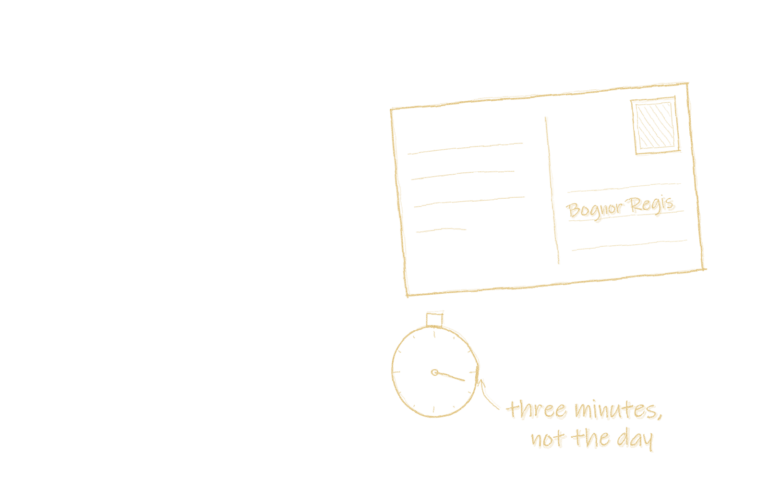
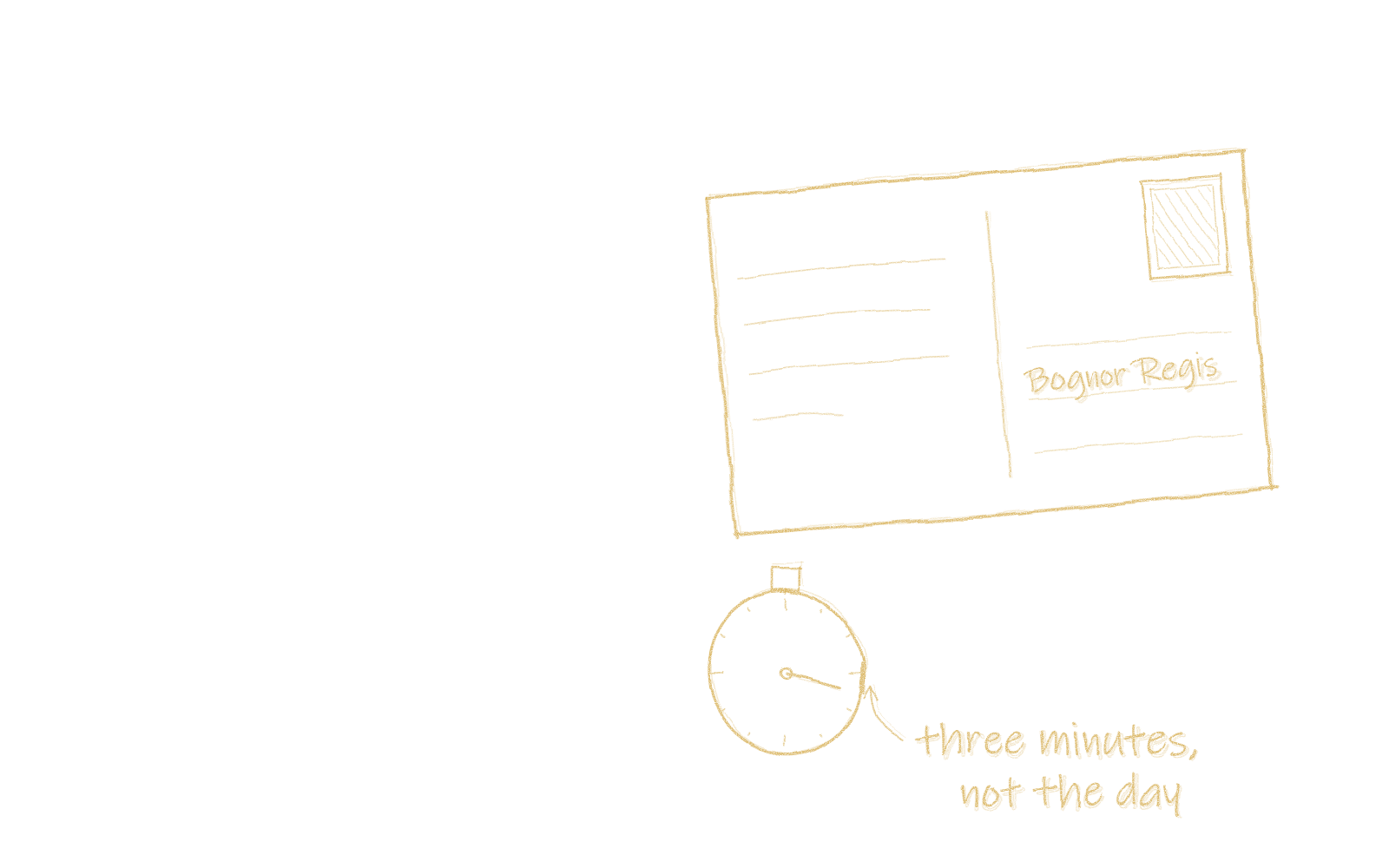
And almost at once Parkinson brings in an elderly lady of leisure, who can spend the entire day writing and sending a postcard to her niece at Bognor Regis. He itemizes her day like an expense report. An hour goes on finding the postcard and another on hunting for her spectacles. Half an hour is spent in a search for the address, an hour and a quarter on composition, and twenty minutes on deciding whether or not to take an umbrella to the pillar-box in the next street[1]. (I added it up, and that’s four hours and five minutes of postcard. Twenty of those minutes were the umbrella, which seems unnecessary for a trip to the next street.) The same job, he wrote, would occupy a busy man for three minutes[1].
So this is a man writing to get a laugh. The line everyone quotes, that “work expands so as to fill the time available for its completion”, is only his opening line, and he calls it “a commonplace observation”, so he never even claimed it as his own idea[1]. It’s the 1955 way of saying “as everybody knows”.
Then he gets to what he was actually after. Because paper work is “elastic in its demands on time,” he argues, there need be “little or no relationship between the work to be done and the size of the staff”[1]. THAT is the law he named, and it’s about bureaucracy, where the size of the staff has little to do with the workload. It’s not about your to-do list. The magazine’s editor added a footnote on the name that reads “Why? Why not?”[1], which is the kind of fact-checking I can respect.
And his evidence? Two small tables. Admiralty officials rose from 2,000 in 1914 to 3,569 in 1928, while the navy shrank “by a third in men and two-thirds in ships”[1]. So more people to run the navy, and a lot less navy to run. (Those are the essay’s own figures, and I haven’t checked them against official records.)
So more people to run the navy, and a lot less navy to run.
But look at what he counted. He counted officials. He never timed anybody doing a job, and he never tests the time sentence itself. He illustrates it with stories, like the postcard, and his numbers are about staff and not about how long anyone took over anything[1].
So the sentence that got famous is the one part of the essay that nobody had measured, including the man who wrote it. Somebody was going to have to go and time people.
Meeting canceled, nobody panic: How the time spent on a job grows when spare time turns up by surprise
Psychologists did try, from the 1960s on. So, spoiler: in four small lab studies from 1999, people who were handed spare time by surprise did take longer over the task at hand[3]. But getting to a fair test took a while (decades, basically). In 1999 three researchers, Laura Brannon, Paul Hershberger and Timothy Brock, went back over those early tests and said none of them had really shown it[3].
But why not? Their complaint was that the old setups kept waving the clock in people’s faces. Take the one by Aronson and Landy from 1967. As the 1999 team describes it, people who knew they had 5 minutes used a bit under five, and people who knew they had 15 minutes used more than ten. That sure looks like work expanding to me. But everybody in it had been told exactly how long they had, so time had been pushed at them from the start, and the 1999 team judged that even this one “could not be convincing”[3, 5].
So they ran their own, and they hid the clock. (Their paper is called “Timeless demonstrations of Parkinson’s first law”, and I think they were pretty pleased with that title.) Students ranked photos of faces, guessing each person’s education and job level, in what they expected to be four sets. Just before the third set, some of them were told that a later one was canceled. That handed them spare time they hadn’t planned for, like a meeting vanishing from your calendar. And the whole time, a hidden timekeeper was running a stopwatch on them[3], which is not a comforting thought if you’ve ever wondered what your manager does all day.
A fourth study swapped the faces for counting the letters in short gloomy phrases like “suffocating air”[3]. I don’t know why the phrases had to be gloomy either.
So what happened? In all four studies, the students who were handed surprise spare time took longer on the set in front of them than the comparison group did, although the third result narrowly missed the usual statistical cutoff[3]. A point for the postcard lady!
OK, but did the extra time at least buy better work? In the letter-counting study, no. The dawdling (the authors call it “dalliance”, which sounds a lot more fun than counting letters) “was not associated with better performance on the counting task.” And when students in two of the studies were asked how the cancellation had affected their time, not one of them mentioned spending more of it. So the authors concluded that the slowdown seems to happen “insidiously and without obvious benefit” to the quality of the work[3]. People slowed down, the work didn’t get better, and nobody brought it up. So it wasn’t even a case of diminishing returns, where more time buys you a little more quality. In that study, the extra time bought exactly nothing.
Now, the limits. These were students from one Midwestern US university, doing jobs that took a few minutes, and the “two exact replications” came from the same team in the same paper[3]. So I wouldn’t lean my whole weight on it.
And there’s a bigger catch. The usual time management advice isn’t about canceled meetings at all. It’s about giving yourself less time on purpose, and that needs a different experiment.
Same puzzle, bigger clock: Does a longer deadline make the same job take longer?
In the one experiment here that tested it, no. And this is the version of Parkinson’s law that the productivity advice actually needs: a deadline you knew about from the start, which is a different thing from a surprise gap. If more time makes the same job take longer, then cutting the time should speed you up. That sounds reasonable to me.
So in 2020, two researchers named Indranil Goswami and Oleg Urminsky gave 116 people in a lab the same digital jigsaw puzzle, with a randomly assigned limit of 5 minutes, 15 minutes or none at all[4]. They had tried the puzzle out beforehand, and nearly everyone could solve it inside 5 minutes. Everyone was paid a flat $3 however long they took to complete the task, and they were free to go once they were done, so nobody had a reason to stretch it out[4].
If work really expands to fill the time, the people with no limit should have been the slowest of all, and in theory they should still be in that lab. They weren’t. The average times barely differed, and the gaps could easily be chance by the usual statistical test[4]. The 15-minute group was a touch slower on paper, but the no-limit group was as fast as the 5-minute group, and that pattern doesn’t fit a simple rule of more time, more work.
If work really expands to fill the time, the people with no limit should have been the slowest of all, and in theory they should still be in that lab.
Then they did the part I like even more. They asked 602 other people online to guess how long the puzzle solvers had taken. And the guesses came out at about 3.5 minutes for the 5-minute limit and about 6.9 for the 15-minute limit[4]. Same puzzle, and the guess nearly doubled.
The authors call this “Parkinson’s Law of the Mind”: our sense of how big a task is grows with the time we are given, “even when both the actual work done and time taken are not affected”[4]. So the job didn’t get any bigger. It just LOOKED bigger to the people guessing, and I think that’s the most useful insight in this whole post.
Average time the solvers actually took (minutes)
What 602 online judges guessed they took (minutes)
Now, it was one easy puzzle, and the judges were guessing about strangers, so it says little about a report due next week[4]. But put it next to the 1999 study and here’s what I think is going on: two separate things are sharing one name. A surprise gap can invite dawdling you don’t notice[3], and a generous limit can make a job look bigger whether or not it takes longer[4]. And the 2020 authors themselves write that Parkinson’s law “has been highly influential, despite limited empirical evidence”[4], which is how a research paper says that everyone has heard of it and not many people have tested it.
Due at 11:59, submitted at 11:58: Why so much lands on the last day
OK, but then why does so much of our own work finish right as the time runs out? If the work isn’t expanding, what is going on? Well, part of it is that our guesses slip. In 1994, Roger Buehler, Dale Griffin and Michael Ross phoned psychology students at the University of Waterloo who were in the last semester of their honors thesis, and asked them when they expected to finish[6]. On average the students predicted 33.9 days. It took them 55.5[6] (so about three weeks longer than their own best guess).
This habit of guessing that a task will take less time than it does has a name, the planning fallacy, and the term comes from Daniel Kahneman and Amos Tversky[6]. To be fair to Parkinson, it compares a forecast with a finish, so it isn’t a direct test of his sentence.
But the same authors also note, as an anecdote, that people “do typically meet important deadlines”. And in their classroom survey, students said they finish about three quarters of their projects on deadline day itself, though that was only the students’ own impression[6]. Three quarters, on the day! That will surprise nobody who has watched a submission page at two minutes to midnight.
Now picture that from the outside. Work that finishes on deadline day looks exactly like work that expanded to fill the available time. But in my reading, the planning fallacy and the plain fact that we procrastinate explain it at least as well. There’s more on the last-day rush in wait-until-the-last-minute.
“Just move the deadline up,” they said: The tighter-deadline trick sold as effective time management
So here’s the obvious fix, the one every productivity video gets to eventually: just move the deadline closer and you’ll get more done. The usual tips for beating Parkinson’s law all run on that one idea. Allocate a short block of time to each task, set a timer app for a 25-minute sprint, put milestones on the timeline, and then the sense of urgency is supposed to kick in, so you work in one focused burst and get it done more efficiently (cue the training montage). And does it work? Well, I found no good direct test showing that it does, and one experiment hints that deadlines can backfire.
In a field experiment with paid online tasks, two economists named Alberto Bisin and Kyle Hyndman let students choose a binding deadline for themselves. Binding meant a hard one: a task not finished by it could no longer earn pay. And “a substantial fraction” of students chose one (working paper)[8]. So people WANTED the deadline. They volunteered for the version where they could lose the money.
And the deadlines did do something. The economists saw “large spikes in task completions in the time immediately before the deadline” (working paper)[8]. But did they get more of the tasks done? The published abstract says “deadlines do not increase completion rates in our experiment” and that deadlines “may hurt them”[7]. So students asked for a deadline, there was a rush right before the deadline, and none of it raised how many tasks got finished. Why would a deadline make things worse? The abstract doesn’t say, so I’m not going to pretend I know.
And the best-known study behind self-set deadlines, by Ariely and Wertenbroch in 2002, was retracted in September 2026[9] (How to stop procrastinating on the one thing you keep putting off).
So is Parkinson’s law true? What it means for your productivity this week
Half true, in my opinion. The surprise-gap dawdle and the bigger-looking job both turned up in experiments, and the popular productivity version, the one that gets sold as an efficiency trick, where a shorter deadline makes the same job go faster, has the least behind it as far as I can tell, because the one direct test I could read found no reliable difference. A tight deadline may still help you. I just found no good direct test of it. If you’d rather pick the order than the clock, eat the frog is the one about doing the hardest job first. And the ideas below weren’t tested directly either, but each one borrows from a study above.
When a project (or a “deliverable”, if your office talks like that) arrives with three weeks attached, ask what it would involve with three days, since in the puzzle study a longer limit changed how big people guessed the job was[4]. And before you plan, look up how long the last similar job really took (more on that at the end).
When a meeting is canceled and one hour opens up, decide what that hour is for before you go back to the task in front of you. A surprise gap is the setup where the canceled-task experiments caught people dawdling[3]. The same goes for a shift that suddenly goes quiet.
And a word on what I can’t tell you. None of the studies I could read looked at shift work or weeks with no steady schedule, and none checked whether squeezing the time hurts the quality of long or creative work, so I wouldn’t trade quality for a made-up constraint. (Research on time pressure and creativity exists, but it wasn’t part of this reading.) Same with distraction and perfectionism, which are the reasons people usually give for a job stretching. I’d love to tell you about them, but none of the experiments here measured either one. For timers, the Pomodoro technique has its own post. More everyday questions like this live on the Work page.
No relation: Parkinson’s law of triviality, and Parkinson’s disease
Two quick ones, because people go looking for them. Parkinson’s law of triviality is the committee version: the cheaper an item, the longer the argument. It’s usually quoted as “The time spent on any item of the agenda will be in inverse proportion to the sum involved”[2], though I haven’t checked that wording against his book. So if a meeting spends longer on the snack budget than on the actual budget, this is the law for that.
And Parkinson’s disease is unrelated. It’s named after a different Parkinson, the English surgeon James Parkinson, who described it in An Essay on the Shaking Palsy in 1817[10].
A few more on time:
- More from the Work page
- The Pomodoro technique: does it work?
- Eat the frog: should you do the hardest task first?
- Is decision fatigue real?
For the busy man with a postcard to send: Quick answers about Parkinson’s law, and yes, whether you can prevent it
Why does work expand to fill the time available?
Nobody has shown for sure that it does, and the best evidence covers one narrow case, surprise spare time. In four small studies from 1999, students who learned that a later task was canceled took longer over the one in front of them, and in the two studies that asked, none of them mentioned spending more time[3]. So the dawdle is sneaky. A 2020 puzzle study adds that a longer time allotted makes a job look bigger, even when people take no longer to complete a task[4].
Is Parkinson’s law scientifically proven?
No, Parkinson’s law is not scientifically proven, and the man who wrote it never tested it (he was busy being funny). His 1955 essay was satire about inefficiency in the civil service, and its numbers counted officials[1]. Later lab studies caught people dawdling over surprise spare time[3]. But the one direct test I could read found no reliable difference in how long a puzzle took with 5 minutes, 15 minutes or no limit, and its authors write that there is “limited empirical evidence” behind Parkinson’s law[4].
How can you use Parkinson’s law to improve productivity and manage time?
The usual advice is to give every job less time, but the direct tests I could read don’t show it gets the same work done in less time. What they found is narrower. When free time opens up by surprise, decide what it’s for, because that’s where people dawdled[3]. And when a job comes with a generous limit, ask how big it really is, because a longer limit made the same puzzle look bigger[4]. It’s not an effective time management system, but each half has a study behind it.
How can you overcome Parkinson’s law?
There is no tested way to overcome Parkinson’s law, or to prevent it, in the studies I could read. Setting yourself a deadline is the popular answer, but in one field experiment with students the published abstract says deadlines “do not increase completion rates in our experiment” and “may hurt them”[7]. So urgency alone isn’t shown to do it. Checking how long the last similar job took may help. In one study, that removed the average optimism in people’s forecasts, although their individual guesses were no more accurate[6].
Who first coined Parkinson’s law?
Cyril Northcote Parkinson first coined the name “Parkinson’s Law” in a satirical essay in The Economist on 19 November 1955[1]. The sentence about work expanding was only his opening line, and he called it “a commonplace observation”, so he didn’t even claim that part. The law he named said that the number of officials grows whatever happens to the amount of work[1]. He later turned the essay into a book, which came out in Britain as Parkinson’s Law: or, The Pursuit of Progress[2].
The numbers, if you want them
- Parkinson’s tables: 2,000 Admiralty officials in 1914 and 3,569 in 1928 is a 78.45 percent increase, by the essay’s own figures[1] (he gave it to two decimal places, which is a lot of precision for a joke).
- The 1967 test: people who knew they had 5 minutes used an average of 288 seconds, and people who knew they had 15 minutes used 640. I’m going by how the 1999 paper describes it, not by the 1967 paper itself[3, 5].
- The surprise-time studies: the third of the four results was only “borderline significant”, meaning it narrowly missed the usual statistical cutoff. The authors rate the sizes of the effects as medium to high[3]. I couldn’t find an independent repeat among the ten papers that cite it (I searched OpenAlex and Europe PMC in October 2026, but not Google Scholar).
- The puzzle study: the average times were 2.24 minutes with the 5-minute limit, 2.75 with the 15-minute limit and 2.23 with no limit. Of the 602 judges, 63 percent said people take more time when more time is available[4].
- The thesis study: the researchers phoned 37 students and the averages cover 33 of them. Only 29.7 percent finished by their best-guess date, and 48.7 percent by the date they gave for everything going as badly as possible[6].
- The deadline experiment: in the three-task, two-week version, students who could set their own deadlines had the lowest completion rate of any group, narrowly but reliably below those with no deadlines (working paper)[8].
Three minutes, allegedly: One small thing to try today
Take one job on today’s list and write next to it how long the last job like it really took. I mean how long it actually took, and not how long it should have. And if writing it down is too much, just say the number to yourself before you start. In one of Buehler’s studies, the average optimism disappeared for people told to connect their forecast to relevant past experiences, although their individual guesses were no more accurate[6]. If you’d like to time a job properly, the Procrastination worksheet: a free printable to help you start has room to log it.
And if the job still takes all afternoon, well, the lady in the essay needed a whole day and twenty minutes of thinking about an umbrella. You’re doing fine.
Sources
- Parkinson, C. N. (1955, 19 November). Parkinson’s Law. The Economist. Internet Archive copy: https://archive.org/details/parkinsons-law-the-economist
- Wikipedia. Parkinson’s law (law of triviality section) and C. Northcote Parkinson (secondary source, used for “naval historian” and the triviality wording). https://en.wikipedia.org/wiki/Parkinson%27s_law
- Brannon, L. A., Hershberger, P. J., & Brock, T. C. (1999). Timeless demonstrations of Parkinson’s first law. Psychonomic Bulletin & Review, 6(1), 148–156. https://doi.org/10.3758/BF03210823
- Goswami, I., & Urminsky, O. (2020). More time, more work: How time limits bias estimates of task scope and project duration. Judgment and Decision Making, 15(6), 994–1008. https://doi.org/10.1017/S1930297500008196
- Aronson, E., & Landy, D. (1967). Further steps beyond Parkinson’s law: A replication and extension of the excess time effect. Journal of Experimental Social Psychology, 3(3), 274–285. https://doi.org/10.1016/0022-1031(67)90029-7 (the numbers come from the description in Brannon et al. 1999)
- Buehler, R., Griffin, D., & Ross, M. (1994). Exploring the “planning fallacy”: Why people underestimate their task completion times. Journal of Personality and Social Psychology, 67(3), 366–381. https://doi.org/10.1037/0022-3514.67.3.366
- Bisin, A., & Hyndman, K. (2020). Present-bias, procrastination and deadlines in a field experiment. Games and Economic Behavior, 119, 339–357 (published abstract). https://doi.org/10.1016/j.geb.2019.11.010
- Bisin, A., & Hyndman, K. (2018 revision). Present-bias, procrastination and deadlines in a field experiment. NBER Working Paper 19874 (not peer-reviewed; the spikes, the “substantial fraction” and the three-task finding are quoted from this version, and it also describes Burger, N., Charness, G., & Lynham, J. (2011), Journal of Economic Behavior & Organization, 77(3), 393–404, which I did not read). https://www.nber.org/papers/w19874
- Ariely, D., & Wertenbroch, K. (2002). Procrastination, deadlines, and performance: Self-control by precommitment. Psychological Science, 13(3), 219–224. https://doi.org/10.1111/1467-9280.00441 Retracted (September 2026). Retraction notice: https://doi.org/10.1177/09567976261488042
- Wikipedia. James Parkinson (secondary source). https://en.wikipedia.org/wiki/James_Parkinson