A lean mass hyper-responder is someone on a low-carb diet whose blood test shows three things together: very high LDL cholesterol, high HDL cholesterol and low triglycerides. Most people meet the phrase the same way, which is that they’ve been eating low-carb for a while and feeling better than they have in ages, and then a routine blood test comes back with an LDL far higher than it has ever been, so they type the numbers into a search box and this is what comes back. (There are more questions like it on the Body page.)
If that’s you, here’s the short version first. The phrase is a name for a pattern of three blood numbers, seen more often in people with a lower BMI (mostly in analyses by the group that named it). And it’s no all-clear: no study has shown that LDL that high is harmless[2, 4]. So before any of the debate below, take those numbers to your own doctor.
The rest of this post is about the name, because the name is doing a lot of work. It sounds like something a panel of heart doctors voted on, and it sounds a little like a compliment (lean! hyper! responder!). So I went and read where it came from and what’s been tested since. And here’s my argument: we now have a name, a survey and a pretty neat explanation involving delivery trucks, and not one of them answers the question that actually matters. Nobody yet knows whether LDL this high is harmless, and the people who coined the label say “we don’t know” too[12].
I’ll go through it in the order it happened: the checklist, the guy who wrote it, the survey, the trucks, and then the part about risk, which is the part I’d read twice.
What is a lean mass hyper responder?
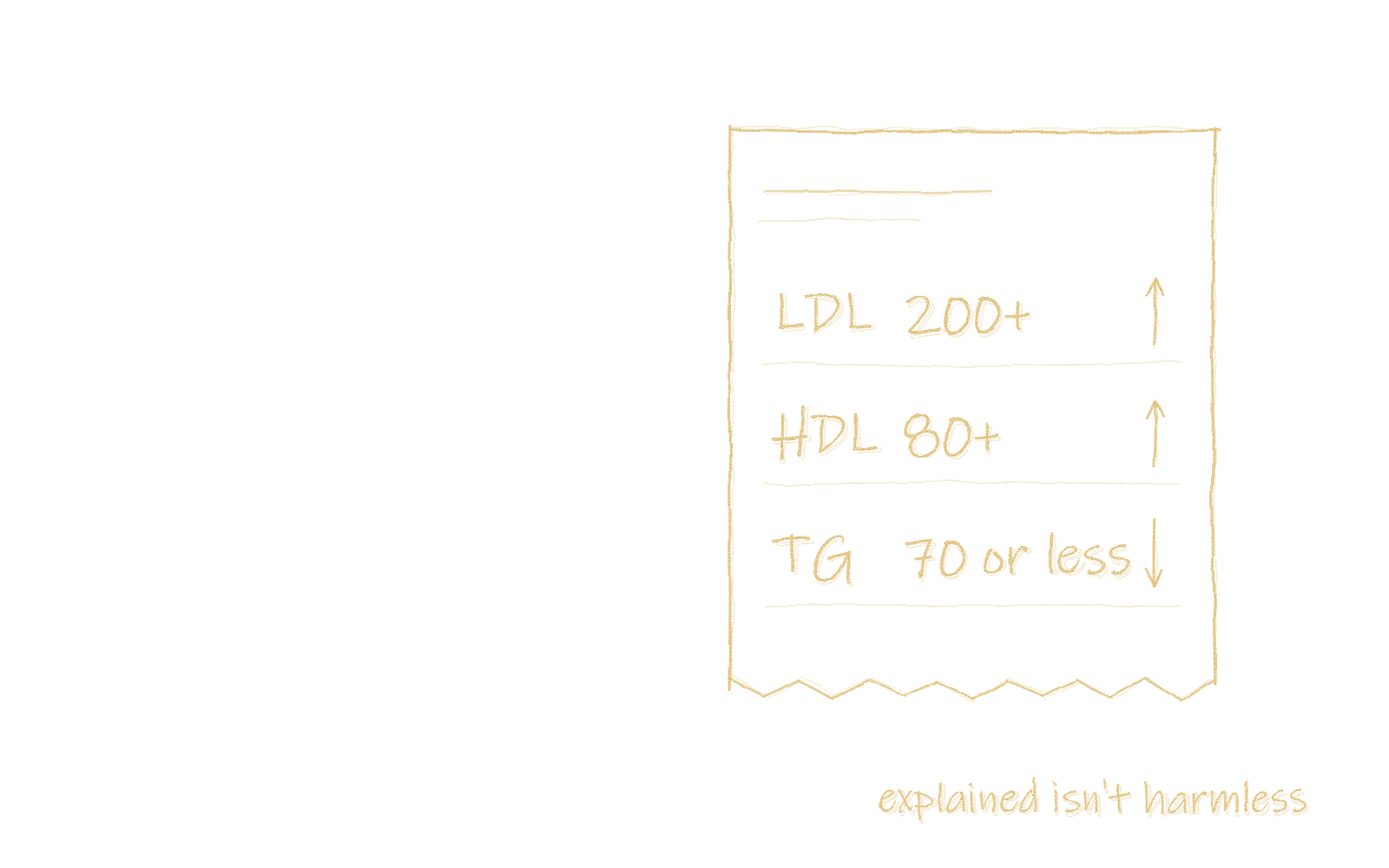
A lean mass hyper-responder (LMHR) is someone on a low-carb diet whose blood test shows three things together[1, 2]:
- LDL cholesterol (short for low-density lipoprotein cholesterol) of 200 mg/dL (5.2 mmol/L) or higher
- HDL cholesterol of 80 mg/dL (2.1 mmol/L) or higher
- Triglycerides of 70 mg/dL (0.79 mmol/L) or lower[1]
That’s the WHOLE definition. Despite the name, leanness isn’t one of the three numbers, and neither is the size of the rise[3]. (And “lean mass” has nothing to do with building muscle.) So it’s a checklist with “lean” in the title that never asks how lean you are, and if you find an online “LMHR calculator”, checking this list is all it does.
Now, you’d guess that cut-offs this exact came out of a committee of heart doctors, after years of meetings and at least one argument about the font. They came from a blog.
Bug report #1: Dave Feldman, the software engineer whose LDL cholesterol jumped on a ketogenic diet
The blog belonged to Dave Feldman, a senior software engineer, and yes, he’s the person who coined the name “lean mass hyper-responder”, in a post there in July 2017[1]. In 2015 he got a blood result that was a marker for prediabetes. So he started a low-carb diet, lost 35 pounds, and wrote that it “seemed to improve my health in almost every way”[9, 10]. And then his LDL went from 137 to 271 mg/dL[9] (so just about double).
Here’s how he took it:
“Given how incredibly great I felt the entire time, I was in complete disbelief.”[9]
And this is where he did the most software-engineer thing I can think of. The more he learned about how the body moves fat around, the more it reminded him of work: he wrote that he saw “a distributed network of objects”[9] (which I gather is a software thing). So if the body was a system, then a number that jumped like that was a bug, and he went looking for it. He began testing his own blood every one to two weeks, changing what he ate in between. By his own account people told him over and over that this was too often, and he kept going anyway[9].
And he thought he saw the number run backward: the more fat he’d eaten over the previous three days, the lower his LDL came out[9, 11]. Now, that’s one man’s blood tests, run by him and read by him, so it makes a good story and it’s weak evidence. (His own site says its contributors aren’t doctors and can’t give medical advice[10].)
But by then other people on low-carb diets were sending him their lab results, and in July 2017, on his blog Cholesterol Code, he named the pattern he kept seeing[1]. So a term that now sits in the titles of journal papers started out as a blog post by a software engineer going through his inbox.
So a term that now sits in the titles of journal papers started out as a blog post by a software engineer going through his inbox.
And what did he say about the risk? His site puts it in seven words: “The short answer is: we don’t know.”[12]
Not everyone found that shrug reassuring. Ira Goldberg and colleagues, lipid doctors, answered that line in a paper titled “Ketogenic diets, not for everyone”: “The suggestion that the marked elevations of LDL with these diets might not be harmful is chilling and has the potential to create premature CVD in uninformed patients seeking to control their body weight.”[13]
So at this point there was a name, a blog and an inbox full of other people’s blood tests, and that isn’t much to argue over. Somebody had to actually count.
Please take our short survey: What the 2021 Norwitz paper found about the lean mass hyper responder phenotype
If you only have ten seconds, here’s what the 2021 paper found: 100 of the 548 survey respondents on a carbohydrate-restricted diet met all three cut-offs, a lower BMI went with a bigger LDL rise on average across the people who answered, and the paper itself says none of that implies the pattern is safe[2]. And now the version with the fun details. Emailed lab results can’t tell anyone much on their own, so in January 2020 Feldman put a questionnaire online. He called it the Cholesterol Super Survey (its real name, and honestly a pretty good one), advertised it on social media, and asked people on low-carbohydrate diets about their height, their weight, what they ate, and their lipid levels (LDL-C levels, HDL and triglycerides) from before and now[2]. Then he analyzed the answers with Nick Norwitz, Adrian Soto-Mota, Tro Kalayjian and David Ludwig in a 2021 paper[2].
They ended up with 548 adults on a carbohydrate-restricted diet, eating no more than 130 g of carbohydrate a day and taking no statin or other cholesterol-lowering drug[2]. And 100 of them (18%) met all three cut-offs, with LDL averaging 320 mg/dL[2]. The other thing they found is the bit that matches the first word of the name: the LDL rise was inversely related to BMI, which is the paper’s way of saying that, across the people in that survey, a lower BMI went with a bigger LDL rise on average[2].
The obvious guess here is that these 100 were just people whose cholesterol had always run high, and the diet had little to do with it. Well, as a group, they weren’t. Before the diet, those 100 people had LDL like the other survey respondents’[2].
But look at who was answering. If you put a survey online about cholesterol changing on a low-carb diet, you’d expect a good share of the people who answer to be ones whose cholesterol changed. And the authors were plain about that. People chose to answer and reported their own numbers, and the paper’s last sentence reads, “This study should not be interpreted as implying cardiovascular safety of the LMHR phenotype.”[2]
So how common are LMHRs? Nobody knows. The 18% comes from people who chose to answer[2], and when the same team went through a large US health survey for a 2022 case report, they found just 3 people who met all three cut-offs, out of 70,310[14]. The Cholesterol Super Survey says 18% of the low-carb eaters who chose to answer, and the big US health survey says 3 people out of 70,310 in the general population. Those two figures are a looong way apart, which is roughly what “nobody knows” looks like in numbers.
The Cholesterol Super Survey says 18% of the low-carb eaters who chose to answer, and the big US health survey says 3 people out of 70,310 in the general population.
Still, a pattern that seems to pick out slimmer people on very few carbs is asking for an explanation, and Feldman had been carrying one around since the blog days.
Out for delivery: The lipid energy model and why LDL might rise in LMHRs on a low-carbohydrate ketogenic diet
Feldman’s hunch about the cause was already in his 2017 post[1], and in 2022 Norwitz, Feldman and colleagues turned it into the lipid energy model, published as a hypothesis[7]. And I mean that literally, because “Hypothesis” is the type of article it is. So nobody ran an experiment for this one. It’s an idea, written down carefully enough that other people can go and test it.
Picture a particle called VLDL as a delivery truck. The liver loads it with fat (triglycerides, or TG in the papers) and sends it out to the muscles and other tissues, which unload it. An unloaded truck is remodeled into an LDL particle[1, 7]. Now, a lean person on a very low-carb diet has little stored carbohydrate or body fat to fall back on, so the body relies more on these deliveries. In the model, that means more emptied trucks on the road (high LDL) and faster unloading (low triglycerides), with higher HDL as well[7]. (Whether a road full of emptied trucks is hard on the road is a different question, and the model doesn’t answer it. That part still needs studying.)
It’s a tidy picture. And it does the thing a hypothesis is supposed to do, which is stick its neck out: it predicts bigger changes with stricter carbohydrate restriction, lower body fat and higher energy use[7]. So if leaner people DON’T get the bigger rise, the trucks have a problem.
The middle one sounds like the name itself: leaner people, bigger rise. And that one has been looked at, using BMI, by (you may have guessed) the same group.
41 trials walk into a spreadsheet: Whether low-carb raises LDL more in lean people, and whether saturated fat explains it
On average, in the 41 trials this group pooled in 2024, the trials with a lower average BMI saw the bigger rise. What they did is called a meta-analysis, which means nobody got fed anything new. The same research group gathered up randomized trials of low-carb diets that had already been run (1,379 people in all) and grouped them by their participants’ average BMI[4].
Change in LDL cholesterol on the low-carb diet (mg/dL). The dashed line is zero.
Where a trial’s average BMI was under 25, LDL rose by 41 mg/dL. From 25 to just under 35, it didn’t change. At 35 or more, it fell by 7[4]. So it’s a low-carb diet in all three rows, and the LDL goes up, stays put or dips, in line with the average BMI of the people in the trial.
That looks like a point for the trucks, but there are two catches. It’s the group that named the pattern doing the counting (so the people with the idea are also the ones keeping score). And a trial’s average can’t show by itself what happens inside each person (the authors did also check pooled data on individuals)[4]. So these trial averages are no forecast for your own body.
And what about saturated fat? That’s where my mind went first, because “cholesterol went up on a diet with a lot of fat in it” pretty much writes its own headline. Well, the same analysis checked, and the amount of saturated fat in a trial’s diet was not significantly linked to the change in LDL[4]. What the paper did find is right there in its title: increased LDL “in adults with normal but not high body weight”[4]. Still, that’s one analysis of trial averages, so it doesn’t settle what saturated fat does for any one person.
One trial did put the food in front of people directly. In a Swedish feeding trial, LDL rose in all 17 healthy, normal-weight young women who completed it, after four weeks of a ketogenic low-carbohydrate high-fat diet[19]. But it had no heavier group, so it can’t show that lean women rise more. Its authors wrote that the rise “should be a cause for concern”[19].
And the critics doubt the pattern is a distinct thing at all. The survey’s data and code were posted publicly[2], which is to the authors’ credit, and somebody took them up on it. Jeff Moore and three co-authors re-ran the public data and found the evidence for the pattern “weak”[16]. Why weak? Well, by their sums, BMI and the triglyceride-to-HDL ratio together explained only about 7% of the differences in people’s LDL rises[16] (so about 93% of it comes down to something ELSE). The nutrition scientist Kevin Klatt called the identity of a true phenotype “questionable without more representative data,” while allowing that leanness might explain some of the differences[20].
OK, but suppose the pattern is real and the trucks explain every bit of it. Then you’d know why the LDL went up. You still wouldn’t know whether it’s safe, and that’s what the rest of this post is about.
Is elevated LDL cholesterol safe for a lean mass hyper responder? What we know about atherosclerosis, and what we don’t
Nobody knows, and no study has shown that it is[2, 4]. What exists is a large case for worry, and one camp’s argument that this group was never studied.
If I were trying to work out whether an LDL this high is risky, the first thing I’d want to know is what high LDL has done in the people who have been studied. Then I’d want to know whether there’s a good reason to think this group is different. So I’ll take those in order.
Start with the worry. A 2017 European consensus panel, pooling studies of more than 2 million people, concluded that LDL causes heart disease, with harm that appears to grow with how high LDL is and for how long[8] (The keto CTA study (KETO-CTA): what it found about LDL cholesterol, ApoB and coronary plaque). Then there’s an inherited condition to compare with. In the common inherited form of high cholesterol, familial hypercholesterolemia (FH), untreated LDL runs at roughly 174 to 464 mg/dL. The survey’s LMHR average of 320 sits inside that range[2, 8].
Michael Mindrum, an internist who consults for the low-carb website Diet Doctor, made that point in a 2022 letter: whatever the cause, this LDL is “similar to LDL cholesterol levels found in familial hypercholesterolemia”[15]. The authors’ reply conceded more than you might expect[17]:
“we acknowledge that extreme elevations of LDLc with a low-carbohydrate diet may confer major ASCVD risk, despite any associated benefits for metabolic syndrome, in the small minority of people with this response.”[17]
(ASCVD stands for atherosclerotic cardiovascular disease: heart disease and other harm from plaque in the arteries, coronary artery disease included.) And the two sides didn’t stay on opposite pages for long. In November 2022, Mindrum was one of ten authors, with Nick Norwitz, Adrian Soto-Mota, Matthew Budoff and the lipid researcher Ronald Krauss among them, of an editorial saying these LDL levels “deserve urgent clinical attention and further research.”[18]
Now the second question, whether this group is different. The LMHR camp’s answer, as Norwitz put it in 2026, is that the big body of LDL evidence never studied lean mass hyper-responders[23]. And in the 2021 paper, five people with very high LDL all tested negative for FH genes, which makes the classic inherited form unlikely but doesn’t say whether their LDL is risky[2, 15].
Two more pieces lean toward caution. The first needs one new word. ApoB is a protein carried one per LDL-type particle, so it works as a particle count[8]. A 2019 genetic study found that, for the same drop in ApoB, genes that mainly lowered triglycerides and genes that mainly lowered LDL cut heart risk by a similar amount[21]. Put that next to the delivery trucks and you get the critics’ sharpest point: the route the extra particles take may not matter. The count might. (That’s my reading; neither paper is about LMHR.)
The second piece is from 2026. Doctors in Munich described three people sent to them for suspected FH after a ketogenic diet, none consistently meeting all the LMHR cut-offs, whose LDL and ApoB fell substantially when some carbohydrate came back[22]. They wrote:
“Because ApoB-containing lipoproteins are causal in atherosclerosis, severe diet-induced ApoB elevation should not be assumed to be benign.”[22]
What about looking straight at the arteries? That was the idea behind KETO-CTA, a study that used coronary CT angiography, a heart scan that looks for plaque, in people with LMHR-like cholesterol. Two of its papers have had different fates. The 2024 snapshot, by Budoff and colleagues, found no more plaque than in matched people with much lower LDL, but it can’t show safety. That paper has not been retracted. The study’s 2025 one-year paper, by Soto-Mota and colleagues, was retracted in 2026 “at the request of the authors and the Editors” (the keto CTA study post)[3, 24, 25].
One last thing to know about the argument: both camps have interests, from diet books and Patreon support on the LMHR side to drug-company fees for Mindrum and several of the European panelists[2, 8, 15].
The rest of the blood panel is what the paper calls good, though: What the studies say about metabolic health markers in lean mass hyper-responders
A lot of the argument for treating this group as a special case rests on the rest of the blood panel. So here’s what the papers themselves say about it, and, just as important, where they stop.
In the 2021 survey, the triglyceride-to-HDL ratio mattered as well as BMI. The paper calls a low ratio “a marker of good metabolic health”, and a low ratio went with larger LDL increases[2]. So here’s the odd part: in that survey, the people with what the paper treats as good metabolic health markers tended to be the ones whose LDL went up more.
And the lipid energy model builds that right in. One of its predictions is that a carbohydrate-restricted diet in what the authors call “lean metabolically healthy persons with high aerobic energy demands” would bring on the pattern[7]. That’s a prediction about who gets the pattern. It isn’t a claim about what happens to them afterwards.
And the 2024 KETO-CTA paper, the one by Budoff and colleagues that has not been retracted, describes its own participants as “metabolically healthy individuals” with diet-induced LDL-C of 190 mg/dL or higher[3]. That’s the paper describing who it recruited, and it looked at them only once.
So does a good set of other markers change what the LDL means? Helpfully, the two camps laid out the possibilities themselves. Mindrum’s letter says that with all other cardiovascular risks being equal, the starting assumption is “the higher the apoB, the higher the cardiovascular risk”[15]. The authors’ reply offers two options: that the link between LDL particle number and heart disease has “a similar slope throughout the population”, or that the particles are “inherently less dangerous on a background of low insulin resistance, chronic inflammation, and oxidative stress”[17]. And then it says the question “will require long-term prospective studies”[17].
I found no study in this post’s sources that has run that test. So for now, the other markers are a reason researchers want this group studied, and none of the studies here show that they make LDL this high harmless.
The case reports: when a ketogenic diet looks like familial hypercholesterolemia
Alongside the survey, some of what has been published about this pattern comes from case reports, which is when doctors write up a few of their own patients. A case report can’t tell you how common something is or what it leads to, but it does show you what actually turns up in a clinic.
The earliest ones I have here came from lipid doctors in New York and Ontario. Goldberg and colleagues described five patients in the paper called “Ketogenic diets, not for everyone”, and concluded that “underlying dyslipidemias may only become manifest as a result of a high fat diet”[13].
The 2021 paper had five patients of its own, seen at a primary care practice. They were eating under 25 grams of carbohydrate a day, their LDL ran from 239 to 665 mg/dL, and genetic testing for familial hypercholesterolemia was negative in each case[2]. When carbohydrate was added back, LDL fell in all five[2].
In 2022 the same group published a single case report, and the point is right there in its title: in their patient, the hypercholesterolemia of this phenotype presented in the context of a low saturated fat carbohydrate-restricted diet[14]. It’s one person, so it shows that this can happen, not how often.
And in 2026 the Munich doctors described three people referred to them for suspected FH, under the title “Severe diet-induced hypercholesterolemia mimicking familial hypercholesterolemia”[22]. Their LDL peaked between 364 and 682 mg/dL, and it came down substantially after what the authors call modest carbohydrate reintroduction, without cholesterol-lowering drugs[22].
Why does the comparison with FH keep coming up? Because the numbers overlap, as the section on risk showed. The European consensus statement covers two forms, heterozygous and homozygous familial hypercholesterolemia, and says that in both, the extent of atherosclerosis and the risk of cardiovascular events are proportional to how high LDL is and for how long[8]. The case reports show an elevation in LDL cholesterol of that size arriving with a diet, and easing after carbohydrate was added back, in the five patients of the 2021 paper and, as the Munich doctors report it, in their cases too. But none of these reports follows what happens to the heart over years.
What to do with your own numbers
So, back to those three numbers, and the phrase that came up when you searched them.
Take the name one piece at a time. “Lean” isn’t in the criteria, and in the studies it meant a lower BMI, not measured body fat[2, 3, 4, 16]. “Hyper-responder” describes how LDL responds to a diet. It doesn’t describe what that LDL does to arteries. Both camps agree nobody can yet claim this LDL is safe[2, 15]. Even the lipid energy model paper, which Feldman co-wrote, calls treating these particles as plaque-forming “the conservative clinical perspective”[7].
If those three numbers are yours, here’s something for today. Copy your LDL, HDL and triglycerides from your latest blood test onto one page, with the date and a line about how you were eating then. If even that’s too much today, set a reminder to ask for a copy of your results. Then bring the page to your doctor, who can see the rest of your picture in a way a three-number label can’t.
And when the next headline about lean mass hyper-responders comes along, ask it two things: which definition it used, and whether it measured LDL or actual plaque and heart disease. The 2023 headline that said keto doubles heart attack risk gets the same treatment in the keto heart attack study post. More questions about food and blood tests, read the same way, are on the Body page.
If you’d like to read more on this:
- More from the Body page
- The keto CTA study and its retraction
- Does keto double heart attack risk?
- Is spinach high in iron?
Before you close the tab: Quick answers about lean mass hyper-responders
How does the ketogenic diet affect cholesterol levels?
In the 41 trials one research group pooled in 2024, it depended on who was in it. On a low-carbohydrate diet, LDL rose by 41 mg/dL on average where a trial’s average BMI was under 25, didn’t change from 25 to just under 35, and fell by 7 at 35 or more[4]. In a Swedish trial of 17 normal-weight young women following a ketogenic diet for four weeks, the LDL cholesterol increase showed up in all of them[19]. Those are averages and one small trial, so they’re no forecast for any one person.
Can you be lean and still have high cholesterol?
Yes, being lean doesn’t rule out high LDL. In fact, in the trials pooled in 2024 the increases in LDL cholesterol on a low-carb diet were bigger, on average, in the trials with a lower average BMI[4]. The lipid energy model is one group’s attempt to explain why lean individuals might see that, and it’s still a hypothesis[7]. There’s also an inherited form of high cholesterol, familial hypercholesterolemia[8]. Sorting out which is which is a job for your own doctor.
What characteristics are commonly seen in lean mass hyper-responders?
The defining characteristics are just three blood results on a low-carb diet: elevated LDL-C levels (200 mg/dL or higher), HDL, or high-density lipoprotein cholesterol, of 80 mg/dL or higher, and low TG (triglycerides of 70 mg/dL or lower)[1, 2]. In the 2021 survey, the people who fit also had a lower BMI as a group[2]. That paper treats a low triglyceride-to-HDL ratio as a marker of good metabolic health[2], which is a nice thing to say about a ratio and says nothing about whether the LDL is safe.
Is an LDL cholesterol level of 136 considered high?
I can’t answer that one from the research here, because none of it gives a general cut-off for “high”. What I can tell you is that 136 mg/dL is below the 200 mg/dL where the lean mass hyper-responder checklist starts[1, 2], and that checklist is a label, not a safety line. Whether a number like 136 matters for you is a question for your own doctor, who can see the rest of your picture.
Can reintroducing carbohydrates lower LDL cholesterol in lean mass hyper-responders?
In the handful of patients described here, LDL did fall when some carbohydrate was added back. That happened in all five patients in the 2021 paper[2], and in the three people in Munich, whose LDL and ApoB fell substantially, though none of those three consistently met all the LMHR cut-offs[22]. That’s eight people, all of them seen by doctors, so it’s a report of what happened to them and not a plan. If the numbers are yours, take them to your own doctor.
How is cardiovascular risk assessed in lean mass hyper-responders?
As far as the research here goes, there’s no settled way of assessing it for this group, and none of these studies show that LDL this high is harmless[2, 4]. So far, researchers have looked at LDL itself, at ApoB, which works as a count of LDL-type particles[8], and at heart scans for plaque in the KETO-CTA study, whose 2024 paper can’t show safety and whose 2025 one-year paper was retracted in 2026[3, 24, 25]. For one person, that assessment belongs with their own doctor.
The numbers, if you want them
- The interests, spelled out: Norwitz co-wrote a Mediterranean low-carbohydrate diet cookbook and says he donates the royalties, and Feldman receives membership contributions (through Patreon, for example)[2]. Mindrum reports consulting fees from Diet Doctor and consulting and speaker fees from a drug company[15].
- The 2017 consensus: it drew on meta-analyses covering more than 200 studies of three kinds: prospective cohort studies, which follow people over time, Mendelian randomization studies, which use genes people were born with as a natural experiment, and randomized trials[8].
- The 2022 editorial: its full title is “Elevated LDL-cholesterol levels among lean mass hyper-responders on low-carbohydrate ketogenic diets deserve urgent clinical attention and further research”[18].
- KETO-CTA: the “CTA” is coronary computed tomography angiography, the heart scan described above[3].
- The 2021 survey: the paper is cited as Norwitz NG and colleagues; it went online in November 2021 and carries a 2022 date. In it, people with the lowest BMI and the best triglyceride-to-HDL ratio had a median LDL rise of 135 mg/dL; people at the opposite corner rose by 35. Before the diet, median LDL was 133 mg/dL for the 100 who met the cut-offs and 135 for the rest[2].
- Moore’s re-analysis: the “about 7%” is their figure for BMI and the triglyceride-to-HDL ratio together[16].
- The 2024 meta-analysis: trials lasted an average of 19.4 weeks, and saturated fat intake wasn’t significantly linked to the change in LDL[4].
- The Swedish trial: LDL rose by 1.82 mmol/L (about 70 mg/dL) on average[19].
- The genetic study: 654,783 people, comparing risk per 10 mg/dL lower ApoB[21].
- The Munich cases: LDL peaked between 364 and 682 mg/dL[22].
- Still to come, from outside the LMHR group: Penn State’s 28-day keto trial in adults with a BMI of 18.5 to 22 or 30 to 35 (finished March 2026, 25 people)[5], and Washington University’s tracer study of normal-weight “responders” (aiming for 100 people by late 2030, and yes, that says 2030)[6].
Sources
- Dave Feldman. “Are you a Lean Mass Hyper-responder?” CholesterolCode.com, 3 July 2017. https://cholesterolcode.com/are-you-a-lean-mass-hyper-responder/
- Norwitz NG, Feldman D, Soto-Mota A, Kalayjian T, Ludwig DS. “Elevated LDL Cholesterol with a Carbohydrate-Restricted Diet: Evidence for a ‘Lean Mass Hyper-Responder’ Phenotype.” Curr Dev Nutr 2022;6(1):nzab144 (online 30 Nov 2021). https://doi.org/10.1093/cdn/nzab144 · https://pmc.ncbi.nlm.nih.gov/articles/PMC8796252/ · data and code: https://github.com/AdrianSotoM/LMHR
- Budoff M, Manubolu VS, Kinninger A, et al. “Carbohydrate Restriction-Induced Elevations in LDL-Cholesterol and Atherosclerosis: The KETO Trial.” JACC Adv 2024;3(8):101109. https://doi.org/10.1016/j.jacadv.2024.101109 · https://pmc.ncbi.nlm.nih.gov/articles/PMC11450898/
- Soto-Mota A, Flores-Jurado Y, Norwitz NG, Feldman D, Pereira MA, Danaei G, Ludwig DS. “Increased low-density lipoprotein cholesterol on a low-carbohydrate diet in adults with normal but not high body weight: A meta-analysis.” Am J Clin Nutr 2024;119(3):740–747. https://doi.org/10.1016/j.ajcnut.2024.01.009
- “The Ketogenic Diet, Blood Lipids, and Heart Health in Healthy Adults With Differing BMI.” Penn State, NCT06515912. https://clinicaltrials.gov/study/NCT06515912
- “Mechanism of Ketogenic Diet-Induced Hypercholesterolemia.” Washington University, NCT06894004. https://clinicaltrials.gov/study/NCT06894004
- Norwitz NG, Soto-Mota A, Kaplan B, Ludwig DS, Budoff M, Kontush A, Feldman D. “The Lipid Energy Model: Reimagining Lipoprotein Function in the Context of Carbohydrate-Restricted Diets.” Metabolites 2022;12(5):460. https://doi.org/10.3390/metabo12050460 · https://pmc.ncbi.nlm.nih.gov/articles/PMC9147253/
- Ference BA, Ginsberg HN, Graham I, et al. “Low-density lipoproteins cause atherosclerotic cardiovascular disease. 1.” European Atherosclerosis Society Consensus Panel. Eur Heart J 2017;38(32):2459–2472. https://doi.org/10.1093/eurheartj/ehx144 · https://pmc.ncbi.nlm.nih.gov/articles/PMC5837225/
- Dave Feldman. “Cholesterol Code – Part I : More Fat, Less LDL-C.” CholesterolCode.com, June 2016. https://cholesterolcode.com/cholesterol-code-part-i/
- Dave Feldman. “About.” CholesterolCode.com. https://cholesterolcode.com/about/
- Dave Feldman. “Cholesterol Code – Part III : The Divergence.” CholesterolCode.com, 22 June 2016. https://cholesterolcode.com/cholesterol-code-part-iii-the-divergence/
- Dave Feldman. “Lean Mass Hyper-responders.” CholesterolCode.com. https://cholesterolcode.com/lmhr/
- Goldberg IJ, Ibrahim N, Bredefeld C, et al. “Ketogenic diets, not for everyone.” J Clin Lipidol 2021;15(1):61–67 (online 31 Oct 2020). https://doi.org/10.1016/j.jacl.2020.10.005 · https://pmc.ncbi.nlm.nih.gov/articles/PMC7887024/
- Norwitz NG, Soto-Mota A, Feldman D, et al. “Case Report: Hypercholesterolemia ‘Lean Mass Hyper-Responder’ Phenotype Presents in the Context of a Low Saturated Fat Carbohydrate-Restricted Diet.” Front Endocrinol 2022;13:830325. https://doi.org/10.3389/fendo.2022.830325 · https://pmc.ncbi.nlm.nih.gov/articles/PMC9048595/
- Mindrum MR. “Let’s Be Clear about Expected Cardiovascular Risk.” Curr Dev Nutr 2022;6(5):nzac042. https://doi.org/10.1093/cdn/nzac042 · https://pmc.ncbi.nlm.nih.gov/articles/PMC9154254/
- Moore JM, Diefenbach D, Nadendla M, Hiebert N. “Evidence for a Lean Mass Hyperresponder Phenotype Is Lacking…” Curr Dev Nutr 2022;6(5):nzac043. https://doi.org/10.1093/cdn/nzac043 · https://pmc.ncbi.nlm.nih.gov/articles/PMC9154228/
- Ludwig DS, Norwitz NG, Feldman D, Soto-Mota A, Kalayjian T. “Reply to M Mindrum and J Moore et al.” Curr Dev Nutr 2022;6(5):nzac029. https://doi.org/10.1093/cdn/nzac029 · https://pmc.ncbi.nlm.nih.gov/articles/PMC9154284/
- Norwitz NG, Mindrum MR, Giral P, et al. “Elevated LDL-cholesterol levels among lean mass hyper-responders on low-carbohydrate ketogenic diets deserve urgent clinical attention and further research.” J Clin Lipidol 2022;16(6):765–768. https://doi.org/10.1016/j.jacl.2022.10.010
- Burén J, Ericsson M, Damasceno NRT, Sjödin A. “A Ketogenic Low-Carbohydrate High-Fat Diet Increases LDL Cholesterol in Healthy, Young, Normal-Weight Women: A Randomized Controlled Feeding Trial.” Nutrients 2021;13(3):814. https://doi.org/10.3390/nu13030814 · https://pmc.ncbi.nlm.nih.gov/articles/PMC8001988/
- Kevin C. Klatt. “Keto, LDL-C, & LMHR, Oh My!” Substack, 13 Apr 2025. https://kcklatt.substack.com/p/keto-ldl-c-and-lmhr-oh-my
- Ference BA, Kastelein JJP, Ray KK, et al. “Association of Triglyceride-Lowering LPL Variants and LDL-C-Lowering LDLR Variants With Risk of Coronary Heart Disease.” JAMA 2019;321(4):364–373. https://doi.org/10.1001/jama.2018.20045 · https://pmc.ncbi.nlm.nih.gov/articles/PMC6439767/
- Lechner B, Lechner K, Rubinstein G, Parhofer KG, Vogt A. “Severe diet-induced hypercholesterolemia mimicking familial hypercholesterolemia in atypical lean mass hyper-responders on ketogenic diets: A case series.” J Clin Lipidol (online 11 Sep 2026). https://doi.org/10.1016/j.jacl.2026.09.002
- Nick Norwitz. “We Want to Retract Our Own Paper.” Stay Curious Metabolism (Substack), 5 Mar 2026. https://staycuriousmetabolism.substack.com/p/we-want-to-retract-our-own-paper
- Soto-Mota A, Norwitz NG, Manubolu VS, et al. The KETO-CTA one-year (longitudinal) paper. JACC Adv 2025;4(7):101686. RETRACTED. https://doi.org/10.1016/j.jacadv.2025.101686 · https://pubmed.ncbi.nlm.nih.gov/40192608/
- Retraction notice for[24]. JACC Adv 2026;5(5):102824 (May 2026). https://doi.org/10.1016/j.jacadv.2026.102824 · https://pubmed.ncbi.nlm.nih.gov/42206798/