“Can you study – really study – for 10 minutes?” That’s the bet a university student says he made with himself in the late 1980s, and years later, in a booklet about what came of it, he called the bet “as helpful as it was humiliating”[1]. (Not ten hours. Ten minutes. Most of us have had that kind of afternoon.)
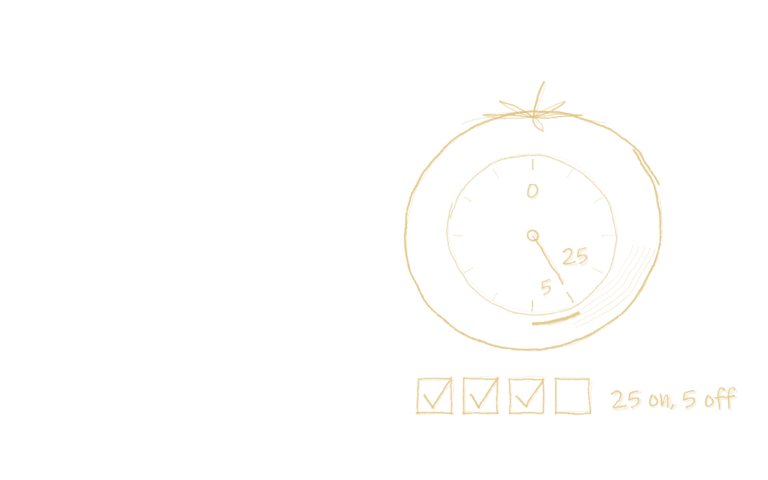
The student was Francesco Cirillo, and by his account that bet grew into the Pomodoro technique[1, 6]. He wanted something objective to keep score, and what he found was a tomato-shaped kitchen timer[1, 6]. So yes, the famous method is named after the Italian word for tomato, because of a kitchen gadget. (This is one of several time-and-focus questions on the Work page.)
Decades and a lot of productivity apps later, the recipe is everywhere: work in short bursts of 25 minutes, take a five-minute break, and repeat. And it gets recommended with a LOT of confidence, usually next to a promise that it’ll boost productivity and help you work smarter and get things done. So you’d think somebody had checked whether it beats the obvious alternative, which is just taking a break whenever you feel like one.
Well, a few people did check, and it took a while. So here’s what I’m going to argue in this post: the Pomodoro technique got famous first and got tested waaay later, and the testing so far is three small experiments that didn’t find it getting more work done than breaks you pick yourself[2, 3, 4]. That doesn’t make the timer useless. But it did make me wonder what the timer is actually for, so I went and read Cirillo’s own booklet.
Ten minutes, or possibly two: What is Francesco Cirillo’s Pomodoro technique?
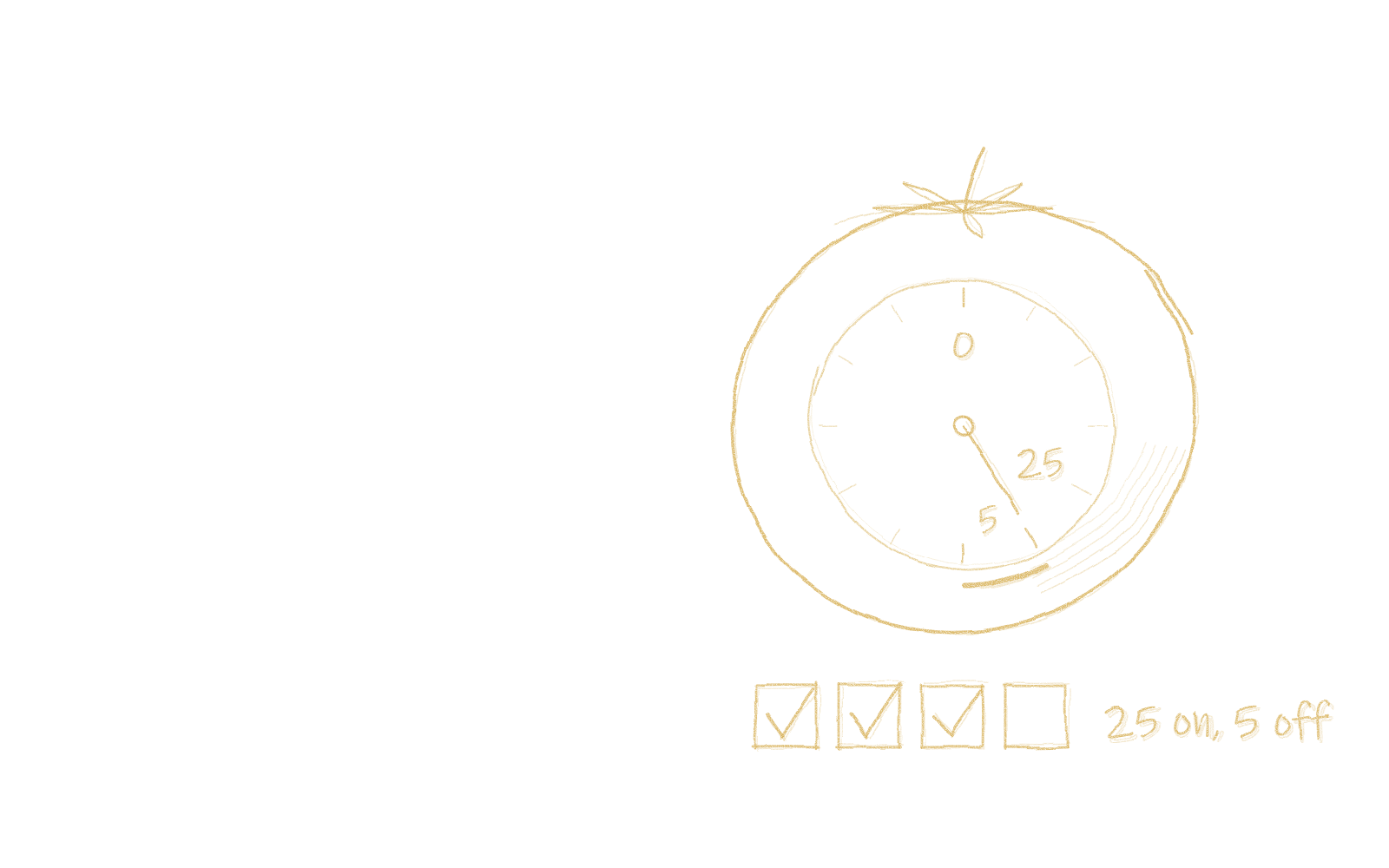
The Pomodoro technique is a time-management strategy built around a timer, and the short version is working in 25-minute intervals with short breaks in between. You set it for 25 minutes and focus on one task, take a break of about five minutes when it rings, and take a longer break after every fourth round[1]. The rounds are called Pomodoros in the booklet, so a morning’s work might be four of them[1] (or four tomatoes, which I like better). That’s pretty much the whole thing, and it would fit on a sticky note.
Now, about that bet. Cirillo’s 2006 booklet says ten minutes. But the “What is the Pomodoro Technique?” page on the official site now says two[1, 6]. So… which was it? I don’t know, and I’m not sure anyone’s keeping track. But most stories get bigger every time they’re told (the fish, the snowstorm, how far your grandpa walked to school), and this one somehow got smaller. And honestly, the two-minute version is the one most of us would sign up for.
And then the booklet surprised me. I’d assumed the whole point of the timer was focus. But the first goal the booklet sets is to find out how much effort a job takes, by counting the rounds it needs[1]. You write your tasks for the day on a to-do list (the booklet calls it the To Do Today Sheet), and the timer is used to track how many rounds each one really takes[1]. So the timer starts out as a measuring cup. You learn that an essay is a four-tomato job the same way you learn that the drive to your parents’ place is three podcasts long.
They tried an hour, then two hours, then 45 minutes, then ten: How the Pomodoro method settled on a 30-minute round
And the famous 25? I was sure there’d be an experiment behind it, with a lab and a stopwatch and a chart. Well, the booklet doesn’t give a reason for the 25, and the round length came from trying things out. The booklet calls the “traditional” round 30 minutes, which is a 25-minute work block plus a 5-minute break, and it puts the ideal at 20 to 35[1]. And it never says where the 25 came from.
But why 25? Why not 20? Or 40? Who decided? Was there a MEETING?
If there was, it isn’t in the booklet. What the booklet does tell us is how Cirillo’s teams found their own length. They started with hour-long rounds (25 minutes seemed too short at first), moved to 2 hours, then down to 45 minutes, then 10, and finally settled on 30[1]. So they got there the way you find the right temperature in a shower you’ve never used before: too far one way, then too far the other, and eventually you stop touching the handle. That’s experience, not a test. (Work stretching to fill the time you give it has its own name, Parkinson’s law.)
Minutes, as the booklet describes them
So the famous number is a tradition, more or less. And before asking whether it’s the right number, there’s something more basic to check, which is whether short breaks do anything at all.
I clicked the link so you don’t have to: The study that’s supposed to prove short breaks work
Well, short breaks do seem to help a little, with how you feel. But the study that gets linked as proof that taking regular breaks keeps you focused never tested rest breaks at all, only a quick switch to another small task[8], and I’ll get to that one in a second. In 2022, Patricia Albulescu and colleagues gathered up the studies of breaks of ten minutes or less and combined their results (the paper’s title starts with “Give me a break!”, so somebody had fun). Nobody ran a new experiment for this one, they added up other people’s. And they found small gains in energy and small drops in tiredness that were unlikely to be chance. But the gain in performance could have been chance[7].
So a short break seems to make you feel a bit better, and whether it makes you work better isn’t settled. But why would it do one and not the other? Well, the review’s own guess is that for performance, getting over really draining work may take more than a ten-minute break[7].
That’s a pretty modest finding. But one older study gets quoted as proof that short breaks help you stay focused. BetterUp’s page on the technique links a 2011 study and concludes “Based on this research, the Pomodoro Technique keeps you focused with its brief, regular breaks”[5].
Sounds great! So I went and looked at what the 2011 study did. Two researchers, Ariga and Lleras, had people do a long screen-watching task while holding some digits in memory. Some of them were asked to recall the digits now and then during the task, and the others were asked only at the end. Attention held up for the first group and fell steeply for the second[8].
So the “break” in that study was being asked for a few numbers in the middle of the same task. That’s a long way from five minutes of rest, and the study never tested a break schedule at all[8]. (I’d love to watch someone try this at work. “I’m not on a break, I’m recalling digits.”)
So the “break” in that study was being asked for a few numbers in the middle of the same task.
And when another team tried the same idea in 2012, with 498 people, every group’s attention faded about equally[9]. Now, one failed repeat doesn’t erase the first study, so I’d hold both loosely. But neither of them is about the tomato. For that, the timer has to go up against its obvious rival, which is a break whenever you feel like one.
Tomato timer vs. “eh, I’ll stop when I feel like it”: Does working in short bursts help you get more done?
Every med school influencer recommends the Pomodoro technique, but how much have we actually tested it? Did someone run a study, or did we all just agree because the timer was shaped like a tomato?
Turns out, there have been a few small experiments. And in those, people got about the same amount of work done whether they used Pomodoro or just took breaks whenever they felt like it[2, 3, 4].
Now, “a few” means three that I could find, and “people” means Dutch university students. All three experiments come from one research group in the Netherlands, and Anique de Bruin is an author on every one of them[2, 3, 4]. (So if you were picturing labs all over the world racing each other to crack the tomato, it’s more like one group.) And the set-up was about the same each time: some students studied on a fixed timer, and the others took a break whenever they chose.
In 2023, the students were doing their own self-study, on 24 minutes on and 6 off, or 12 on and 3 off, or their own breaks. The fixed-break students got as much done, and the authors read that as the same work done in less time, which is the timer’s best result so far[2].
In 2025, psychology students got exactly two hours, and the timer group did four blocks of 25 minutes with 5-minute breaks in between, which is the classic recipe (a sound told them when to switch). Afterwards everyone rated how much they’d finished, and the students on the timer rated it about the same as the students on their own breaks[3].
And in 2026, everyone read the same long text about groundwater and climate change (which does sound like the kind of reading you’d want a break from). One group stopped for 3 minutes after every 12, and the other stopped whenever they liked. Then they all took a 20-question test on it, and the two groups scored about the same, though the authors warn the test may have been too blunt to show a difference[4].
So neither side got more done, as far as anyone could tell. OK, but maybe the timer makes the hours feel better? Well, here the three studies can’t agree with each other. In 2023, fixed breaks went with less tiredness and more concentration and motivation, while the students who chose their own breaks studied in longer sessions, which went along with more tiredness and distraction[2]. So that’s a point for the tomato.
But in 2025 it tilted the other way. Tiredness rose faster and motivation fell faster on the timer, though overall levels ended up no different[3]. And in 2026, the students who chose their own breaks reported better mood, more energy, concentration and motivation, and the 12-minutes-on, 3-off schedule was mostly seen as too frequent and too short[4] (which, fair, three minutes is barely long enough to find your phone).
So we’ve got a tie on the work and a disagreement on the feelings, all from one kind of person doing one kind of work. And look at what didn’t get tested. All three tested only the timing of the breaks, and not Cirillo’s estimating and record-keeping, which is where his booklet starts. The two later studies also covered a single session each[1, 2, 3, 4]. So what’s been tested is the part with the bell, and the rest of the method hasn’t had its turn in these studies.
So if it helps you, great. But the claim that it works better? We’re gonna need a little more than a guy with a ring light having a productive Tuesday.
We’re gonna need a little more than a guy with a ring light having a productive Tuesday.
The questions the studies skipped: procrastination, ADHD and flow
Procrastination, ADHD and flow are the three questions I’d most want answered, and the studies barely touch procrastination or ADHD, while the one that measured flow found no difference. Every student in these studies sat down for a planned study session[2, 3, 4]. None of the studies looked at shift work, at jobs where someone else decides when you get interrupted, or at working from home with no fixed hours. So if your days never have the same free stretch twice, the research just hasn’t gotten to you yet, and that’s the research’s problem and not yours.
Does it help you stop procrastinating? This is the one I most wanted an answer to, since the whole thing started as a bet about not studying. The only randomized trial I found with a Pomodoro group that measured procrastination is a 2026 preprint, which means other scientists haven’t reviewed it yet[11]. Students with problematic procrastination took one of three five-week online courses, and one of the three added the timer. All three cut the problem by a large amount compared with a waiting list, with no significant difference between them[11]. So… the timer worked? Well, everything worked, including the two courses with no tomato in them, so the trial can’t show what the timer added[11].
My untested guess is that a fixed block makes starting feel more manageable, like the two-minute rule (2 minute rule: two productivity rules with one name, and which one fits you). I looked for a study of whether the timer on its own gets people to sit down and didn’t find one (if you’re running that study, I would genuinely love to read it). And if starting is your whole problem, begin with the long essay on how to stop procrastinating.
Is it good for ADHD? I couldn’t find a trial of the technique on its own in people with ADHD. If trouble with attention is a steady part of your life, your own doctor is the person to ask.
Will the bell break my flow? That’s the worry, right? You finally get going, and then a tomato goes off. Well, the 2025 study measured flow, the feeling of being absorbed, and found no difference[3]. But none of the three compared kinds of task[2, 3, 4], so whether the bell is more annoying in the middle of writing than in the middle of flashcards is something nobody has looked at in these studies.
Some assembly required: How to make this time management technique suit you
To make the timer suit you, pick your own round length, keep to one task per round, decide what the break is for, and let a broken round go. Those are all the tips and tricks I’ve got, and the reason there are so few goes back to the bet. It never asked “can you get more done?” It asked whether he could sit down and really study for ten minutes, with something to keep score. So the timer was for starting, and for keeping count. And nothing in the studies points to a magic number for either one, so you can customize the thing around what you need from it.
Pick a length you can live with. The booklet’s own range is 20 to 35 minutes[1]. So if 25 keeps catching you mid-sentence, try 30. The tomato won’t know.
One task per round. That’s the booklet’s rule[1], and I suspect it’s what keeps a round from turning into 25 minutes of switching tabs with a timer running in the background.
Decide what the break is for before the bell rings. In the 2026 study, about half of the break activities students reported were checking or sending messages on social media[4]. Which is what most of us would do too (one notification, a quick scroll, and there go the five minutes), and nobody needed a study to guess that. If anyone has tested whether it matters, I didn’t find it. But if your five minutes keep turning into twenty, I’d look at the phone first. For the 15 to 30 minute rest after four rounds, the booklet suggests a coffee, a tidy desk or a quick walk, and nothing complex[1].
Let a broken round go. If an interruption stops a round for good, the booklet says it counts as if it had never been set, so you just start the next Pomodoro fresh[1]. And on a day with no steady schedule, that’s kind of freeing. A round is a round, whenever the next 25 minutes turn up.
And since this little has been tested, you may as well try the Pomodoro technique on yourself and keep score. Here’s a week’s worth: write P (a Pomodoro session) on three slips of paper and S (a session in your own rhythm) on three more, draw one before each of six sessions of the same kind of work, and note how much you finished and how you felt. (Yes, this is pulling slips out of a hat. It’s also roughly what “assigned by chance” means in the 2025 and 2026 studies.) Cirillo says mastering the full method takes “seven to twenty days of constant application”[1], so even this tests only the timer.
Free trial, no credit card required: One timer, today
Or start smaller, because you don’t have to optimize your whole week to find out. Pick the thing you’ve been avoiding and try one Pomodoro on it today, which is one 25-minute timer. Before you start, estimate how many Pomodoros the whole job will take. And when the bell rings, notice two things: how much moved, and where your hand went during the break (if it went to your phone, see the 2026 study above, you’ve got company). The phone question has a post of its own, on dopamine detoxes.
And if 25 minutes feels like too much, set it for ten. That’s the bet the booklet says started all of this[1]. And if ten feels like too much, well, the official site says two[6]. If you’d like more everyday time questions, they live on the Work page.
More on time and focus, if you want it:
- More from the Work page
- Parkinson’s law: does work expand to fill the time?
- Does a dopamine detox work?
- How to stop procrastinating, the long essay
The tomato will see you now: Quick answers about using the Pomodoro technique
How do you properly use the Pomodoro Technique?
You pick one task, set a timer for 25 minutes, work on only that until it rings, take a break of about five minutes, and take a longer break of 15 to 30 minutes after every fourth round[1]. In the booklet you also mark an X next to the task each time a round ends[1]. A physical timer, a phone or a Pomodoro app will all do. The official site says mechanical and software timers both help[6], so the tomato-shaped timer is optional (sorry, tomato).
How long should Pomodoro work sessions and breaks be?
The traditional round is 25 minutes of focused work time and a 5-minute break, with 15 to 30 minutes off after every fourth round[1]. But the booklet’s own ideal range is 20 to 35 minutes, and it never says where the 25 came from[1] (I’m still a little bothered by that). The studies tried 24 and 6, 25 and 5, and 12 and 3, and none of them got more work done than breaks the students chose themselves[2, 3, 4].
What should you do during Pomodoro breaks?
Something simple. For the longer break, the booklet suggests tidying your desk, getting a coffee or taking a quick walk, and it says the important thing is not to do anything complex[1]. In the 2026 study, about half of the break activities students reported were checking or sending messages on social media[4], and that paper only counted them, it didn’t test whether it mattered. My guess, and it’s only a guess, is that it’s the kind of break most likely to run long (five minutes of scrolling has never once been five minutes).
What tasks work best with the Pomodoro Technique?
I couldn’t find anyone who has tested that. None of the three experiments compared kinds of task, and all three had university students studying[2, 3, 4]. The booklet does have two rules of its own about size: if a job takes more than five to seven Pomodoros, break it down into smaller tasks, and if it takes less than one, add it to other small ones[1]. It also says the technique shouldn’t be used for things you do in your free time[1], so your Saturday nap is safe from the tomato.
What are the benefits and drawbacks of the Pomodoro Technique?
The best-supported benefit is about how studying feels, and even that one is wobbly: in the 2023 study, students on fixed breaks reported less tiredness and more concentration, and the authors read the result as the same work in less time[2]. But in 2025 tiredness rose faster on the timer, though overall levels ended up no different[3], and in 2026 the students on their own breaks reported better mood[4]. So the usual pitch, that it will increase your productivity by breaking work into chunks, train your brain and keep burnout away, is ahead of the evidence (the pitch got promoted before the studies came in).
When does the Pomodoro Technique not work?
The studies can’t say yet, because all three tested students in a planned study session[2, 3, 4]. They didn’t look at shift work, at jobs where someone else sets your workload and your interruptions, or at days with no fixed hours (so if no two of your weeks look alike, you’re off the map for now). What they do show is that a schedule can be too choppy: 12 minutes on and 3 off was mostly seen as too frequent and too short[4]. And the booklet itself says not to use the technique for free time[1].
Is the Pomodoro Technique effective for people with ADHD?
I couldn’t find a trial of the technique on its own in people with ADHD, so the research can’t say whether it is effective. If trouble with attention is a steady part of your life, your own doctor is the person to ask.
What are some effective time management methods?
This post only checked one, so I’m in no position to rank them. The nearest thing in its sources is a 2026 trial, not yet reviewed by other scientists, where students with problematic procrastination took one of three five-week courses, each with a different behavioral technique, one of them the Pomodoro Technique[11]. All three cut procrastination by a large amount compared with a waiting list, with no significant difference between them, and all three shared the same group sessions, so it can’t show which technique did the work[11]. Which is nice for the students, and a bit annoying for anyone who wanted a winner.
The numbers, if you want them
- 2023[2]: 87 students in their own self-study, on 24 minutes on and 6 off, 12 on and 3 off, or their own breaks. The authors concluded fixed breaks “appeared to have efficiency benefits”, meaning similar task completion in shorter time. I could read only the summary, which doesn’t say whether groups were assigned by chance.
- 2025[3]: Maastricht University psychology students assigned by chance to 25 and 5, a third method or their own breaks; 94 analyzed. The authors say their sample “might have been too small” (points for saying it out loud).
- 2026[4]: 176 students analyzed, assigned by chance. Scores averaged 12.93 with fixed breaks and 12.23 with their own, out of 20, not significantly different; the authors’ range for the true gap includes a modest advantage for the fixed schedule. Social media was 49.64% of reported break activities.
- Breaks review[7]: Albulescu and colleagues, 2022; the performance result rested on 15 samples and 1,132 people. Attention studies: Ariga and Lleras, 2011[8]; Helton and Russell, 2012[9].
- A review that disagrees[10]: a 2025 review of anatomy lessons by Eren Ogut says Pomodoro intervals were “outperforming self-paced breaks”. Of its 32 studies, three were randomized trials with 87 people in all, the size of the 2023 study, and its search ended in May 2023[10, 2]. I couldn’t tell which trials it counted.
- Procrastination trial[11]: Browarczyk and colleagues, 255 university students. I searched PubMed and Europe PMC for it and for ADHD trials; the 2025 study cites one by Dizon and colleagues I couldn’t read[3].
- The fuller test: call a winner only if every session of one style beat every session of the other. With three of each drawn at random, that happens by luck about 1 time in 10 even if the styles make no difference (2 of the 20 possible orders), so treat it as a hint.
Sources
- Cirillo, F. (2006). The Pomodoro Technique (The Pomodoro), version 1.3, 15 June 2007 (English translation; v1.0 dated 19 October 2006). Self-published booklet, not peer reviewed. Copy hosted by the University of Maryland iSchool: https://internal.ischool.umd.edu/wp-content/uploads/2020/12/ThePomodoroTechnique_v1-3.pdf
- Biwer, F., Wiradhany, W., oude Egbrink, M. G. A., & de Bruin, A. B. H. (2023). Understanding effort regulation: Comparing ‘Pomodoro’ breaks and self-regulated breaks. British Journal of Educational Psychology, 93(S2), 353-367. https://doi.org/10.1111/bjep.12593 (PubMed 36859717; abstract read, full text not)
- Smits, E. J. C., Wenzel, N., & de Bruin, A. (2025). Investigating the effectiveness of self-regulated, Pomodoro, and Flowtime break-taking techniques among students. Behavioral Sciences, 15(7), 861. https://doi.org/10.3390/bs15070861
- Goksu, A., Wiradhany, W., & de Bruin, A. B. H. (2026). When to take a break: Comparing effects of systematic short (Pomodoro) and self-regulated breaks on subjective experience and actual learning. Behavioral Sciences, 16(7), 1158. https://doi.org/10.3390/bs16071158
- BetterUp. The Pomodoro Technique: How breaks improve productivity and well-being. Company blog, not peer reviewed. https://www.betterup.com/blog/pomodoro-technique (accessed 30 October 2026)
- Cirillo Company. What is the Pomodoro Technique? pomodorotechnique.com. https://www.pomodorotechnique.com/what-is-the-pomodoro-technique/ (accessed 30 October 2026)
- Albulescu, P., Macsinga, I., Rusu, A., Sulea, C., Bodnaru, A., & Tulbure, B. T. (2022). “Give me a break!” A systematic review and meta-analysis on the efficacy of micro-breaks for increasing well-being and performance. PLoS ONE, 17(8), e0272460. https://doi.org/10.1371/journal.pone.0272460
- Ariga, A., & Lleras, A. (2011). Brief and rare mental “breaks” keep you focused: deactivation and reactivation of task goals preempt vigilance decrements. Cognition, 118(3), 439-443. https://doi.org/10.1016/j.cognition.2010.12.007
- Helton, W. S., & Russell, P. N. (2012). Brief mental breaks and content-free cues may not keep you focused. Experimental Brain Research, 219, 37-46. https://doi.org/10.1007/s00221-012-3065-0
- Ogut, E. (2025). Assessing the efficacy of the Pomodoro technique in enhancing anatomy lesson retention during study sessions: a scoping review. BMC Medical Education, 25, 1440. https://doi.org/10.1186/s12909-025-08001-0
- Browarczyk, W. M., Kowalski, J., Pietruch, M., Piwinska, J., Wypych, M., & Michalowski, J. M. (2026). Comparative efficacy of CBT protocols with different behavioral techniques for procrastination: a randomized controlled trial. PsyArXiv preprint, not peer reviewed. https://doi.org/10.31234/osf.io/245au_v1
- The 3-3-3 method, often credited to Oliver Burkeman; described in news and newsletter coverage. No primary source confirmed.