Say you find a habit tracker printable on a Sunday night, print it and stick it on the fridge. Monday gets a tick, and so does Tuesday, and by the next Sunday there are seven ticks in a row and the page looks so good you kind of want to show someone. Then a very long Tuesday happens and that box stays empty. On Wednesday the gap is the first thing you see when you go for the milk. By Friday you’ve stopped looking, and a month later the sheet is somewhere under a takeaway menu. (I wrote a long essay on why we put things off at all, in case the tick boxes are hiding something you keep avoiding.)
So what went wrong? Well, the obvious answer is that you missed a day, the streak broke, and the habit went with it. And that sounded right to me too, because it’s what every app with a streak counter has been telling us for years. But did anyone actually CHECK what one missed day does to a new habit? Turns out somebody did, in a study published in 2010, and the answer was: very little[1].
So that’s my argument for this post: I don’t think the missed Tuesday is what finished off that sheet. I think it was the sight of the broken row. The research can’t prove that part for me (I’ll show you how far it goes), but it was enough to make me want a different sort of sheet.
So here it is, a free printable habit tracker: one habit, twelve weeks, 84 boxes, and no streak counter anywhere on it. When you miss a day, you put a small dot in that box and do the habit the next day. You don’t need an email address to get it.
Download the habit tracker printable (US Letter PDF) · Download it in A4
If your habit is really one task you keep putting off, how to stop procrastinating is a better place to start. New memos go out every Sunday by email.
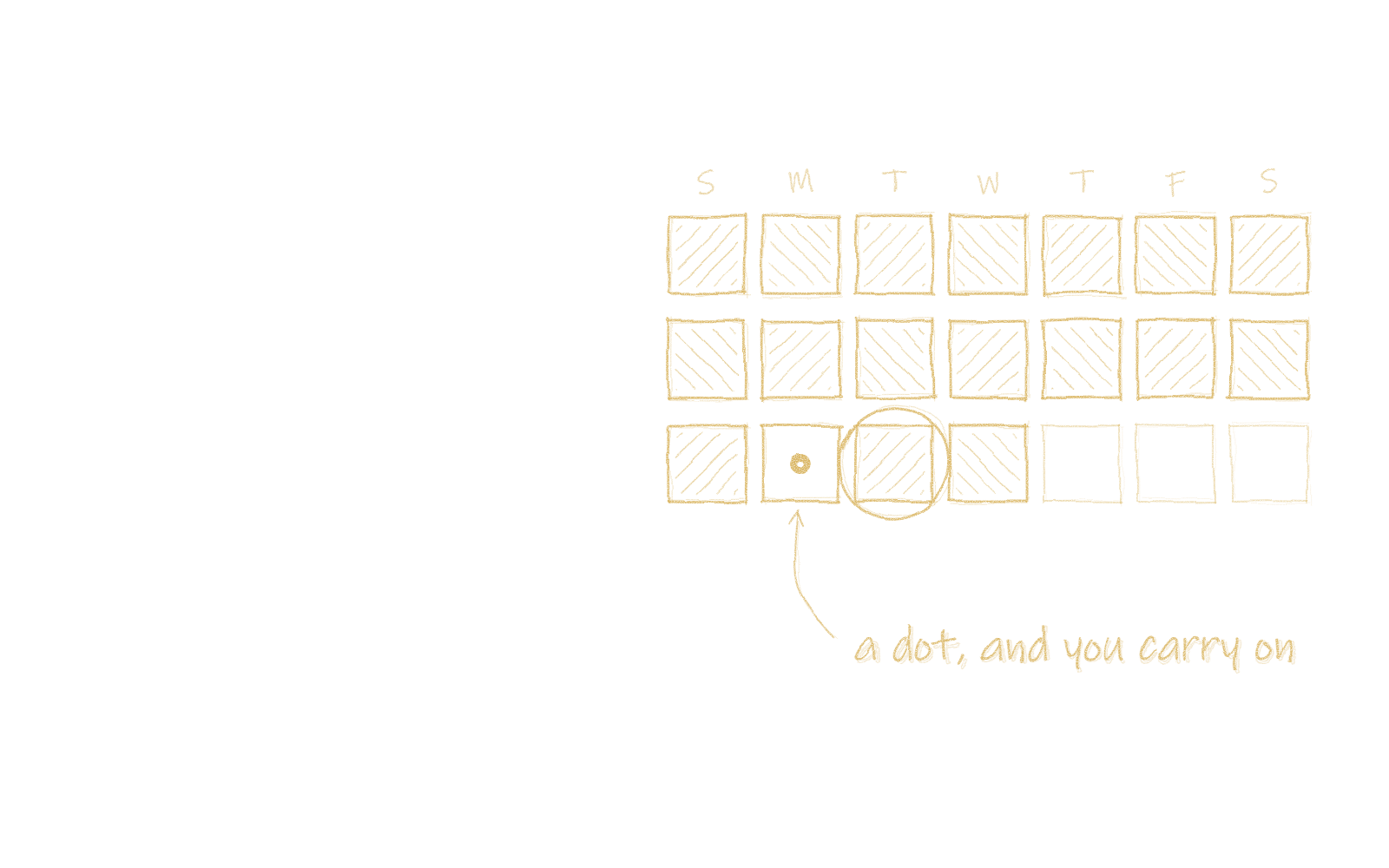
A missed day gets a dot, and you carry on.
No streak count. We count the days you did, not the days you missed.
Error 404, Tuesday not found: What one missed day does to a new habit
Very little, going by the only study I found that checked. The day after a single missed day, a new habit felt only slightly less automatic[1].
OK, but says who? And how do you even measure a habit? Did somebody stand in people’s kitchens with a clipboard?
Well, no clipboard. In a study published in 2010, Phillippa Lally and three colleagues followed 96 volunteers, mostly postgraduate students who had been recruited through a university email[1]. Each of them picked a new healthy eating, drinking or exercise habit that they didn’t already have (eating a piece of fruit with lunch, say, or running for 15 minutes before dinner) and was asked to do it daily for 84 days. And every day they were asked to log on to a website, say whether they’d done it, and rate statements like “I do without thinking”[1]. So that’s what “automatic” means here. Think of the way you brush your teeth without holding a meeting about it first. That’s the feeling the researchers were watching grow.
And people being people, some days got missed. Nobody was asked to skip one (that would’ve been a strange thing to sign up for). It just happened, and that gave the researchers a chance to look at what followed a miss. So they picked out the days when someone missed the habit right after doing it three days running, and looked at what happened to that automatic feeling. There were 140 of those missed days[1].
Now, what would you expect? I’d have bet on a real dent, the kind that takes a week to climb back out of.
And there WAS a dent. It was just a tiny one. The habit felt only slightly less automatic the next day, a drop the authors call “a very small decrease”[1]. The average drop was 0.29 of a point on a scale that goes from 0 to 42. That’s less than 1% of the scale, if my maths is right. So the authors concluded that missing one opportunity “did not materially affect the habit formation process”[1].
The average drop was 0.29 of a point on a scale that goes from 0 to 42.
So if you miss a day, do the thing tomorrow and carry on. As far as this study can tell, one lunch without the fruit, right after three fruit lunches in a row, didn’t cancel those lunches.
Now, that’s good news, and it comes with limits. Because nobody was asked to skip a day, this is only what happened to people who happened to miss, and everything was self-reported. A miss only counted if it came right after three days of doing the habit. And the analysis looked no further than the next day the habit was done again[1]. So it’s one study, about one very particular kind of missed day, and that’s about how much weight I’d put on it.
And what about two misses in a row? That wasn’t tested, here or anywhere I could find. “Never miss twice”, the rule from James Clear (the Atomic Habits author), fits with all of this[4], but it’s his advice, and as far as I can tell nobody has tested it either.
So the missed Tuesday didn’t do much, which makes the sheet under the takeaway menu a bit of a mystery. My guess is that the trouble started on Wednesday morning, at the fridge.
Day 1 (again): Why the design of this free printable habit tracker leaves out the streak
Here’s what I think is going on, and this part is my own reading: the missed day did less harm than the sight of a broken row. That’s why this habit tracker has no streak counter: with no streak on the page, a missed day has nothing to break.
Streaks can keep you going, right up until they break. And if you’ve ever used an app that counts your days in a row, you know the moment I mean: the number goes back to zero, and a cartoon owl looks at you like you’ve let the whole family down.
So is that a real effect, or am I just being dramatic about a fridge? Well, in 2023, Jackie Silverman and Alixandra Barasch reported seven studies of consumer decisions. People shown a log that highlighted an unbroken streak engaged more afterward than people shown a broken one, whatever they had actually done[5]. And “whatever they had actually done” is the strange part. So the look of the log mattered, apart from what sat behind it.
There were two more details. The effect was stronger when people put the break down to themselves and not to something outside them. And the gap between the two groups shrank when people could “repair” a broken streak[5]. I ended up borrowing that second one, as you’ll see in a minute.
Then there are the runners, who show what a streak can feel like at the far end. One of the two papers is really called “Look, over there! A streaker!”[6] (and I’d like to thank whoever got that title past a journal). Interviews with runners on streaks of 100 days or more found many running through injury, and several describing a “grieving process” when a streak ended. All those asked, who had chosen streaks themselves, still saw streaking as positive overall[6]. So these were people who liked their streaks, and the injuries and the grieving turned up in their interviews anyway.
So the design of this sheet makes a trade. It gives up the lift from an unbroken streak to avoid the drop from a broken one. That’s a bet, and I’d rather say so, because I couldn’t find a trial of trackers with and without a streak counter. And a row of filled boxes still looks like a streak, too, so the sheet softens the sting without removing it.
What the sheet does is count the days you did, and only those. It works like a jar of coins: a missed day puts nothing in the jar, and it doesn’t reach in and take anything out either. Most habit tracker templates and printables are built for the good days. This one is built for day nine, the evening you pass the sheet on the fridge and see a gap where yesterday should be. Here the gap gets a dot, the count of days done carries on, and when you come back the next day you draw a ring around that box. The ring for coming back borrows the repair idea[5] (the ring itself is my own addition, so nobody has tested it, but you do get to draw a little circle, and that has to count for something).
Which does bring up an awkward thought. If seeing the gap is what stings, why keep a record at all? So I went and checked that too.
Dear diary, I did not do the thing: Does it help to track a habit or a goal at all?
On average, keeping track does seem to help people reach a goal. The best evidence I have is about goals in general, though, and not about habit tracking.
In 2016, a review led by Benjamin Harkin pooled 138 experiments (that’s 138 papers somebody had to read, and I’m grateful it wasn’t me). In each one, people were put at random into a group that was prompted to keep track of their progress toward a goal or a group that wasn’t. And the people prompted to keep track did better at reaching the goal, on average[2]. Physically recording that progress, for example in a diary, went with larger effects than not recording it[2].
But why would writing it down matter? The authors have an explanation, and they say themselves that it still needs testing. They think it isn’t enough to keep track of your progress, because you also have to “face up to what the information shows”, and information “may be more difficult to ignore or reject when it has been recorded”[2]. Which sounds right to me. It’s very hard to argue with a fridge.
It’s very hard to argue with a fridge.
But a record also shows the days you missed, and that’s the part that stings. It would be easy to draw a sheet that leaves them out, and it would feel nicer for about a week. The dot stays because hiding a miss would make the record less honest. So a missed day gets a small, quiet mark, and never a cross.
Prep time, two minutes: How to use this habit tracker printable for one daily habit
The sheet is for one daily habit. Write it on the top line, then its cue (“After I ___, I will do it”) and a start date. The volunteers each tied their habit to a daily moment, such as “after breakfast”[1], so pick a moment that’s already in your daily routine, like the kettle boiling. On nights or rotating shifts, pick something that happens once every waking day whatever the hours, like your first drink after you get up. That suggestion is mine, and the study didn’t cover it.
Each day, fill in the box if you did the habit, or put a small dot in it if you didn’t. On the day you come back after a miss, draw a ring around that box. Each row ends with a count of days done out of seven and an optional 0 to 6 scale for how automatic it felt. The scale is a simpler version of what the volunteers rated, and it isn’t a tested measure[1] (so nobody is grading it, including you).
After a miss, do the habit the next day, which is the case the study measured[1]. The sheet forgives an early miss too. If a whole week slips, start again today on the next row. A week is a different animal from a day: Lally’s team cites a gym study in which a week without attending predicted attending less later[1, 3]. And if you’re unwell or hurt, it’s fine to skip. The runners who ran through injury to protect a streak are the reason that rule is printed at the bottom[6]. Questions about your health belong with your own doctor.
Twelve weeks, in this economy? Not a monthly habit tracker, not a weekly one, and yes, a planner or a bullet journal works too
If you came here looking for a monthly habit tracker or a weekly habit tracker, this is not quite either one, and it isn’t a 30 day habit challenge either. It’s twelve weeks of one habit on one page. And why twelve weeks? Well, the 84 boxes copy the length of Lally’s study[1], because I’d rather copy a real study than pick a number that looks nice on a poster. That same study is also the best-known one on how long a habit takes. The middle time to reach a plateau was 66 days, among the 39 volunteers whose results could be timed well, and it ranged from 18 to 254 days[1] (so anywhere from about two and a half weeks to more than eight months, which is not a range you can print on a mug). There’s more in how long it takes to form a habit.
A single habit per sheet is my choice, matching the study, where each volunteer worked on one[1].
And does it have to be paper? I found no trial of paper against an app for forming a habit. So if you live on your phone, the same three marks work in any notes app: fill, dot, ring. They’d work just as well in a planner, a bullet journal, a wall calendar, or the back of an electricity bill. The other printable on this site, for one task you keep putting off, is the procrastination worksheet. And if the habit is really a job you can’t seem to start, the long essay on how to stop procrastinating is where I’d go next.
More for the fridge-door crowd:
- How to stop procrastinating, the long essay
- How long does it take to form a habit?
- A free printable procrastination worksheet
- Motivation vs discipline vs willpower
The fridge will now take questions: Quick answers about habit tracking, templates and apps
What is a habit tracker, and does it help you build better habits?
A habit tracker is a tool for recording, day by day, whether you did the thing you meant to do (or, on some days, didn’t). And on average, keeping track does seem to help: in a 2016 review of 138 experiments, people prompted to track their progress toward a goal did better at reaching it[2]. That review covered goals of many kinds and not habits specifically, so I’d call it encouraging, and not proven for a sheet on a fridge.
What habits should I track each day?
Track one small daily habit that you can tie to something already in your day. If you’re after habit tracker ideas, the study’s own examples make a decent list: eating a piece of fruit with lunch, drinking a bottle of water with lunch, or running for 15 minutes before dinner[1]. Going for a walk after dinner would fit just as well, and so would something about study or productivity (those examples are mine). The volunteers picked eating, drinking and exercise habits, and small and achievable is roughly what those examples look like (that part is my reading).
How many habits should I track at once?
This sheet tracks one habit at a time, and that is my choice more than a finding. Each volunteer in the 2010 study worked on a single new habit[1], so one is the only number the research here can speak to. This post’s sources don’t compare one habit with several. If you have a list of five, I’d start with the one you care about most and give the others their own sheet later (they’ll wait, they’re on paper).
How long should I track a habit?
Twelve weeks is a sensible length, because that is how long the best-known study ran. In it, the middle time for a habit to level off was 66 days, among the 39 volunteers whose results could be timed well, and the range was 18 to 254 days[1]. So a 30 day habit sheet would have ended before most of those 39 got there. If yours needs more than 84 boxes, print a second sheet.
What tips help you stay consistent with habit tracking?
After a missed day, do the habit the next day, because that is the case the research here measured. A single missed day right after three days of doing the habit left it only slightly less automatic the next day[1]. Lally’s team says consistency is required, though how much of it is not yet known[1]. And if you want to stay accountable, the 2016 review found larger effects when people reported their progress or made it public[2]. A sheet on the fridge is also its own reminder, and it’s hard to miss.
Where can I find a free habit tracker template to download?
This page has one, so you’re already in the right place: a habit tracker printable you can download as a PDF in US Letter or A4, from the links near the top. It’s one of those free printables with no catch, so there’s no email address to hand over first. It is a single template, for one habit over twelve weeks.
What types of printable habit trackers are there?
There are lots of different designs, going by what people search for (some are honestly works of art): a free printable monthly habit tracker, a 31-day grid, annual habit trackers, a mandala habit tracker or circle habit tracker to colour in, floral and colorful ones, vertical ones, an editable habit tracker. This page has one type only. It’s a minimalist design (thin black lines on white, as in the preview near the top), and you write in your own start date, so you can begin on any day, New Year’s resolution or not. If you like a sticker or a reward for a full row, I won’t stop you adding one.
How can I make a custom habit tracker printable?
Draw twelve rows of seven boxes, one row per week, and you have the grid of this sheet. Put a line for the habit, a line for its cue and a start date at the top, and use the same three marks: fill for done, a dot for missed, a ring for the day you come back. This page offers a PDF to print, so for a custom version a ruler and a pen is the honest answer (and a straight-ish line is good enough).
Should I use a paper habit tracker, an app, or a spreadsheet?
Use whichever one you’ll actually look at, because I found no trial of paper against an app for forming a habit. The 2016 review found larger effects when progress was physically recorded than when it wasn’t, but it didn’t compare paper with screens[2]. It does mention one study that put a handheld device against a written diary and found no significant difference in weight loss[2]. A spreadsheet, a planner insert or a bujo can hold the same three marks just as happily.
The numbers, if you want them
- Tracking progress: Harkin’s review pooled 138 experiments with 19,951 people. The average effect size was 0.40 (a standard measure, where bigger means a bigger gap), or 0.19 after allowing for weak results going unpublished, a correction the authors think can undershoot. Physically recording progress, for example in a diary, went with larger effects than not recording it (0.43 against 0.29); the review didn’t compare paper with screens[2].
- The missed day: seven of the statements volunteers rated each day added up to a score from 0 to 42. A missed day was a day not done right after three days done, and the 140 of them came from 55 people. The next day, the score was down 0.29 points on average. For 67 misses, the score on the next day the habit was done again was 0.55 points above the score before the miss, a difference that was not significant[1].
- The volunteers: 96 started, and 82 of them logged on a median of 47 out of the 84 days[1] (so even the people in the habit study didn’t log on EVERY day, which I find comforting).
- The streak studies: I read the summary only, and it doesn’t give the sample sizes or say what the people in the seven studies were doing[5].
- The runners: 21 runners with streaks of at least 100 days in one paper, and 17 who had ended a streak that long in the other. I read the summaries only[6].
- The gym study: I know it only from the way Lally’s team describes it[3].
Step one, find a pen that works: Download the habit tracker printable (PDF) and what to do tonight
Back to the fridge, then. As far as that one study can tell us, the missed Tuesday did very little on its own. So tonight’s plan is short: download the habit tracker PDF from the links near the top, print it, and when a Tuesday gets missed, do the thing on Wednesday.
So print the sheet at full size and write your habit and its cue on the top lines. If the printer won’t cooperate (printers can tell when you need them), use the sheet as a template: seven boxes drawn on an envelope will do. When a day slips, put a dot in the box and do the habit the next day.
I hope your first row fills up nicely, dots and all. And if you end up with a sheet that’s half dots and still going in week twelve, I’d love to hear about it.
Sources
- Lally, P., van Jaarsveld, C. H. M., Potts, H. W. W., & Wardle, J. (2010). How are habits formed: Modelling habit formation in the real world. European Journal of Social Psychology, 40(6), 998–1009 (online 16 July 2009). https://doi.org/10.1002/ejsp.674
- Harkin, B., Webb, T. L., Chang, B. P. I., Prestwich, A., Conner, M., Kellar, I., Benn, Y., & Sheeran, P. (2016). Does monitoring goal progress promote goal attainment? A meta-analysis of the experimental evidence. Psychological Bulletin, 142(2), 198–229. https://doi.org/10.1037/bul0000025 (PubMed: https://pubmed.ncbi.nlm.nih.gov/26479070/)
- Armitage, C. J. (2005). Can the theory of planned behavior predict the maintenance of physical activity? Health Psychology, 24(3), 235–245. https://doi.org/10.1037/0278-6133.24.3.235 (cited here only as Lally and colleagues describe it; I did not read the full text)
- Clear, J. The ultimate habit tracker guide: Why and how to track your habits. https://jamesclear.com/habit-tracker
- Silverman, J., & Barasch, A. (2023). On or off track: How (broken) streaks affect consumer decisions. Journal of Consumer Research, 49(6), 1095–1117. https://doi.org/10.1093/jcr/ucac029 (I read the abstract only; the full text is paywalled)
- Curran, M., Larade, N., Özakinci, G., Tymowski-Gionet, G., & Dombrowski, S. U. (2024). “Look, over there! A streaker!” Qualitative study examining streaking as a behaviour change technique for habit formation in recreational runners. Health Psychology and Behavioral Medicine, 12(1), 2416505. https://doi.org/10.1080/21642850.2024.2416505. And Ingalls, E. E., Larade, N., Özakinci, G., Tymowski-Gionet, G., Fleig, L., & Dombrowski, S. U. (2026). The dark side of streaking: Examining the backfire potential of run streaking in recreational runners who broke a long-term streak. PLOS One, 21(5), e0317254. https://doi.org/10.1371/journal.pone.0317254 (I read the abstracts only)