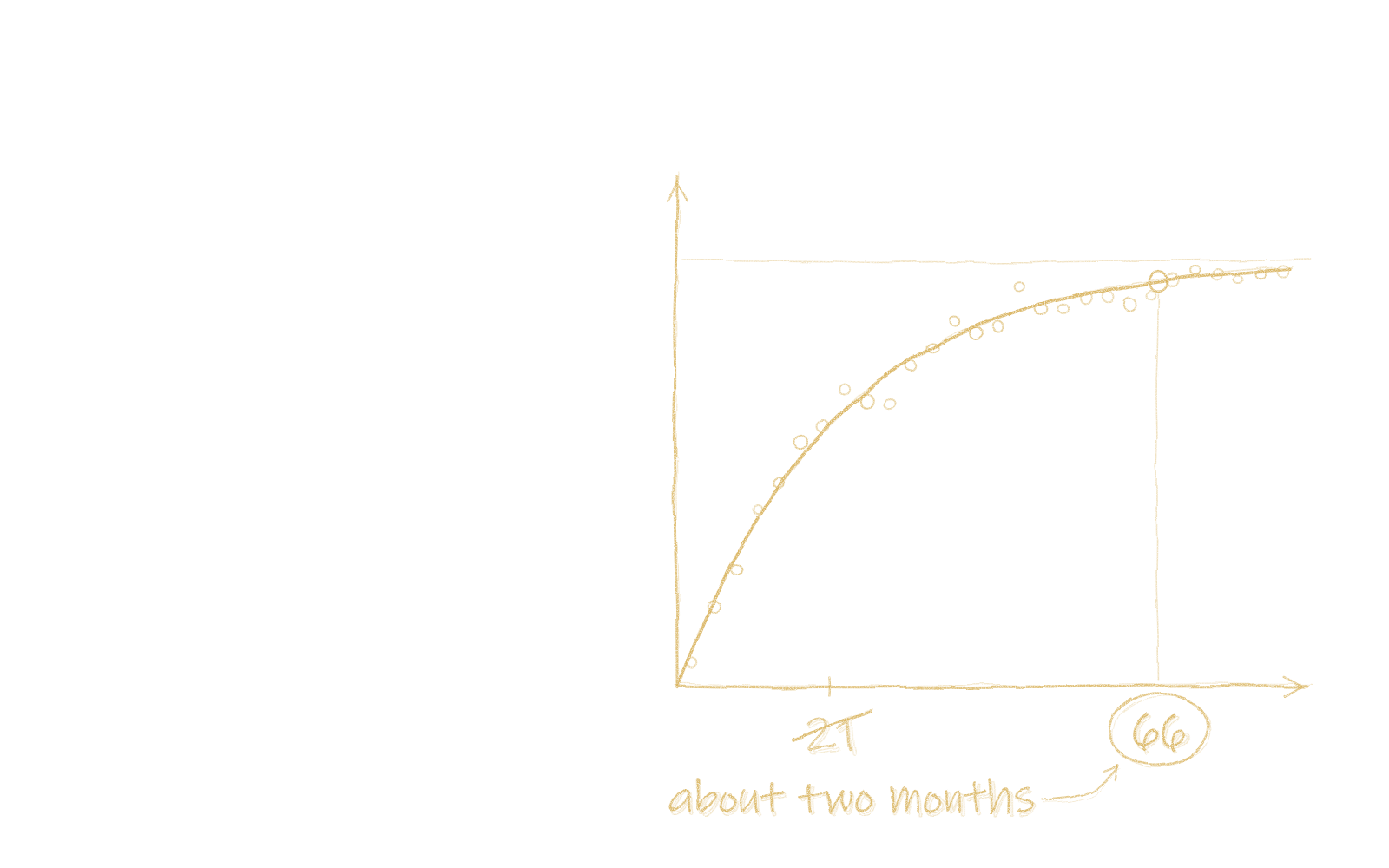
You’ve probably heard that it takes 21 days to build a habit. But in the best-known study, the middle number of days to build a habit was actually 66 days (so a little over three times as long)[1, 2]. And I say “middle” on purpose, because that 66 isn’t an average of everyone. It’s the halfway mark among the 39 people whose results fitted well, and their times ran from 18 days to a forecast 254[1]. If what you’re trying to get going is really something you keep putting off, that’s the bigger question behind how to stop procrastinating, which I wrote up at length.
So how long does it take to form a habit when somebody sits down and measures it? My reading of the studies: for a simple daily habit, about two months or more is a fairer guess than three weeks, and some people take much longer. Any single number is a rough guide. And that’s my argument for this post: the 21 probably was never about habits in the first place, the number that replaced it is shakier than it sounds, and the calendar was the wrong thing to be watching anyway.
So if it’s day 23 of your after-dinner walk and your feet still aren’t heading for the door on their own, you’re about where you’d expect to be. (Your feet have not read the self-help books.) And if you started a new healthy habit on New Year’s Day, the 21 would have had you done by the third week of January, while 66 days for a new habit takes you into March. And no, missing a day doesn’t send you back to day one, but I’ll get to that.
We’ll start with the 21, because a number that specific had to come from somewhere.
Nobody reads the preface: Where “21 days to build a habit” came from
Short version: the myth that it takes 21 days probably started in the preface of a 1960 book by a plastic surgeon, in a passage about patients getting used to a new face[4, 5]. A face! Not flossing. But let me back up, because twenty-one days is such a specific number that I always figured there was a study behind it. You know, a few hundred people, three weeks, somebody with a clipboard. That seemed fair to me, because who makes up a number like 21?
Well, in 2012 two researchers at University College London (UCL), Ben Gardner and Susanne Meisel, went looking for where it started. And in a post on their department’s blog they wrote that they thought they had tracked the idea down, to the preface of a 1960 book called Psycho-Cybernetics by Maxwell Maltz, “a plastic surgeon turned psychologist” in their words[4, 5]. So, not a study. That preface is the best guess Gardner and Meisel had for where “it takes 21 days to form a habit” got started[4].
And what Maltz wrote there was about faces. After plastic surgery, he said, it “takes about 21 days for the average patient to get used to his new face”[4, 5]. A “phantom limb” after an amputation, he went on, “persists for about 21 days”[4, 5]. And as Gardner and Meisel quote him, the passage builds up to one more line: “it requires a minimum of about 21 days for an old mental image to dissolve and a new one to jell”[4, 5].
Now look at who’s in that passage. Someone with a new face, and someone who has lost an arm or a leg. Nobody is flossing or jogging. Maltz was describing patients getting used to a change that had already happened, which Gardner and Meisel call anecdotal evidence[4]. And for that old mental image, he called his number a minimum. So “at least three weeks for a new picture of yourself to settle in” somehow turned into “three weeks and you’ll be a person who flosses” (the worst game of telephone I’ve come across).
But how? Well, Gardner and Meisel couldn’t say. How the idea “came to be generalised so broadly is unclear,” they wrote[4]. They do offer one possibility, which is that two similar-sounding things got mixed up[4]. Habituation means getting used to something. Habit formation means a situation starting to trigger an action automatically[4]. A new haircut is the first kind. Buckling your seatbelt before you’ve thought about it is the second. So if they’re right, we got a rule about flossing because two words sound alike.
So the 21 days did come from somewhere. It probably came from people getting used to a new face.
So the 21 days did come from somewhere. It probably came from people getting used to a new face.
You may have met the “21/90 rule” too, which is the same idea with a second number tacked on: 21 days to build a habit and 90 to build a lifestyle (a sequel nobody asked for). The passage Gardner and Meisel found mentions no 90[4], and I couldn’t find a study behind it.
So the famous number started out as a note about something else. And then in 2010 somebody timed an actual habit, with a LOT of questionnaires.
Results may vary: How long does it take to form a habit when someone measures it?
About two months, in the study most people point to, with a huge spread around that[1, 2].
That study is by Phillippa Lally and colleagues, published in 2010, and it’s the best-known study of habit timing[1]. They wanted to watch the process of habit formation in everyday life, so they had 96 volunteers, mostly postgraduate students with an average age of 27, and each one chose one eating, drinking or exercise behavior to do every day in the same setting, such as “after breakfast,” for 84 days[1]. And each day they also filled in a questionnaire called the Self-Report Habit Index[1]. (I do wonder whether filling in the form became a habit before the thing itself did.)
What the questionnaire tracked was automaticity: how much an action seems to run by itself once its cue turns up, the way brushing your teeth at night does[1, 2]. And that’s the feeling people are after when they ask when a new behavior will become automatic.
Now, you can’t just ask someone “is it a habit yet?” (well, you can, but you’ll mostly get a shrug). So for each person, the team fitted a curve that climbs and then levels off toward a ceiling, and asked on which day that person reached 95% of their own ceiling[1]. Think of a hill that’s steep at the bottom and nearly flat at the top. The day count marks where one person’s climb mostly ended. And I think this makes “how automatic does it feel?” a kinder question than “how many days?” The paper’s own summary of that shape is “With repetition of a behaviour in a consistent context, automaticity increases following an asymptotic curve”[1], which is the same hill, just wearing a lab coat.
So that’s where the 66 comes from. It’s a median, which means it’s the person in the middle of the line and not an average[1, 2]. And the line is shorter than you’d think, because the 66 comes from the 39 volunteers whose curves fitted their data well[1]. So 96 people started, and the number everyone quotes is the middle of 39 of them.
And among those 39, times ran from 18 to 254 days[1]. That’s one person who was done in under three weeks (hi, Maltz) and another who was forecast to need a little over eight months. Same study, same instructions.
Hang on, though. The study stopped at day 84. So how did anyone get clocked at 254? Well, nobody did. Anything past day 84 was a forecast from a curve that was still rising[1, 4]. So the 254 belongs to someone who was still climbing when the study packed up, and the math just kept walking up the hill without them.
Gardner and Meisel, who were then in the same UCL department as the study’s authors, summed it up like this: “The best estimate is 66 days, but it’s unwise to attempt to assign a number to this process”[4]. I love that sentence, because it hands you the number and tells you off for wanting it at the same time.
And one more detail made me sit up. A 2010 summary in the BPS Research Digest adds that even after 84 days, about half the participants hadn’t reached an automaticity score high enough to count as a habit[6]. About half! So if your walk still doesn’t feel habitual at 12 weeks, you’d have had plenty of company in that study.
That’s one study, though, with 39 people doing most of the work, and a rule wants more than one. So the next thing I wanted to know was whether anyone else got the same answer.
Four studies and a stopwatch: What the other habit formation studies found, and the gym number that got corrected
Mostly, they found that how long it takes is about two months too, so the 66 has some friends. A 2021 trial by Jan Keller and colleagues, Lally among them, used the same method and found a middle time of 59 days among the people who formed the habit[3]. That last part matters, because only 23% of the people in the trial reached the team’s threshold[2, 3]. So the 59 only counts the people it worked for, one successful habit at a time (which is a bit like timing a marathon by only asking the people who finished).
Then in 2024 a review by Ben Singh and three colleagues went and gathered up the studies of people forming new habits for their health, 20 of them. And only four of the 20 had timed how long a habit took[2]. Four! Everybody has a number for this, and four studies had actually held the stopwatch. Their middle values ran from 59 to 66 days (which should look familiar by now)[2]. The review says habits “can start forming within about two months,” and elsewhere that most health behaviors need “2 to 5 months”[2]. I think the upper end leans on one study of daily stretching, so I lead with two months.
Then there’s the biggest study, which at first seemed to disagree. Anastasia Buyalskaya, Colin Camerer and colleagues didn’t ask anybody how anything felt. They used gym and hospital records instead of questionnaires, and counted a habit as behavior that becomes highly predictable from its setting[8]. And their figure for people who go to the gym was first given as 4 to 7 months.
So… an exercise routine takes half a year? Well, no. A 2023 correction changed that to 68 to 78 days, or about 2 to 3 months, for gym-goers whom the model fitted well[8, 9]. So the one big number that stuck out ended up right next to the others after all, even though it was measuring something different (I would love to have seen that email thread). If you’ve seen “about half a year” for the gym, that matches the figure from before the correction.
Can you build a habit in 2 weeks, then? Only in a few cases I found. The review gives the quickest person in Keller’s trial as 4 days[2], and the other case counted a habit as behavior that had become highly predictable. In the hospital records, handwashing became highly predictable in a couple of weeks, after about 220 chances to wash[8]. That’s a lot of practice packed into two weeks, against one go a day for an after-dinner walk. The quickest time in Lally’s study was 18 days[1]. And for new gym members, a 2015 study by Kaushal and Rhodes put “the minimum requirement to establish an exercise habit” at exercising at least four times a week for 6 weeks[7]. A minimum again, like Maltz’s (and we’ve seen what happens to those).
So two weeks is where the faster habits sit (the handwashing kind, with a couple of hundred tries), and the middle keeps landing near two months. Here are the numbers side by side.
Days, by study. Each one measured something different.
Lally’s volunteers and Keller’s had something in common, though. Each tied the new thing to one daily cue[1, 3]. Which is lovely if your days come with one.
“After breakfast” assumes there’s a breakfast: Building good habits when your week has no steady shape
My short answer, which is mine and hasn’t been tested, is that if your week has no steady shape, you tie the habit to something that happens on every kind of day you have, not to a time on the clock (in Keller’s trial a routine cue and a time cue worked about equally well[3], so the clock isn’t magic). But first, what seems to influence habit strength at all, apart from waiting around? A 2026 survey by Sebastian Bürgler and colleagues, Lally and Gardner among them (yes, the same Lally and the same Gardner, habit research is a small town), found that stronger habits went with wanting the behavior for your own reasons, doing it often, a steady setting, feeling energized and feeling pleased[11]. These are links in survey data, though, so they can’t show what makes a habit form sooner[11]. And the same survey followed habits over time and saw them go two ways, some forming and some fading[11], which is a very honest thing for a study to admit.
And “a steady setting” can sound like bad news if you’re starting a new routine and your weeks go nights, days, then nights again, or if no two weeks look alike. None of the studies here set out to follow people on rotating shifts or without a fixed routine, so I can’t say how the timeline changes for them.
Two details help, though. The example setting in Lally’s study was an event, “after breakfast,” not a time on the clock[1]. And in Keller’s trial, tying a habit to a daily routine worked about as well as tying it to a set time[3].
So here’s what I take from that: the best cue is something that happens on every kind of day you have, like walking in the door after work, or the first coffee or tea after you wake up, whenever that is. A clock time moves when your shifts move. “After I get in the door” doesn’t. Your 7am alarm has no idea you worked nights, but your front door is there every time.
That takes care of the setting. But if a habit takes months, somewhere in them there’ll be a day when the walk doesn’t happen.
Your streak is probably fine: Missing a day and whether it will break a habit that’s new
One missed day probably won’t break a habit that’s still forming. Lally’s study puts it in one flat sentence: “Missing one opportunity to perform the behaviour did not materially affect the habit formation process”[1] (which is researcher for “relax”). My guess is that once you’re a few weeks in, the steep part of the climb is behind you, so one gap barely shows.
And in that study, missing ONE day didn’t make a meaningful difference. So if you miss a day, just pick it back up. You didn’t lose all your progress because you didn’t DO the thing on Tuesday.
You didn’t lose all your progress because you didn’t DO the thing on Tuesday.
Now, there’s some fine print. That finding is about one missed chance, and it says nothing about long breaks[1]. And the BPS summary reports “some evidence” that many missed repeats, even spread out over time, lowered the level of automaticity people eventually reached[6]. So one skipped Tuesday is fine. But a skipped Tuesday, then Thursday, then a lot more after that is a different situation, and that’s the kind the “some evidence” is about.
So the rule I’d take from it is simple. One missed day probably isn’t going to make or break this, so pick the habit back up the next day and just try not to let the misses pile up. A tracker without a streak counter fits that better than one that resets to zero, because a streak counter looks at weeks of showing up plus one miss and decides the miss is the headline.
Are we there yet? How long does it take to form a habit, and how to tell if yours is forming
If you came here for how to make a habit stick, what all this changes is mostly what you expect of yourself: effort on day 22 fits these studies[2, 3]. And if you were hoping for a shortcut, I’m sorry to report there isn’t one in here (I checked, I wanted one too). None of these studies found a way to speed a habit up, so nothing in here makes a habit much easier to build. As far as habit building goes, the volunteers’ recipe was almost boring: pick one behavior and link it to one daily cue[1, 3], and starting tiny is the idea behind the two-minute rule. If it’s willpower you’re really wondering about, motivation vs discipline has its own post.
And if the habit you want to change involves a substance such as alcohol, your own doctor or pharmacist is a better first step.
But there is one thing you can do today, and it takes a minute. Rate your new habit from 1 (not at all) to 7 (completely) on three statements: “I do it automatically,” “I do it without thinking,” and “I’d find it hard not to do.” Those statements are examples from the questionnaire in Lally’s study, as the BPS summary lists them[6]. The 1 to 7 scale is my adaptation, not a validated test. Write the three numbers somewhere you’ll see them in a month.
The fuller version is to rate it again on the same day each week (that weekly rhythm is my adaptation too). In the study, automaticity typically climbed and then flattened[1], which is the shape to watch for. Now, the check can’t tell a formed habit from a line that went flat at a low score. So if yours levels off, take that as a reason to look closer, not as proof you’re done.
And if even that sounds like too much paperwork, keep one question for the end of the week: did it take a little less pushing this week than last?
So here’s where I’d leave it. Maltz said it took the average patient about 21 days to get used to a face that was already there, and all they had to do was keep owning a mirror. You have to actually go on the walk. So give it a couple of months before you judge it, and if day 23 still takes effort, that’s just what day 23 is like. And if the habit you’re after is really a task you keep putting off, the long essay on why we procrastinate and how to start is where I’d go next.
If habits are your thing, here’s where I’d go next:
- How to stop procrastinating, the long essay
- Motivation vs discipline vs willpower
- A printable habit tracker with no streak to lose
- The 2 minute rule, which is really two rules
The questionnaire, but shorter: Quick answers about habit formation and healthy habits
What is the 21-90 habit rule?
The 21-90 rule says a habit takes three weeks to build and 90 days to become a lifestyle, which is a very confident pair of numbers. The three-week half probably traces back to Maxwell Maltz’s 1960 preface about patients getting used to a new face, and the passage Gardner and Meisel found mentions no 90 at all[4, 5]. I couldn’t find a study behind the rule. In the studies that timed it, habit development for a simple daily action ran closer to two months[1, 2].
Can you build a habit in 2 weeks?
Only in a few cases I found: one that got a couple of hundred tries, and one person in Keller’s trial who reached the threshold in 4 days[2] (whoever you are, well done). Hospital workers’ handwashing became highly predictable in a couple of weeks, after about 220 chances to wash, and that study counted a habit as predictable behavior and not as how automatic it felt[8]. The quickest person in Lally’s study took 18 days[1]. Gardner and Meisel’s own line is that “habit formation typically takes longer than that”[4], and they meant three weeks.
What factors influence habit strength and how quickly a habit forms?
Several things went along with stronger habits, but the psychology of habit hasn’t pinned down what makes a habit form sooner, at least not in these studies. In a 2026 survey, habit strength was higher with wanting the behavior for your own reasons, doing it often, a steady setting, feeling energized and feeling pleased, and lower when the behavior felt difficult[11]. In Keller’s trial, repeating the plan was a key predictor of automaticity[3]. These are links, though, so they can’t say what causes what.
How can you build a habit faster and make it stick?
Faster, no: none of the studies in this post found a way to make a habit form faster. Stick, maybe, and what the volunteers in those studies did is plain: pick one behavior, tie it to one daily cue, and repeat it in the same setting[1, 3]. So if you want to develop new habits, expect it to take a couple of months to feel automatic, and after a missed day pick it back up the next day so the misses don’t stack up. Not glamorous, I know.
Which habits are easiest to form?
Different habits seem to move at different speeds, and simple habits that you get to repeat often seem easier to form, though the evidence is thin. Handwashing became predictable in weeks, where going to the gym took months[8]. In new gym members, low complexity was one of the things that predicted habit formation[7]. And the BPS summary of Lally’s study says exercise tended to take longer than eating or drinking[6]. So more challenging habits may be slower than a glass of water after breakfast (a low bar).
How long does it take to break a bad habit?
I can’t answer that one from this post’s sources, because the studies in it were about forming new habits, and none timed anyone trying to change a habit they already had or break a bad one. The three-week figure doesn’t help either, since it probably started as a note about surgery patients[4, 5]. And if the habit involves a substance such as alcohol, your own doctor or pharmacist is a better first step.
The numbers, if you want them
- The sum from the top: 66 divided by 21 is about 3.14, so “a little over three times as long” (yes, that’s pi, and no, I don’t think it means anything). And 254 days is a little over eight months. Counting New Year’s Day as day 1, day 21 is 21 January and day 66 is 7 March (or 6 March in a leap year).
- Lally and colleagues, 2010: of the 96 who started, 82 gave enough data to analyze, a curve could be fitted for 62, and it fitted well for 39. The 66-day median and the 18 to 254 day range are for those 39[1]. In the paper’s words, “The time it took participants to reach 95% of their asymptote of automaticity ranged from 18 to 254 days”[1]. The BPS summary notes that the whole result rests on people rating their own automaticity[6].
- Keller and colleagues, 2021: 192 adults aged 18 to 77 linked one eating behavior to a daily routine or a set time[3]. Only 23% reached the team’s threshold, so the 59 days describes that group. The review gives individual times of 4 to 335 days, the longest of them forecasts, since the trial ran 84 days[2, 3].
- Singh and colleagues, 2024: a review by Ben Singh and three colleagues gathered 20 studies of health habits with 2,601 people. Only four of them timed how long a habit took. Those four gave medians of 59 to 66 days and means of 106 to 154 days, both means from one study of daily stretching, and 11 of the 20 studies had a high risk of bias[2].
- Kaushal and Rhodes, 2015: in 111 new gym members followed for 12 weeks, exercising at least four times a week for 6 weeks (42 days) was “the minimum requirement to establish an exercise habit”[7]. That’s a minimum, not a typical time.
- Buyalskaya and colleagues, 2023: records from 30,110 gym-goers and 3,124 hospital workers[8], with the gym figure corrected in August 2023[9]. Hospital handwashing became highly predictable in a couple of weeks, after about 220 chances to wash[8] (so the fast one is the habit that got about 220 tries in a fortnight).
- Bürgler and colleagues, 2026: a re-analysis of a six-month survey of 254 people during the COVID-19 pandemic[11].
- Still to come: a four-site repeat of Lally’s study, aiming for 800 people, was approved in principle in 2023[10]. I haven’t seen a published paper from it yet.
Sources
- Lally, P., van Jaarsveld, C. H. M., Potts, H. W. W., & Wardle, J. (2010). How are habits formed: Modelling habit formation in the real world. European Journal of Social Psychology, 40(6), 998–1009. https://doi.org/10.1002/ejsp.674
- Singh, B., Murphy, A., Maher, C., & Smith, A. E. (2024). Time to form a habit: A systematic review and meta-analysis of health behaviour habit formation and its determinants. Healthcare, 12(23), 2488. https://doi.org/10.3390/healthcare12232488
- Keller, J., Kwasnicka, D., Klaiber, P., Sichert, L., Lally, P., & Fleig, L. (2021). Habit formation following routine-based versus time-based cue planning: A randomized controlled trial. British Journal of Health Psychology, 26(3), 807–824. https://doi.org/10.1111/bjhp.12504
- Gardner, B., & Meisel, S. (2012, 29 June). Busting the 21 days habit formation myth. UCL Research Department of Behavioural Science and Health blog. https://blogs.ucl.ac.uk/bsh/2012/06/29/busting-the-21-days-habit-formation-myth/
- Maltz, M. (1960). Psycho-Cybernetics: A New Way to Get More Living Out of Life. Prentice-Hall. Preface, pp. xiii–xiv, as quoted in[4].
- Jarrett, C. (2010, 6 October). How to form a habit. BPS Research Digest. https://www.bps.org.uk/research-digest/how-form-habit
- Kaushal, N., & Rhodes, R. E. (2015). Exercise habit formation in new gym members: A longitudinal study. Journal of Behavioral Medicine, 38(4), 652–663. https://doi.org/10.1007/s10865-015-9640-7
- Buyalskaya, A., Ho, H., Milkman, K. L., Li, X., Duckworth, A. L., & Camerer, C. (2023). What can machine learning teach us about habit formation? Evidence from exercise and hygiene. Proceedings of the National Academy of Sciences, 120(17), e2216115120. https://doi.org/10.1073/pnas.2216115120 Corrected in August 2023, see 9.
- Correction for Buyalskaya et al. (2023). Proceedings of the National Academy of Sciences, 120(34), e2312763120. https://doi.org/10.1073/pnas.2312763120
- de Wit, S., Bieleke, M., Fletcher, P. C., Horstmann, A., Schüler, J., Brinkhof, L. P., Gunschera, L. J., & Murre, J. M. J. (2023). How long does it take to form a habit? A multi-centre replication. Registered report, in-principle acceptance, Peer Community in Registered Reports.
- Bürgler, S., Milyavskaya, M., McMillan, G., Burns, R. J., Lally, P., & Gardner, B. (2026). What makes a habit? Investigating potential determinants of habit formation. Personality and Social Psychology Bulletin (online 29 April 2026). https://doi.org/10.1177/01461672261440446