Picture a monk alone in his desert cell, sometime before the year 400. He keeps getting up and going to the window to see how far the sun is from the ninth hour (mid-afternoon). The sun, apparently, is in no hurry. The man who wrote him down says the day feels “fifty hours long”[1, 2], which is a pretty accurate review of a slow afternoon.
Most of us would know what to call him. Lazy. And it’s a fair first guess, so he’s a good place to start on procrastination vs laziness, because the guess only lasts until you read the rest of the description. (This is one small corner of why we put things off at all, and I wrote the long version of that one, how to stop procrastinating, which is long, sorry.)
The short answer is that procrastination and laziness aren’t the same thing. Procrastination has a fairly plain meaning: putting off something you meant to do, while expecting to be worse off for the wait[3]. “Lazy” is a judgment about a whole person[4], and I couldn’t find an agreed way to measure it. So that’s my argument for this post: “lazy” is a verdict that usually gets handed out without anybody checking, and procrastination is something you can actually check, one delay at a time.
And checking only takes two small questions: did I mean to do this, and will waiting cost me? They work the same on the thing that’s been on your to-do list since Monday as on your first day off after a run of night shifts.
OK, back to the desert, because the monk gets a lot more interesting.
Out of office, ‘visiting the sick’: the monk everyone might call lazy
The man who wrote him down was Evagrius of Pontus, and he had a name for what was going on: the “noonday demon”[1, 2] (which, yes, sounds like a hot sauce). And here’s the spoiler for this section: the monk everyone might call lazy is, in these two accounts, a man struggling to stay with his actual work and restlessly looking for ways out of it, which looks a lot more like avoidance than not caring[1, 6]. His actual word for it was acedia. In Greek that’s “care” with a “not” stuck on the front, and the lexicon glosses it “indifference, torpor, apathy”[5].
So, a monk who doesn’t care. That fits the lazy guess pretty well. Except the monk Evagrius describes is anything BUT indifferent. He hates “his place, his way of life and the work of his hands”. He dreams of “an easier, more convenient craft” somewhere else (that’s Luke Dysinger’s translation)[1]. So this is a man with plenty of feeling about his work, and all of it just points away from the work. He’s basically browsing job listings in his head, fourth-century edition.
Evagrius also warns monks against leaving their cells “making eloquent excuses”[1]. And you don’t write a warning about a thing nobody does. It’s like the sign on the office microwave about fish: nobody puts that sign up unless somebody has already microwaved the fish.
Then there’s John Cassian, who spent time in the desert himself and wrote about it in the 420s. And yes, he admits, acedia makes a monk “lazy and sluggish”[6, 7]. So… the lazy guess was right? Well, in the same passage it tells the monk he “ought to show courteous and friendly hospitalities to the brethren, and pay visits to the sick”[6], whether they live nearby or far away (the far away ones being especially handy, because that takes all day). So the same thing that slows him down at his own work also hands him a very respectable reason to head out the door and do good deeds for somebody else. Meet Brother Suddenly Very Helpful. This is the monk version of cleaning the whole kitchen to avoid one email.
This is the monk version of cleaning the whole kitchen to avoid one email.
And Cassian wasn’t above it either. Early in his own time in the desert, he told Abbot Moses that he’d had an attack of it and “could only be freed from it by running at once to Abbot Paul”. Moses was not impressed. He answered: “You have not freed yourself from it, but rather have given yourself up to it as its slave and subject”[6]. (No “thanks for sharing”, no “that sounds hard”. Straight to slave and subject.)
Now, I should be fair to the monks here. Acedia isn’t procrastination. For them it was weariness with a whole way of life[8], which is a good deal bigger than one email. What the two share, as I see it, is a commitment and a good excuse for leaving it. But it’s still one of the oldest detailed portraits of something like procrastination, and it shows busyness as much as sluggishness, in people who cared a great deal.
So if the monks’ word covered all of that, how did we end up with plain “lazy”? Well, veeery slowly.
A very long game of telephone: how the noonday demon shrank into “lazy”
Over the centuries acedia narrowed into sloth, one of the seven deadly sins. But even then it wasn’t the word we have now. Thomas Aquinas, writing in the 13th century, still defined sloth as “an oppressive sorrow”[2, 9]. SORROW. That’s a long way from can’t be bothered.
So who says it kept shrinking after that? That’s Rebecca DeYoung, who laid out this history in a 2004 paper about Aquinas, building on a 1967 book by Siegfried Wenzel called The Sin of Sloth[8] (a whole book about sloth, which somebody had to actually sit down and finish). As she tells it, with the Reformation acedia “came to mean neglect of one’s work in general”[8]. And why then? Well, by that point all work could count as part of a person’s religious calling, so neglecting any kind of work counted too[8]. And in the end, she writes, little was left “save aversion to effort in general; acedia is merely laziness”[8]. (She isn’t happy about that ending, to be clear. She tells it in order to argue against it[8].)
So what we inherited was a verdict on a person. The man at the window, the excuses and the sudden urge to visit the sick mostly dropped out of the picture, and the sluggish part kept the name[8]. Which is how telephone usually goes: a long, strange message goes in at one end, and one word comes out the other.
And that made me wonder whether anyone had gone back and looked at the behavior instead of the person. Turns out, someone had.
One word doing all the work: what procrastination actually means
In 2007 the psychologist Piers Steel published a large review of the research on procrastination, and in it he defined procrastination like this: “to voluntarily delay an intended course of action despite expecting to be worse off for the delay”[3].
OK, but who did he test, and what even is a “review”? Fair questions. Steel didn’t run a new experiment. He gathered up the studies other people had already done and pooled their results (691 correlations in all, which is a lot of other people’s spreadsheets)[3]. So when I say Steel “found” something, I mean it’s what turned up when everybody’s studies were added together.
Now read the definition again, because one word in it is doing all the work: intended. By this definition you can only procrastinate on something you meant to do.
And that’s something we can check. If people who procrastinate are just lazy, then the heaviest procrastinators should be the ones who intended to do the least. That’s what “lazy” would predict (they just don’t want to work), and it’s a sensible enough prediction. But it isn’t what turned up. In the studies Steel pooled, how much people intended to work had almost nothing to do with how much they procrastinated[3]. So people who put things off meant to do them about as much as anyone. What did go with procrastination was the gap between intending and doing[3].
So people who put things off meant to do them about as much as anyone.
One caution before we lean on that too hard. Most of those studies had university students rate themselves on questionnaires (and I like to think a few of them filled one in to avoid an essay), so none of them tests his definition directly[3]. The figures are near the bottom, if you like that sort of thing.
Which leaves the obvious question: if a procrastinator really means to do the thing, why doesn’t it get done? Well, the psychologists Fuschia Sirois and Timothy Pychyl took that one on in 2013. Theirs is a review too, so no new experiment, just the two of them going through the research and making an argument. And the argument is that putting things off is often a way to feel better right now[10] (Why do I procrastinate on things I want to do? The likely reasons, and what helps). As they tell it, it happens most with a task that feels boring or frustrating: the task brings on a bad mood, and avoiding the task is the quick way out of the mood[10] (which is one way to end up scrolling instead of working).
When I read that I thought of the desert straight away. To me, that’s the monk’s “easier, more convenient craft”, 1,600 years early[1].
Great. So procrastinators care, lazy people don’t, and we can all go home. (We cannot all go home.)
Why not both: procrastination vs laziness in the same person
So are laziness and procrastination the same thing? No. But one person can be both, and this is where the tidy story comes apart a little.
The tidy story goes: procrastinators care, lazy people don’t. I’d have liked that one. But Steel’s own numbers make it messier. Conscientiousness is a personality trait (picture the coworker who owns a label maker), and in his paper its facets include self-control and organization[3]. And low conscientiousness was one of the strong and consistent predictors of procrastination he found[3]. (These are correlations, so they don’t show which causes which.)
I think that’s about as close as psychology gets to what people mean by “lazy”. So yes, you can be BOTH. And Cassian had already said as much (in the 420s, so nearly 1,600 years ahead of the review): the same demon made his monk sluggish and told him he ought to be out visiting[6].
OK, but if you can be both, it would help to know what laziness actually is. And here things got strange.
Everybody uses it, and good luck finding an agreed way to measure it: what counts as laziness
Nobody seems to have settled it. For a word that gets handed out this freely (school reports, group chats, the inside of your own head at 4pm), I couldn’t find an agreed definition of laziness or an agreed way to measure it. (If you’ve got one in a drawer, I’d love to see it.)
The one paper I found that tries is a 2018 theory paper by Thomas Madsen. A theory paper means he didn’t measure anybody. He’s working out what the word means and how people use it on each other. And he calls laziness a negative term for people who don’t show an effort matching their abilities or the task[4]. Then he adds the part that stayed with me: the person’s actual motivation and abilities are almost never checked[4].
So somebody decides your effort doesn’t match what you could do, and the bit where they find out what you could do mostly gets skipped. To me, that makes “lazy” a verdict more than a measurement, a bit like getting a grade on a paper nobody read. It judges a whole person, and people who procrastinate don’t intend any less[3], so I’d rather ask about ONE delay at a time.
What about the popular test, “do you feel guilty about it?” Well, it’s half right. Steel reports that guilt about a project goes along with putting that project off, from a 1995 study by Pychyl[3]. My hunch is that guilt is how an expected cost feels, so it’s simpler to ask about the cost directly. And guilt may also be a bad fix. Sirois and Pychyl cite research suggesting the bad feeling “may actually promote rather than prevent future procrastination”[10]. So beating yourself up about the thing might just get you more of the thing, which seems like a bad trade.
Two questions, no wrong answers: the procrastination vs laziness test
So here’s what I’d do with all of this. It isn’t a validated questionnaire (nobody in a lab coat has signed off on it). It’s Steel’s definition turned into two questions to ask when you put something off[3]:
- Did I mean to do this, around now?
- Do I expect to be worse off for waiting? (A deadline, a fee, someone left waiting.)
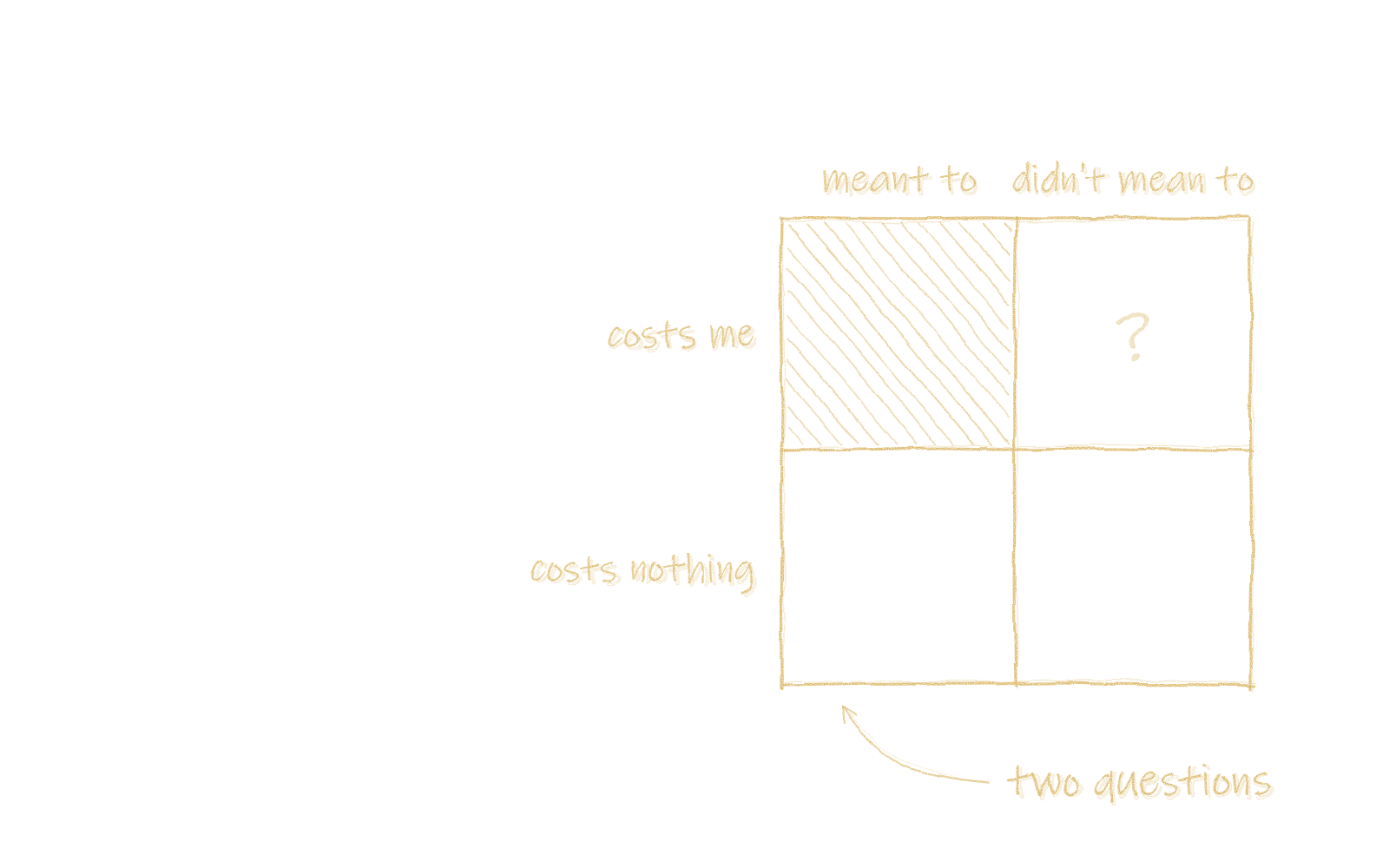
Left column: you meant to do it now. Right column: you didn’t. Top row: waiting costs you. Bottom row: it costs nothing.
Two yes-or-no questions give you four possible answers (two times two, I checked).
If both answers are yes, that’s procrastination. You meant to do it, and you expect the wait to cost you.
If you never meant to do it and waiting will still cost you, Steel’s definition doesn’t count it[3]. You haven’t decided yet, and the question is whether to commit.
Meant to, but waiting costs nothing? The psychologist Katrin Klingsieck calls useful delay like that “strategic delay”[11], which is a great phrase to have ready the next time someone asks why it isn’t done yet.
That leaves the fourth box: you never planned to do it, and not doing it costs nothing. That’s rest, like the slow first day off after a hard week of shifts or an evening on the sofa or with a hobby. And I suspect it’s where “lazy” gets pinned least fairly and checked least[4].
Notice what the two questions leave out. Neither one is about productivity or time management, and neither asks what kind of person you are. They won’t tell you to work smarter, keep pushing, find more willpower, fix your prioritization or break complex tasks into manageable steps, which is what most advice about getting things done will tell you, usually from someone with a suspiciously clean desk (and to be fair, some of it may well help motivate you to achieve your goals). All you get is a little clarity about one delay, and you’ll notice that none of the four boxes says “lazy”.
Is procrastination really a bad thing?
Well, by Steel’s definition, yes, pretty much by design. The cost is built right in: a delay only counts as procrastination if you expect to be worse off for it[3]. But delay itself is another matter. Delay can be fine, and only the costly kind is procrastination[3]. When someone delays tasks consciously, for a good reason, and expects to lose nothing by it, that isn’t procrastination by this definition[3]. And I’d apply the same test to what people call chronic procrastination: one delay at a time. So in a week that’s full enough to overwhelm anyone, when something slides, the fair thing to ask isn’t “what’s wrong with me?” but which of the four boxes it slid into.
Is it laziness, depression or ADHD?
The two questions can’t tell you about either depression or ADHD. A couple of things are worth knowing all the same.
Steel’s analysis suggests depression’s link to procrastination comes mostly from “waning energy levels, which make many tasks more aversive to pursue”[3]. A lack of energy isn’t a character flaw. If you’ve lost interest or pleasure in things you used to enjoy and it doesn’t go away, that’s worth raising with a doctor or counselor[12].
ADHD is a developmental disorder marked by persistent inattention, hyperactivity and impulsivity, and diagnosing it takes a health care provider’s evaluation[13]. If starting is the hard part, try the post on task paralysis. And if you’ve heard that putting things off is really a trauma response, I looked at that one separately, in is procrastination a trauma response.
One more look at the monk at the window: a thing to try today
It’s easy to start out sure he was lazy. But read to the end of the description and what you see is a man who, in Evagrius’s telling, came to hate the work of his hands, kept being handed worthy things to do instead, and got one small word for his trouble[1, 6].
So here’s one thing to try today: pick one thing you put off and borrow the monks’ question. What did you do instead, and did it come with an eloquent excuse?[1] Once is plenty. And if the answer points to procrastination, there’s a fuller plan for getting started in the long essay on how to stop procrastinating.
Evagrius, for what it’s worth, wrote that after the struggle came “a peaceful state and unspeakable joy”[1]. I can’t promise unspeakable joy for answering two questions about a form you haven’t filled in (if you get some, great). But the next time “lazy” turns up, at a desk at 3pm or on the couch after a night shift, ask the two questions before you believe it. And if the answers come out as “never meant to” and “costs nothing”, that’s the rest box, and you can go back to the couch.
If this was your kind of rabbit hole, here are a few more:
- How to stop procrastinating, the long essay
- Task paralysis: when you cannot start something you mean to do
- Is procrastination a trauma response?
- The 2 minute rule, which is really two rules
Brother Suddenly Very Helpful takes your questions: Quick answers about procrastination and laziness
Are laziness and procrastination the same?
No, laziness and procrastination aren’t the same thing, though one person can be both. Procrastination isn’t a judgment of a person: in Piers Steel’s 2007 definition it’s voluntarily delaying something you intended to do while expecting negative consequences from the wait[3]. “Lazy” is a judgment about a whole person, and I couldn’t find an agreed way to measure it[4]. So putting something off doesn’t mean you are lazy. To me that’s the crucial difference between procrastination and laziness: you can check one of them, and the other mostly just gets handed out.
Why do people procrastinate, even when they care about the task?
People procrastinate, often, to feel better right now, according to Fuschia Sirois and Timothy Pychyl[10]. It happens most with certain tasks, the boring or frustrating ones, where avoiding the task is the quick way out of a bad mood[10]. The idea that people who put things off simply don’t mean to do the work looks like a misconception, because in the studies Steel pooled, how much people intended to work had almost no link to how much they put it off[3]. You’ll also see perfectionism, fear of failure, self-doubt and dopamine blamed, but those are a story for another post.
How can you overcome procrastination or laziness?
The first step is working out whether this particular delay is procrastination at all, and two questions about that one delay will do it[3]. Pick one unfinished thing and ask: did I mean to do this, and will waiting cost me (a looming deadline, missed opportunities, someone left waiting)? If both are yes, the fuller plan to deal with procrastination is in How to stop procrastinating on the one thing you keep putting off. If you get stuck on an important task because you feel overwhelmed and don’t know where to start, try What is task paralysis? Why starting feels impossible, with or without ADHD.
What’s the difference between procrastination and ADHD?
Procrastination is a kind of delay, and ADHD is a developmental disorder that takes a health care provider’s evaluation to diagnose[3, 13]. In Steel’s definition, procrastination is putting off something you intended to do while expecting to be worse off for it[3]. ADHD is marked by persistent inattention, hyperactivity and impulsivity[13]. The two questions in this post can’t tell you about ADHD, and this post’s sources don’t compare the two.
Can mental health or burnout make someone seem lazy?
Low energy can make tasks harder to face, and that isn’t a character flaw. Steel’s analysis suggests depression’s link to procrastination comes mostly from “waning energy levels, which make many tasks more aversive to pursue”[3]. This post’s sources don’t cover burnout. If you’ve lost interest or pleasure in things you used to enjoy and it doesn’t go away, that’s worth raising with a doctor or counselor[12].
The numbers, if you want them
All from Steel’s 2007 review, which pooled 691 correlations[3]:
- How much people intended to work against how much they procrastinated: a correlation of −.03 (0 means no link, so this is about as close to “nope” as these numbers get), across 8 studies and 1,017 people[3].
- The gap between intending and doing against procrastination: .29, across 6 studies and 533 people[3].
- Procrastination against conscientiousness: −.62 across 20 studies and 4,012 people, and about −.75 once corrected for measurement error[3].
- Guilt about a project against putting that project off: .46, from Pychyl’s 1995 study[3].
Most of the pooled studies used university students rating themselves, so none tests the definition directly[3].
For Madsen’s paper and Klingsieck’s paper I read the summaries, not the full papers[4, 11].
Sources
- Evagrius of Pontus. Praktikos, chapters 12 and 28. Trans. Luke Dysinger, O.S.B. http://www.ldysinger.com/Evagrius/01_Prak/01_Praktikos.htm
- Crislip A. The sin of sloth or the illness of the demons? The demon of acedia in early Christian monasticism. Harvard Theological Review 2005;98(2):143–169. https://doi.org/10.1017/S0017816005000908
- Steel P. The nature of procrastination: a meta-analytic and theoretical review of quintessential self-regulatory failure. Psychological Bulletin 2007;133(1):65–94. https://doi.org/10.1037/0033-2909.133.1.65
- Madsen T. The conception of laziness and the characterisation of others as lazy. Human Arenas 2018;1:288–304. https://doi.org/10.1007/s42087-018-0018-6
- Liddell, Scott, Jones. A Greek–English Lexicon, entries ἀκηδία and κῆδος. https://www.perseus.tufts.edu/hopper/text?doc=Perseus:text:1999.04.0057:entry=a)khdi/a
- John Cassian. Institutes, Book X, chapters 2 and 25. Trans. C. S. Gibson, Nicene and Post-Nicene Fathers, Second Series, vol. 11 (1894). https://www.newadvent.org/fathers/350710.htm
- “John Cassian”, Catholic Encyclopedia (1908). https://www.newadvent.org/cathen/03404a.htm
- DeYoung RK. Resistance to the demands of love: Aquinas on the vice of acedia. The Thomist 2004;68(2):173–204. Her history builds on Siegfried Wenzel, The Sin of Sloth: Acedia in Medieval Thought and Literature (University of North Carolina Press, 1967). https://uncpress.org/book/9780807836835/the-sin-of-sloth
- Thomas Aquinas. Summa Theologiae II-II, q. 35, a. 1. https://www.newadvent.org/summa/3035.htm
- Sirois FM, Pychyl TA. Procrastination and the priority of short-term mood regulation: consequences for future self. Social and Personality Psychology Compass 2013;7(2):115–127. https://doi.org/10.1111/spc3.12011 (accepted manuscript: https://eprints.whiterose.ac.uk/id/eprint/91793/)
- Klingsieck KB. Procrastination: when good things don’t come to those who wait. European Psychologist 2013;18(1):24–34. https://doi.org/10.1027/1016-9040/a000138
- National Institute of Mental Health. Depression (NIH Publication No. 24-MH-8079). https://www.nimh.nih.gov/health/publications/depression
- National Institute of Mental Health. Attention-Deficit/Hyperactivity Disorder: What You Need to Know (NIH Publication No. 24-MH-8300, revised 2024). https://www.nimh.nih.gov/health/publications/attention-deficit-hyperactivity-disorder-what-you-need-to-know