You’ve probably run into this idea by now, in a short video or on a therapist’s blog: putting things off was never laziness, it was a trauma response. And I can see why it travels. It’s kind, it’s one line long, and it explains a habit most of us feel a bit bad about. But is procrastination a trauma response? Did anyone actually check? This is one part of why we put things off at all, which I wrote up in more detail.
The format itself has been around for a while (the internet does like a one-line explanation for things). Back in 2021 the journalist Shannon Palus wrote in Slate: “In current TikTok parlance, almost any behavior can be a trauma response”[13]. Her examples included overpreparing and perfectionism, and procrastination wasn’t in her article[13]. But type the same question into a search bar today and most of the top answers say yes. Your nervous system learned to freeze in a childhood that wasn’t safe, they explain, and now it shuts down whenever a task feels like a threat[1].
That’s a big thing to say about one of the most ordinary habits there is. So I went looking for the people who had checked, and it turns out a few have. I’ll tell you where I landed now, so you don’t have to wait for it. Nobody has shown that procrastination is a trauma response as a general rule. A hard past may be part of the story for some people, and that is a much smaller claim. If you want it in a few words: true for some, unproven for most.
And the posts are right that the delay isn’t laziness, which I think is worth holding on to. Where they go too far is the claim that it’s wired in, ingrained in the nervous system. The plainer explanation is that putting things off is often a way out of a bad feeling, and anything that makes bad feelings heavier, a hard childhood included, can make the way out more tempting. That’s what this post argues, and the rest of it is how I got there, which I think is the more interesting part anyway.
What the posts describing procrastination as a trauma response get right
The short version is that these posts are right about the feelings and thin on the evidence. Let’s start with the claim at its most confident. A site about complex trauma calls procrastination “a learned survival response, hardwired into a nervous system that was trained in an environment of unsafety”[1].
Now, if we set the word “hardwired” to one side for a minute, much of the rest is right. Putting things off isn’t a character flaw. The delay is about a feeling rather than the clock. And blaming yourself makes it worse[1]. Some of these pages turn to self-compassion as the remedy[1], and I have no quarrel with that. They also go looking for root causes, and one puts it in a single line: “Heal the root cause and unlock your ability to take action”[1]. At their most careful, they say procrastination is often “a protective response rooted in deeper experiences”[1]. Their fairest version is worth keeping too: for some people, the feeling they’re dodging may be closer to threat than to boredom, because they learned early that getting things wrong wasn’t safe.
Where they’re thin is the evidence, and that was the part I was curious about. Of the page-one posts I checked, only one, a clinic’s article, describes any of the studies you’re about to meet: it summarizes three of them[1, 3, 7, 11]. Some borrow the “freeze” language from polyvagal theory, which is in a live scientific dispute[1, 12].
So the idea travels mostly on how true it feels. That doesn’t make it wrong. It means we have to go and look for ourselves, starting with the words the posts borrow, and then the part everyone agrees on, which is the feeling.
Fight, flight, freeze and fawn: where the nervous system words come from
Most of these posts lean on the same few words, and before deciding how much weight those words could hold, I wanted to know where they actually came from. One page says that a task which brings up an old fear “activates your fight-flight-freeze defense system”[1]. Those three words sometimes come with a fourth, fawn.
Fight or flight is the oldest of them. It goes back to Walter Cannon’s 1915 book about how the body changes in pain, hunger, fear and rage, a work that a 2015 review by Kasia Kozlowska and colleagues says is “best remembered for elaborating the concept of fight or flight”[29]. Freezing was worked out mostly in research with animals, and the review says it “has been most extensively studied in rodents and monkeys”[29]. What that research found is that the response depends on how close and how serious the threat is: freezing, flight or fight, and forms of going completely still follow one another along a continuum that researchers call the defense cascade[29]. And I found the review’s description of freezing really clarifying: “a flight-or-fight response put on hold”[29]. So a freezing animal hasn’t switched off. It’s still watching, and it stays still partly because predators are good at spotting things that move[29].
Fawn is the odd one out. It appears in the model of the therapist Pete Walker, which describes four defensive patterns that grow out of “Fight, Flight, Freeze and Fawn responses to severe abandonment and trauma”[30]. In his words, “Fawn types seek safety by merging with the wishes, needs and demands of others”[30]. It’s one clinician’s model, and fawning isn’t one of the steps in the defense cascade review[29].
So fight, flight and freeze are research words, about how a body meets danger in the moment, and fawn is a word from one therapist’s model. Whether a form due on Friday sets off the same response as a predator is a different question, and a fair one to ask, and I found no study that measured it in people who procrastinate.
Why we procrastinate: often, to feel better
You’ve probably noticed that when we’re upset, self-control tends to slip. We eat the snack and leave the work. In 2001, three researchers, Dianne Tice, Ella Bratslavsky and Roy Baumeister, tested an idea about why: maybe giving in makes us feel better[10].
And I really like how they went about it. If we give in to feel better, then convincing people that their bad mood can’t be changed should take away the reason to give in. Why bother with the snack if the snack can’t help? So the whole test rests on getting people to believe their bad mood is frozen and can’t be changed, which is an odd thing to arrange and a clever way to ask the question.
Well, that’s what they found. When people believed their bad mood was frozen and couldn’t be changed, they stopped eating fattening snacks (experiment 1), seeking quick rewards (experiment 2) and putting things off in trivial ways (experiment 3)[10]. Only the third was about procrastination, so I hold it as a strong clue rather than a settled law.
Others have built on it since. The psychologists Fuschia Sirois and Timothy Pychyl argue that putting things off is often a way to feel better right now[15] (Why do I procrastinate on things I want to do? The likely reasons, and what helps). And Pychyl says it about as plainly as it can be said: “Procrastination is an emotion-regulation problem,” and then, “It’s not a time management problem”[16].
So on the first half of the claim, the trauma posts and the lab agree. That leaves the question of which feelings, and two that come up a lot in the research are the fear of doing badly and the need to get things perfect.
Self-handicapping: putting it off so the result doesn’t count
The first is the fear of doing badly, which I think most of us know from the inside. A 2017 review led by Fuschia Sirois says that the things contributing to procrastination, “both in specific instances and as a more chronic behavioural tendency, include fear of failure”[33]. The same review describes that fear as a state “concerned with receiving negative evaluations from oneself and others that can have a paralyzing effect” on getting started[33]. I like that it counts the judging we do of ourselves, and not only the judging we expect from other people.
There’s an older and sneakier version of this idea, which psychologists call a self-handicap. In Jones and Berglas’s 1978 description, as Pychyl quotes it, people sometimes get in their own way on purpose, “by finding or creating impediments that make good performance less likely,” and that way they protect their sense of being competent[34]. It’s the quiet logic of not studying for a test: if you didn’t practice, a bad score says something about the practice and less about you, so a potential failure stings less.
In 2000, Joseph Ferrari and Dianne Tice, the same Tice from the frozen-mood experiments, tested this in two lab studies[34]. As the procrastination researcher Tim Pychyl describes them, chronic procrastinators were more likely than others to self-handicap by procrastinating, and they did it “only when the task at hand was evaluative and potentially threatening”[34]. So for some people, delaying tasks may be less about the task and more about protecting how they’ll feel about themselves if it goes badly.
One of the trauma posts makes a version of this case: “If trying and failing led to criticism, ridicule, or punishment as a child, avoidance becomes safer than trying”[1]. It’s a reasonable idea, and a sad one to read, and I found no study that tested it directly.
Perfectionism and the fear of criticism: which kind goes with putting things off
Being a perfectionist was one of Slate‘s examples of things TikTok calls a possible trauma response[13], and perfectionists have long been suspects in putting things off too. For a while, though, the research answer was oddly unclear, which surprised me, because perfectionism seems like the most obvious suspect there is. Piers Steel’s large 2007 review of the nature of procrastination concluded, as Sirois and her colleagues later summed it up, that procrastination and the perfectionist trait were “negatively, if at all, related”[23, 33].
In that same 2017 review, Sirois, Danielle Sirianni Molnar and Jameson Hirsch pooled the studies again, and this time they split the trait into two kinds[33]. Perfectionistic strivings means “setting and striving for excessively high personal standards”[33]. Perfectionistic concerns is the more troubled kind, marked by “critical and negative self-evaluations, excessive preoccupations with others’ evaluations, expectations, and criticism”[33], which sounds a lot like being afraid of criticism. And the two went in opposite directions. Across 43 studies, perfectionistic concerns went with somewhat more procrastination, and across 38 studies, strivings went with somewhat less[33].
So it seems to matter less whether someone is a perfectionist and more whether their perfectionist streak is about the work or about being judged for it. These are correlations, so they don’t say which comes first. And if the feelings account is right, a painful childhood, which could easily make bad feelings heavier, should go with more putting things off. So did anyone check that? Some people did, and their studies are the next part.
Looking for the childhood roots of procrastination: what the childhood trauma studies found
I found six main studies that measured childhood adversity and procrastination in the same people.
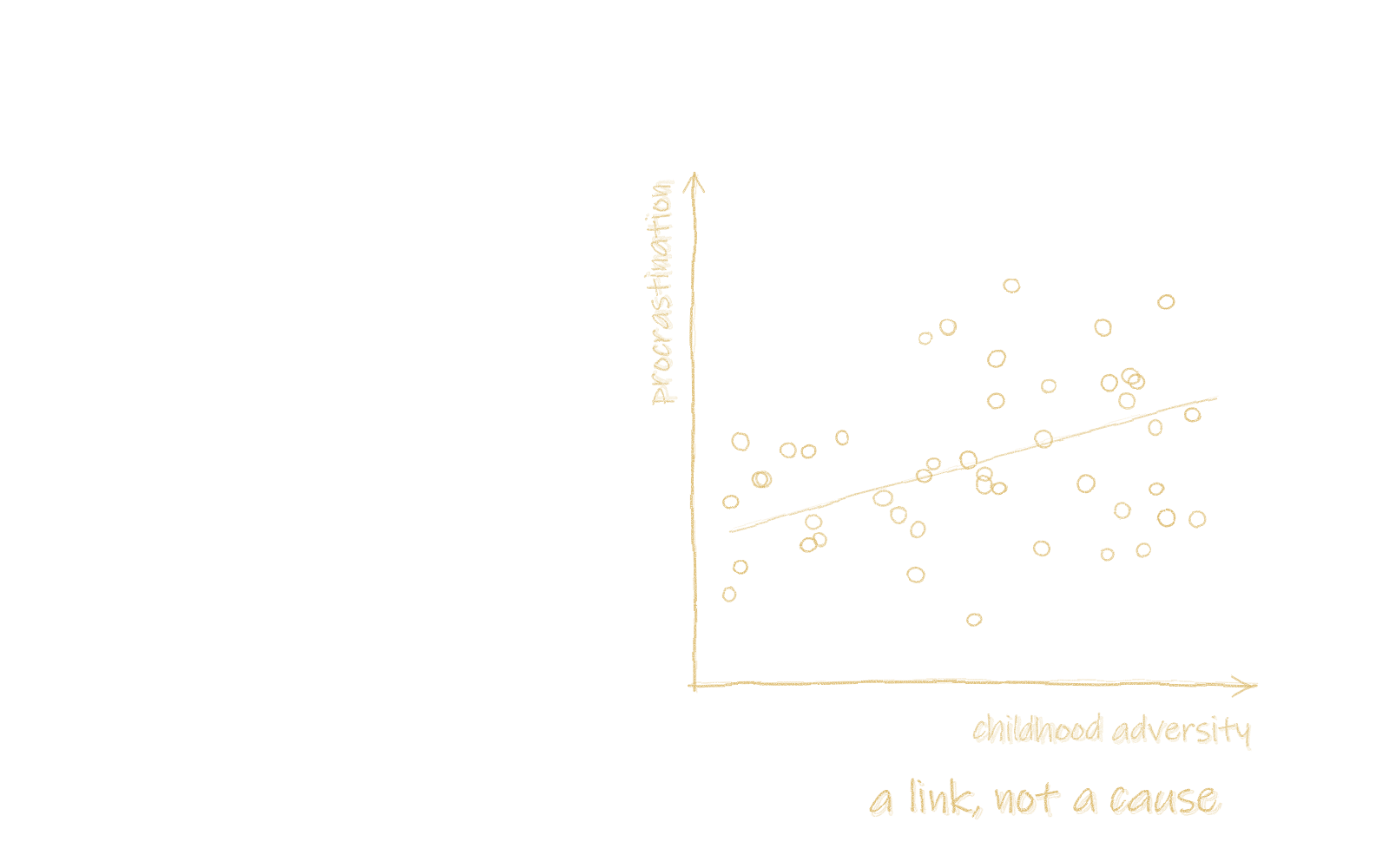
Here is roughly what taking part looked like. A university student sits down and fills in a set of questionnaires in one go. One asks what their childhood was like. Another asks how much they put things off. Then the researchers look at whether the two scores rise together. All six were one-time studies of students, built mostly on questionnaires like this, five of them in China, and most found a modest link[2, 3, 4, 5, 6, 7].
The biggest, from Tingyong Feng’s group in Chongqing, surveyed more than a thousand undergraduates and found that childhood trauma “was a significant predictor of elevated procrastination tendencies,” a link that ran, statistically, through higher anxiety and lower self-control[2].
Now, “predictor” sounds like a forecast, as if the trauma came first and the procrastination followed. But here it means one questionnaire score predicting another, filled in on the same occasion. And words like that tend to grow as they travel. A news headline about this study read “Brain imaging study links childhood trauma to chronic procrastination in adulthood”[17]. The study’s own summary speaks of “procrastination tendencies,” and the people in it were undergraduates[2].
The researchers themselves are often the most careful voices in the room, and I mean that as a compliment. One team wrote plainly: “First, causal inferences cannot be made from the current data”[4].
So there is a link, and it’s modest. Then I looked at what the questionnaires had asked about, and the picture changed again.
What “trauma” meant in these studies
What surprised me was what “trauma” meant. These studies mostly measured something broader than the kind behind PTSD: psychological maltreatment, emotional neglect by parents, checklists of adverse childhood experiences, and an “unpredictable” childhood that counts parental divorce and moving house[3, 4, 5, 6, 7]. Emotional neglect, in one of them, means parents ignoring “the basic emotional needs of children”[4], so it’s about needs that went unmet. In one checklist, the item students ticked most often was “low socioeconomic status,” roughly growing up poor[5].
And none of the six measured a response, like PTSD symptoms. They measured what happened, as an adult or late teenager remembered it[2, 3, 4, 5, 6, 7]. Some of that overlaps with trauma in the clinical sense, and some of it, like moving house, plainly doesn’t.
The other half of the phrase was narrower than it sounds as well. “Procrastination” mostly meant academic procrastination, which is students’ own answers about putting off coursework[4, 5, 6].
So the plain version is this: students who remember a harder childhood report putting things off a bit more. That’s a real finding, and it is a long way from “your procrastination is a trauma response.”
Running low on willpower: the explanation one study used, and what a 23-lab test found
Each of the six studies also tested an idea about what connects a hard childhood to putting things off, and the ideas were all over the place. In the biggest, it was higher anxiety and lower self-control[2]. In the one with the strongest link, one of the ideas tested was adult attachment. Drawing on attachment theory, its authors explain that early traumatic experiences can disrupt secure attachment and lead to insecure patterns “such as anxious or avoidant types,” and that people with insecure attachment “may adopt ineffective coping styles such as procrastination”[5]. That treats procrastination as a coping mechanism, which is close to the feelings account. And in the study of 253 students in Indonesia there was no direct effect at all, only one that ran through self-regulation[6].
The study of emotional neglect leaned on ego depletion[4], which its authors describe as people who “have lost self-control after activities that consume self-control resources”[4]. It’s the idea that self-control works like a fuel tank that runs low the more you use it, and it was a popular way to think about self-control for years[35]. Then, in 2016, 23 labs ran the same standard ego depletion experiment with 2,141 people between them (which I find kind of wonderful, as a way of settling a question), and the effect they found was so small that its margin of error included zero[35].
The neglect study measured ego depletion with a short questionnaire rather than that experiment[4], so this doesn’t undo it. But it’s a reason to be careful before reading “they ran out of self-control” as the reason a hard childhood might go with more putting things off.
Still, a link is a link, and the obvious next thing to ask is whether the hard childhood could be causing it.
Whether trauma fuels procrastination: what one-time surveys can and can’t say
These studies can’t tell us. Trauma might lead to procrastination for some people, but nothing in them shows whether it does. A one-time survey can show that two things travel together, but it can’t say why. It’s like a single photograph of two people standing side by side: you can see that they’re together, and you can’t see who arrived first or what brought them there.
A one-time survey can show that two things travel together, but it can’t say why.
And there are a couple of reasons to be careful with the photograph. Every adversity score came from someone remembering, and one team noted that their students “may not be thorough enough in recalling” how they were raised[3].
Hard childhoods are also common. In CDC survey data from 2011 to 2020, more than six in ten U.S. adults reported at least one adverse childhood experience[20]. If you put things off and had a rough childhood, you’re in very large company, and the overlap alone can’t tell you whether one explains the other.
And the present counts, too. The one study I found that followed people over time near this topic enrolled teenagers in Harbin, China, in a four-wave survey during the pandemic. Those more affected by the pandemic reported more anxiety, then more depression, then more procrastination[21]. That’s the order the feelings account predicts, though it’s still self-report from one city.
All of that is about hard things that happened. The phrase “trauma response” promises something more specific, so I went to see what a list of trauma symptoms says.
PTSD, complex trauma and hypervigilance: what the health pages describe
It helps to be clear first about what PTSD is, because the word trauma in these posts borrows a lot of its weight from it. The VA’s National Center for PTSD calls PTSD “a mental health problem” and says it “can only develop after you go through or see a life-threatening event”[22]. It’s also less common than the everyday use of the word might suggest. The World Health Organization estimates that around 70% of people worldwide will go through a potentially traumatic event in their lifetime, and that “only a minority (5.6%) will go on to develop PTSD”[31]. Which means many trauma survivors never develop PTSD at all, and I think that’s worth knowing before the word gets attached to every habit we have.
Complex PTSD, or CPTSD, is closer to what the procrastination posts have in mind, since the site behind the “hardwired” line writes about growing up in “an environment marked by volatility, criticism, neglect, or conditional love”[1]. The NHS says its symptoms “are largely the same as PTSD but have different causes,” and that the trauma behind it can include child abuse or neglect, ongoing domestic violence or abuse, and repeatedly witnessing violence or abuse[32]. Among the complex trauma symptoms it describes is “feeling very anxious and looking for danger all the time”[32].
And that’s the link the posts draw: one argues that living on constant alert drains the energy that tasks need[1]. It’s a reasonable thing to wonder about, and I can see why it rings true for people, but I found no study that tested it. Procrastination itself isn’t in the NHS’s list of complex PTSD symptoms[32], and as the next part shows, it isn’t on the VA’s list either.
Procrastination isn’t on the VA’s list of PTSD symptoms, though that alone doesn’t rule trauma out
Procrastination isn’t among the PTSD symptoms listed by the VA’s National Center for PTSD (the VA is the U.S. Department of Veterans Affairs)[22]. The closest is avoidance, and there the word has a particular meaning: “Avoiding things that remind you of the event”[22]. That’s narrower than procrastination, which researchers define as delaying something you meant to do while expecting to be worse off for the delay[23] (Procrastination vs laziness: what’s the difference?).
So has anyone measured the two together? Well, I found two studies that measured PTSD symptoms or diagnoses alongside procrastination, one of adults in Italy and one of Ukrainian combatants[8, 9]. People with more trauma symptoms, or with PTSD or another stress-related diagnosis, did seem to put things off more.
But in the Italian study, procrastination went even more closely with everyday depression, anxiety and stress[8]. Both are one-time snapshots, and neither shows that putting things off is a trauma response.
By this point the word “trauma” had covered a lot of ground, from combat to moving house. And it turns out there’s a name for that.
“Not everything is trauma”
That stretch of the word, from PTSD to moving house, is what the psychologist Nick Haslam calls “concept creep.” He grants that it is “often well motivated,” but warns that it “runs the risk of pathologizing everyday experience”[25].
Chandra Ghosh of the Child Trauma Research Program at UC San Francisco put it plainly to Slate: “Lots of things can affect you, and not everything is trauma”[13]. In the same article she said something I find reassuring: “A lot of things that we would do in trauma-informed treatment would be good for anyone”[13].
To be fair to the label, it can change the narrative from “I’m lazy” to “this is hard for a reason,” and that’s a kinder place to start. But my guess is that it also carries a risk of its own here: if a label says your delay is wired in, waiting could, for some people, start to feel like the only option.
So that left me with two accounts on the table. One says putting things off is about a feeling. The other says it’s about the past. I’d been treating them as rivals, and I’m no longer sure they are.
Where the two stories meet
Fuschia Sirois offers the bridge. In her 2023 model, stressful contexts “necessarily increase risk for procrastination because they deplete coping resources and lower the threshold for tolerating negative emotions”[27]. She applied it to chronic illness, not childhood, so extending it there is my step, not hers[27]. Her other examples are ordinary hard situations: job and money insecurity, which she calls “well-known sources of chronic stress,” and being a caregiver for an older family member who is ill[27]. She also notes that the arrow runs the other way too. In one study she describes, procrastination at the start predicted more stress later, even after taking people’s initial stress levels into account[27]. But nothing in her model says the stress has to be recent. And her conclusion is a kind one: “culpability for procrastination does not solely or always rest within the individual”[27].
The biggest trauma study fits. When Feng’s group looked for what connected trauma scores to putting things off, they found higher anxiety and lower self-control[2], which is the feelings account turning up inside a trauma study. One snapshot can’t show the order, but it suggests the two stories aren’t rivals. A hard past may be one of the ways into the feelings story.
So, is procrastination a trauma response?
Here’s where I’ve ended up. The posts are right that putting things off is about feelings, and probably right that a painful past can make them heavier for some people. Nothing in the research shows that most people who procrastinate need a trauma story to explain it, and the habit alone can’t tell you whether your past is part of yours.
If you want it in a few words: true for some, unproven for most.
And whichever story is yours, there’s some trial evidence for working on the feelings directly. In a 2022 randomized trial with university students, a nine-week online course in general emotion-regulation skills, built to help students overcome procrastination, reduced procrastination compared with waiting for it[28]. That’s one trial of a skills course, not trauma therapy.
What’s been tested for procrastination, from therapy to self-forgiveness
None of this tells anyone what to do in their own case, and I’m not going to pretend it does. But since one of the posts offers a “path to healing”[1], it seemed fair to look at what has actually been tested, for procrastination in general.
The broadest summary I found is a 2018 meta-analysis by Wendelien van Eerde and Katrin Klingsieck, which pooled 24 studies of procrastination interventions[36]. Across them, people put things off much less after the interventions and stayed that way at follow-up, and cognitive behavioral therapy did better than the other kinds. That’s encouraging, and the authors are careful with it: they present it as what “the findings so far suggest” and call for research that builds stronger evidence[36]. A 2014 review by Alexander Rozental and Per Carlbring is blunter about the evidence for cognitive behavior therapy here, pointing to “the scarcity of randomized controlled trials”[37]. It also argues that each person’s version of the habit needs its own careful assessment “in order to guide therapists in their work”[37], which is a polite way of saying it differs a lot from one person to the next.
There are gentler approaches too. In Sirois’s 2023 review, a tendency to procrastinate goes with low mindfulness and low self-compassion[27]. The first, as the U.S. National Institutes of Health describes it, involves keeping your attention on the present moment “without making judgments”[38], a kind of non-judgmental noticing. The second, in Sirois’s words, is “taking a kind, accepting, connected, and mindful approach to personal flaws and setbacks”[27]. She also reports that interventions that increase mindfulness “have been found to also reduce procrastination, in part by reducing negative emotions”[27]. And there’s one I really like. In a 2010 study by Michael Wohl, Tim Pychyl and Shannon Bennett, which I know only from Pychyl’s own description of it, students were followed before two midterms: forgiving yourself for putting off studying for the first went with less putting off for the second, though only among students who had put things off a lot the first time[39].
None of these was a study of procrastination tied to trauma. Trauma therapy is its own subject: for PTSD itself, the VA names cognitive processing therapy, eye movement desensitization and reprocessing (EMDR), and prolonged exposure as “the talk therapies that work best”[40]. I found no study that tested any of them on procrastination.
A path forward: two questions for the task in front of you
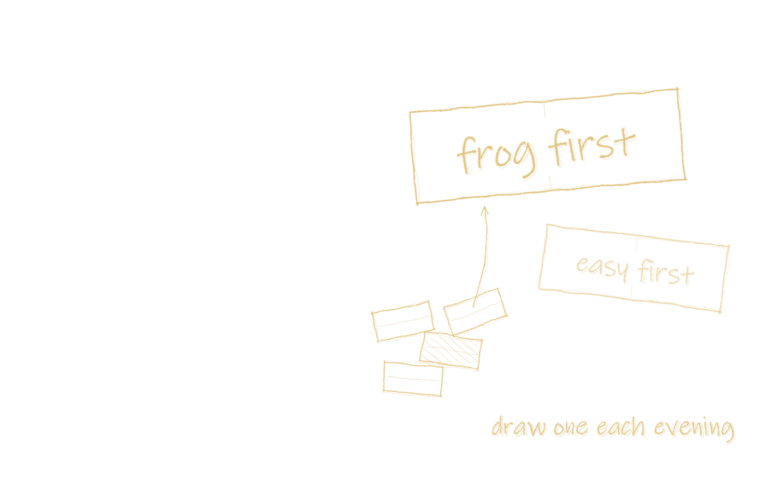
The two questions are what feeling you’re trying to get away from, and whether this is about one task or almost everything. If the trauma label has felt like it fits, you don’t have to argue yourself out of it. These questions work either way. Pick whatever is sitting in front of you: the email you’ve owed for a week, the form with a deadline on Friday.
First: what feeling am I trying to get away from right now? Name it in a word: dread, boredom, fear of doing it badly, overwhelm. Pychyl’s move after naming it is to shrink the next step and ask: “what’s the next action I need to do, if I was to get started?”[16] Make that action as small as you need it to be. And if even that feels like too much today, naming the feeling is enough to count.
Second: is this about this task, or has putting things off felt heavy around almost everything for a while? If it’s this task, the first question is a fair place to start. If it’s almost everything, and it’s persistent or distressing, that’s worth talking through with a therapist or another mental health professional, who can help you work out what’s going on. Neither answer is a diagnosis.
If you feel stuck at the very first step, the post on task paralysis picks up from there. If you’re still wondering whether you’re just lazy, procrastination vs laziness has a test for that.
You don’t need to know where the feeling came from before you take one small step toward the thing on your list. Having a word for it is enough to start with. If you’d like the longer plan for getting started, it’s in the essay on how to stop procrastinating. And if what you keep putting off is something you actually want to do, why we put off the things we want looks at that.
If you’d like to read more on this, these are the closest:
- How to stop procrastinating, the long essay
- Procrastination vs laziness: what is the difference?
- Why do I procrastinate on things I actually want to do?
- Task paralysis: when you cannot start something you mean to do
Quick answers: is procrastination a trauma response, and other questions
Why do we procrastinate, and how can we stop?
We often procrastinate to feel better right now, by getting away from a feeling like dread or boredom. That’s the argument the psychologists Fuschia Sirois and Timothy Pychyl make[15], and the third of the 2001 mood experiments points the same way[10]. As for stopping, in one 2022 randomized trial a nine-week online course in emotion-regulation skills reduced procrastination in university students, compared with waiting for it[28]. A smaller place to start is Pychyl’s question: “what’s the next action I need to do, if I was to get started?”[16]
What is academic procrastination?
Academic procrastination is students putting off coursework, the essay or the reading or the revision. In the studies in this post it was measured by the students’ own answers on a questionnaire[4, 5, 6]. That matters for understanding procrastination and trauma research, because when those studies say “procrastination” they mostly mean this kind. So what they tell us is mostly about students and their coursework, and much less about the rest of a life.
What does research say about procrastination and trauma?
The research so far has found a link between a harder childhood and procrastination in most of six one-time studies of students, usually a modest one, and none of them can show a cause[2, 3, 4, 5, 6, 7]. So procrastination is linked with a harder childhood in most of these surveys, and that, for now, is where the evidence stops. A one-time survey can show that two things travel together, but it can’t say why. Nobody has shown that procrastination is a trauma response as a general rule.
How can childhood trauma contribute to procrastination?
None of the studies I found shows that childhood trauma does contribute to procrastination, though it might for some people. In the biggest study, the link ran, statistically, through higher anxiety and lower self-control[2]. And in Fuschia Sirois’s 2023 model, stressful contexts raise the risk because they “deplete coping resources and lower the threshold for tolerating negative emotions”[27]. She applied it to chronic illness, not childhood, so extending it is my step, not hers[27]. So procrastination may have roots in childhood for some people, by way of heavier feelings, but that part is my reading and not a finding.
Are there strategies to overcome procrastination that is tied to trauma?
The sources for this post don’t include a test of any strategy for procrastination tied to trauma in particular. For procrastination in general, they include a 2018 meta-analysis of 24 intervention studies, in which cognitive behavioral therapy appeared to do better than the other kinds[36], and one 2022 randomized trial in which a nine-week online course in general emotion-regulation skills reduced procrastination in university students, compared with waiting for it[28]. Neither was about procrastination tied to trauma. The two questions above are meant to work whether or not the past is part of it.
How can therapy help with procrastination linked to trauma?
I can’t answer that from the research, because I found no study that tested trauma therapy for procrastination. The studies in this post tested general approaches, such as an emotion-regulation skills course and cognitive behavioral therapy, not trauma therapy[28, 36]. What a therapist can help with for one particular person is a question for that therapist, and the second of the two questions above says when that conversation is worth having.
What is the freeze response, and can it lead to procrastination?
The freeze response, in the posts that use the phrase, is the idea that a nervous system raised in an unsafe childhood learned to shut down whenever a task feels like a threat[1]. In the research on how animals and people react to danger, freezing means something narrower: “a flight-or-fight response put on hold”[29]. Whether that leads to procrastination hasn’t been shown in the studies I read. None of the six childhood studies measured a freeze response. They measured what happened, as people remembered it[2, 3, 4, 5, 6, 7]. And some of the “freeze” language is borrowed from polyvagal theory, which is in a live scientific dispute[1, 12].
The numbers, if you want them
r is a correlation, from 0 (two scores don’t move together) to 1 (lockstep). Squaring it gives a rough sense of overlap: an r of 0.2 means the scores share about 4% of their variation (0.2 × 0.2 = 0.04).
- Childhood surveys: Ma and Chen 2022, 682 students, r = 0.197[3]. Ma and Song 2023, 609 students, r = 0.21[4]. Song and Xu 2026, 928 students, 14 adverse childhood experiences, r = 0.475, about 23%[5]. Feng’s group surveyed 1,189 undergraduates and gave no size for the link in the abstract[2]. So I’d report the range rather than an average.
- Hard childhoods: the CDC report’s own words are “63.9% of U.S. adults reported at least one ACE,” an adverse childhood experience[20].
- The study that followed people over time: 4,156 teenagers in Harbin[21].
- PTSD: the Italian study had 472 adults and the Ukrainian one 129 combatants[8, 9]. In the Italian study, r = 0.34 (about 12%) with PTSD symptoms and 0.46 with depression, anxiety and stress[8]. The Ukrainian study’s procrastination measure was part of a questionnaire about avoiding unpleasant inner experiences[9, 24].
- The course trial, 2022: 148 university students[28].
- For comparison: a 2025 review of 88 studies (63,323 people) found procrastination tracks present-day depression, anxiety and stress at about r = 0.34, roughly 12%[18].
- The two kinds of perfectionist, 2017: perfectionistic concerns r = .23 (43 studies, 10,000 people), perfectionistic strivings r = −.22 (38 studies, 9,544 people)[33]. The authors call both “small to medium.”
- The 23-lab ego depletion test, 2016: 2,141 people, effect d = 0.04, with a 95% interval from −0.07 to 0.15[35].
- Interventions, 2018: 24 studies with 1,173 people in total[36].
- PTSD worldwide: around 70% of people will experience a potentially traumatic event in their lifetime, and 5.6% go on to develop PTSD[31].
Shared variation between procrastination and each measure (r × r)
For the 2001 mood experiments and the Ukrainian study I could read only the summaries, and I didn’t find a direct repeat of the third mood experiment[9, 10]. For the 2000 self-handicap studies and the 2010 self-forgiveness study I read Tim Pychyl’s descriptions of them, not the papers[34, 39].
Sources
- Page-one results for “is procrastination a trauma response”, checked 26 Oct 2026: a complex-trauma education site’s blog (two posts, Sep and Oct 2026, re-read 10 Nov 2026), a trauma therapist’s Substack (30 Dec 2024), and a clinic’s article that summarises three of the studies listed here. Quoted or described; not linked.
- Xu L, Yin Y, Wang X, Xu T, Zhang X, Feng T. Early wounds, delayed consequences: Brain-behavior modeling reveals neural pathways linking childhood trauma to procrastination. NeuroImage 2025;321:121529. https://doi.org/10.1016/j.neuroimage.2025.121529
- Ma H, Chen L. Time management disposition mediates the influence of childhood psychological maltreatment on undergraduates’ procrastination. Psychology Research and Behavior Management 2022;15:1489–1494. https://doi.org/10.2147/PRBM.S367446
- Ma C, Song J. Parental emotional neglect and academic procrastination: the mediating role of future self-continuity and ego depletion. PeerJ 2023;11:e16274. https://doi.org/10.7717/peerj.16274
- Song J, Xu J. Psychological maltreatment, adverse childhood experiences on college students’ academic procrastination: exploring the role of adult attachment and resilience. BMC Psychology 2026;14(1):736. https://doi.org/10.1186/s40359-026-04541-2
- Tahani AVM, Kurniawati K, Amaranggani AP, Rahmandani A. Adverse childhood experiences and academic procrastination in emerging adult students: the mediating effect of self-regulation. International Journal of Islamic Educational Psychology 2023;4(2). https://doi.org/10.18196/ijiep.v4i2.19206
- Shao L, Jin J, Yu G. Childhood environmental risk and youth bedtime procrastination: a path model with life history strategy and sense of control as mediators. Child Abuse & Neglect 2024;150:106137. https://doi.org/10.1016/j.chiabu.2023.106137
- De Biase R, Catalano L, Panico F, Zappullo I, D’Olimpio F, Trojano L, Sagliano L. Assessing the psychological factors associated with vaccine hesitancy: psychometric properties of the psychological factors in healthcare behavior questionnaire (PF-HBQ). Frontiers in Public Health 2026;14:1864623 (published 18 Sep 2026). https://doi.org/10.3389/fpubh.2026.1864623
- Boiko DI, Zhyvotovska LV, Herasymenko LO, Shkodina AD, Skrypnikov AM. Profile of avoidance behavior among Ukrainian combatants with stress-related mental disorders. Psychiatry, Neurology and Medical Psychology 2025;(30):437–448. https://doi.org/10.26565/2312-5675-2025-30-02
- Tice DM, Bratslavsky E, Baumeister RF. Emotional distress regulation takes precedence over impulse control: if you feel bad, do it! Journal of Personality and Social Psychology 2001;80(1):53–67. https://doi.org/10.1037/0022-3514.80.1.53
- Moradi Dolatabadi, Sobhi & Saeid Ahmadi 2024, two papers on 384 female high-school students in Karaj, Iran (β = .201 in both). https://doi.org/10.61838/kman.jarac.6.3.20 and https://doi.org/10.61838/kman.jayps.5.11.4
- Grossman P. Fundamental challenges and likely refutations of the five basic premises of the polyvagal theory. Biological Psychology 2023;180:108589. https://doi.org/10.1016/j.biopsycho.2023.108589 ; reply to a 2026 version of the critique: Porges SW. When a critique becomes untenable. Clinical Neuropsychiatry 2026;23(1):113–128. https://doi.org/10.36131/cnfioritieditore20260111
- Palus S. Why TikTok is so obsessed with labeling everything a trauma response. Slate, 6 Oct 2021. https://slate.com/technology/2021/10/tiktok-trauma-response-why.html
- O’Connor C, Brown G, Debono J, Suty L, Joffe H. How trauma is represented on social media: Analysis of #trauma content on TikTok. Psychological Trauma: Theory, Research, Practice, and Policy 2025;17(Suppl 1):S132–S138 (Epub 9 Sep 2024). https://doi.org/10.1037/tra0001792
- Sirois F, Pychyl T. Procrastination and the priority of short-term mood regulation: consequences for future self. Social and Personality Psychology Compass 2013;7(2):115–127. https://doi.org/10.1111/spc3.12011 (accepted manuscript: https://eprints.whiterose.ac.uk/id/eprint/91793/)
- Coppella L. Procrastination problem? Tim Pychyl knows why. Carleton University Newsroom (undated). https://carleton.ca/news/story/procrastination-problem-tim-pychyl/
- Petrova K. Brain imaging study links childhood trauma to chronic procrastination in adulthood. PsyPost, 11 Aug 2026. https://www.psypost.org/brain-imaging-links-childhood-trauma-to-chronic-procrastination-in-adulthood/
- Nie Y, Wang W, Zhou F, et al. The association between procrastination and negative emotions in healthy individuals: a systematic review and meta-analysis. Frontiers in Psychiatry 2025;16:1624094. https://doi.org/10.3389/fpsyt.2025.1624094
- Gustavson DE, Miyake A, Hewitt JK, Friedman NP. Genetic relations among procrastination, impulsivity, and goal-management ability. Psychological Science 2014;25(6):1178–1188. https://doi.org/10.1177/0956797614526260
- Swedo EA, Aslam MV, Dahlberg LL, et al. Prevalence of adverse childhood experiences among U.S. adults: Behavioral Risk Factor Surveillance System, 2011–2020. MMWR 2023;72(26):707–715. https://doi.org/10.15585/mmwr.mm7226a2
- Qiao Z, Wu Y, Xie Y, et al. The chain mediating roles of anxiety and depression in the relationship between the effects of the COVID-19 pandemic and procrastination in adolescents: a longitudinal study. BMC Public Health 2023;23:2277. https://doi.org/10.1186/s12889-023-16605-8
- U.S. Department of Veterans Affairs, National Center for PTSD. PTSD basics (accessed 26 Oct 2026). https://www.ptsd.va.gov/understand/what/ptsd_basics.asp
- Steel P. The nature of procrastination: a meta-analytic and theoretical review of quintessential self-regulatory failure. Psychological Bulletin 2007;133(1):65–94. https://doi.org/10.1037/0033-2909.133.1.65
- Gámez W, Chmielewski M, Kotov R, Ruggero C, Watson D. Development of a measure of experiential avoidance: the Multidimensional Experiential Avoidance Questionnaire. Psychological Assessment 2011;23(3):692–713. https://doi.org/10.1037/a0023242
- Haslam N. Concept creep: psychology’s expanding concepts of harm and pathology. Psychological Inquiry 2016;27(1):1–17. https://doi.org/10.1080/1047840X.2016.1082418
- Foulkes L, Andrews JL. Are mental health awareness efforts contributing to the rise in reported mental health problems? A call to test the prevalence inflation hypothesis. New Ideas in Psychology 2023;69:101010. https://doi.org/10.1016/j.newideapsych.2023.101010 ; commentary: Bonell C, et al. Child and Adolescent Mental Health 2026. https://doi.org/10.1111/camh.70126
- Sirois FM. Procrastination and stress: a conceptual review of why context matters. International Journal of Environmental Research and Public Health 2023;20(6):5031. https://doi.org/10.3390/ijerph20065031
- Schuenemann L, Scherenberg V, von Salisch M, Eckert M. “I’ll worry about it tomorrow”: fostering emotion regulation skills to overcome procrastination. Frontiers in Psychology 2022;13:780675. https://doi.org/10.3389/fpsyg.2022.780675
- Kozlowska K, Walker P, McLean L, Carrive P. Fear and the defense cascade: clinical implications and management. Harvard Review of Psychiatry 2015;23(4):263–287. https://doi.org/10.1097/HRP.0000000000000065
- Walker P. The 4Fs: a trauma typology in complex PTSD. Author’s website (undated, accessed 10 Nov 2026). https://www.pete-walker.com/fourFs_TraumaTypologyComplexPTSD.htm
- World Health Organization. Post-traumatic stress disorder (fact sheet), 11 Sep 2026. https://www.who.int/news-room/fact-sheets/detail/post-traumatic-stress-disorder
- NHS. Complex PTSD (page last reviewed 8 Apr 2026). https://www.nhs.uk/mental-health/conditions/post-traumatic-stress-disorder-ptsd/complex/
- Sirois FM, Molnar DS, Hirsch JK. A meta-analytic and conceptual update on the associations between procrastination and multidimensional perfectionism. European Journal of Personality 2017;31(2):137–159. https://doi.org/10.1002/per.2098 (accepted manuscript: https://eprints.whiterose.ac.uk/id/eprint/112533/)
- Pychyl TA. Delay as a self-handicapping strategy. Psychology Today, 2 May 2008. https://www.psychologytoday.com/us/blog/dont-delay/200805/delay-as-a-self-handicapping-strategy ; the study it describes: Ferrari JR, Tice DM. Procrastination as a self-handicap for men and women: a task-avoidance strategy in a laboratory setting. Journal of Research in Personality 2000;34(1):73–83. https://doi.org/10.1006/jrpe.1999.2261
- Hagger MS, Chatzisarantis NLD, Alberts H, et al. A multilab preregistered replication of the ego-depletion effect. Perspectives on Psychological Science 2016;11(4):546–573. https://doi.org/10.1177/1745691616652873
- van Eerde W, Klingsieck KB. Overcoming procrastination? A meta-analysis of intervention studies. Educational Research Review 2018;25:73–85. https://doi.org/10.1016/j.edurev.2018.09.002
- Rozental A, Carlbring P. Understanding and treating procrastination: a review of a common self-regulatory failure. Psychology 2014;5(13):1488–1502. https://doi.org/10.4236/psych.2014.513160
- National Center for Complementary and Integrative Health (U.S. National Institutes of Health). Meditation and mindfulness: effectiveness and safety (updated June 2022). https://www.nccih.nih.gov/health/meditation-and-mindfulness-effectiveness-and-safety
- Pychyl TA. Forgive yourself to stop procrastinating. Psychology Today, 7 Feb 2010. https://www.psychologytoday.com/us/blog/dont-delay/201002/forgive-yourself-stop-procrastinating ; the study it describes: Wohl MJA, Pychyl TA, Bennett SH. I forgive myself, now I can study: how self-forgiveness for procrastinating can reduce future procrastination. Personality and Individual Differences 2010;48(7):803–808. https://doi.org/10.1016/j.paid.2010.01.029
- U.S. Department of Veterans Affairs, National Center for PTSD. PTSD treatment basics (accessed 10 Nov 2026). https://www.ptsd.va.gov/understand_tx/tx_basics.asp